Beyond the Battlefield: The Hidden Power of Cultural Narratives
Golden Hook & Introduction
SECTION
Nova: What if everything you thought you knew about human history, about how societies evolved from simple to complex, was fundamentally wrong?
Atlas: Whoa, that's a big claim, Nova! Are we talking about a complete historical rewrite here? Because that sounds like a challenge to pretty much every textbook I've ever read.
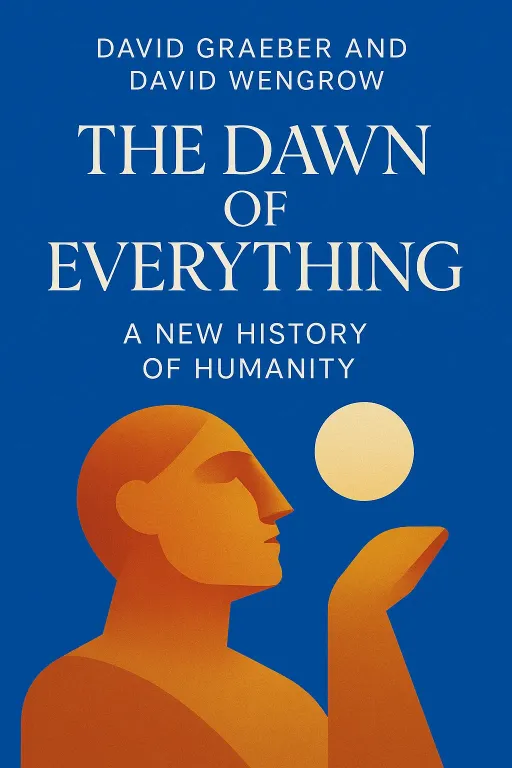
Nova: Not a rewrite, Atlas, but definitely a radical reinterpretation. We're talking about the hidden power of cultural narratives, and specifically, the groundbreaking work of David Graeber and David Wengrow in their book, "The Dawn of Everything: A New History of Humanity." This book has been widely acclaimed for completely shaking up how we view our collective past, showing it's far richer and more experimental than we ever imagined.
Atlas: So, it's not just a dusty history book; it's a paradigm shift in how we understand ourselves and our potential? I'm in. What's the first myth they tackle?
Nova: Exactly. They tackle what we call 'The Blind Spot' – the idea that culture is static, a collection of unchanging traditions. We often simplify past societies, missing their dynamic agency and the incredible choices they made.
Atlas: That's a great setup. So, we're starting by challenging our assumptions about ancient cultures and how they lived.
The Myth of Static Culture: Unpacking Humanity's Experimental Past
SECTION
Nova: We tend to see human history as a linear march from hunter-gatherer to agricultural, then to states and empires. It's often presented as a clear, one-way street of progress, an inevitable path. But Graeber and Wengrow completely dismantle this.
Atlas: Hold on, you're saying that linear progression from simple to complex isn't the whole story? I mean, it seems so intuitive – we started small, then got bigger, more organized, and that was progress.
Nova: That's the myth, Atlas! They show that ancient cultures were incredibly experimental, constantly trying diverse forms of social organization. They weren't just passively evolving; they were actively choosing how to live, how to govern themselves, and how to structure their communities.
Atlas: Choosing? So, not just reacting to environment, but consciously designing their societies? Give me an example. This sounds fascinating, especially for anyone who feels like our current societal structures are just "the way things are."
Nova: Absolutely. Take for instance, the indigenous societies of North America, like the Nambikwara or the Kwakiutl. Conventional history would often label them 'primitive' or 'simple.' But Graeber and Wengrow reveal that these groups practiced seasonal social transformations. For part of the year, they might be highly egalitarian, making decisions by consensus, with little formal hierarchy. Then, for another season, they might adopt a more hierarchical structure, with chiefs and elaborate rituals, only to dismantle it again when the season changed.
Atlas: Wait, so they weren't stuck in one social system? They could just… switch? That's incredible. It's like they were consciously experimenting with different operating systems for their communities, adapting based on their needs. What was the cause for these shifts, and what was the outcome?
Nova: Exactly! They weren't locked into a single "mode" of social organization. The cause often related to resource availability or ceremonial cycles. For example, during times of abundant resources, like the annual salmon runs for the Kwakiutl people, they would engage in grand potlatch ceremonies. During these events, leaders would ostentatiously destroy or give away vast amounts of wealth to gain prestige. This created temporary, highly visible hierarchies. But crucially, it was a, a deliberate performance, not an inevitable state of being. Once the season changed and resources became more scarce, they'd often revert to more egalitarian structures, where everyone had a more equal say and status. The outcome? A society that was fluid, adaptable, and resistant to the kind of permanent, entrenched power structures that we often associate with "civilization." It challenges the very idea that hierarchy is an inevitable endpoint of societal development.
Atlas: That's mind-blowing. It really makes you question our own assumptions about what's "natural" or "inevitable" in society. It's like they had a social imagination that we've lost. So, this wasn't just some accidental happenstance; these were deliberate, cultural innovations? They were actively shaping their world.
Choice, Culture, and the Blueprint for Future Societies
SECTION
Nova: Precisely, Atlas. And that naturally leads us to the second key idea: the profound power of choice, not just in these historical examples, but in how we shape our cultures, even today. Sheena Iyengar, in "The Art of Choosing," dives deep into how choice is deeply embedded in culture, defining our societies and revealing its subtle forces.
Atlas: Ah, so we're linking historical agency to our own individual and collective decisions. I imagine a lot of our listeners, especially those in fast-paced environments, might feel like our choices are often constrained by culture, not the other way around. How does Iyengar show choice defining society, rather than just being defined by it?
Nova: She reveals the subtle forces behind cultural norms, often through surprising global comparisons. For instance, she highlights how different cultures perceive and value choice itself. In Western societies, more choice is often equated with more freedom and happiness. We're told that having endless options is always better. But in other cultures, like some collectivist societies, an overwhelming number of choices can actually be seen as a burden, even a source of anxiety or a distraction from communal harmony.
Atlas: That's a great point. I've definitely felt analysis paralysis when faced with too many options, like trying to pick a streaming show on a Friday night. So, it's not just we choose, but our culture teaches us to choose, or even we're expected to choose in certain contexts? That's a profound insight.
Nova: Exactly! And this connects directly back to Graeber and Wengrow's work. If past cultures were constantly experimenting with their social structures, consciously choosing different ways to organize – sometimes hierarchical, sometimes egalitarian, sometimes switching between them – then choice was their fundamental operating principle. The outcome of their choices wasn't always fixed; it was a dynamic process of adaptation and re-invention.
Atlas: So, if ancient cultures were more experimental than we imagine, consciously choosing their social structures and adapting them, what new possibilities does that open for our own societal challenges today? How does this historical blueprint help us, the curious learners who want to understand how to shape a better future?
Nova: It's a profound question, and one that offers immense hope. It suggests that our current societal structures—our political systems, our economic models, our educational institutions—are not inevitable endpoints. They are, like those ancient seasonal shifts, products of choices, albeit often choices we've forgotten we made, or now feel locked into. The history of human innovation isn't just about technology; it's about social innovation.
Atlas: So, if they could consciously choose to live differently, to experiment with social structures that defied simple categorization, then so can we. It's about remembering our collective agency, then, and applying that same spirit of experimentation to our modern problems. That's actually really inspiring and deeply thought-provoking.
Synthesis & Takeaways
SECTION
Nova: Absolutely. The core insight here is that human history isn't a story of inevitable, linear progression, but of constant, conscious cultural innovation and experimentation. We've always had the capacity to experiment with our social forms, to choose different ways of living together, to continually reinvent our societies.
Atlas: So, whether it's our political systems, our economic structures, how we approach work, or even how we educate our children, we're not bound by some predetermined path. We have the historical precedent, and the inherent human capacity, to choose differently. We can look to the past not for answers, but for models of social flexibility. That's a powerful call to action for anyone who wants to contribute to positive change.
Nova: It truly is. It's an invitation to look at our modern challenges—from inequality to climate change, from social cohesion to technological integration—not as insurmountable problems within fixed systems, but as opportunities for renewed cultural experimentation, for making different choices about how we organize our collective lives. Just as ancient societies would decide to be more egalitarian for a season, we too can consciously design and redesign our societal structures. The hidden power of cultural narratives is that write them, and we can choose to write a new chapter.
Atlas: That gives me chills. This isn't just history; it's a blueprint for re-imagining our future, for empowering us to be active participants in our own cultural evolution. It sparks a deep reflection on our own agency and the choices we make every day.
Nova: And that's exactly what "Beyond the Battlefield" aims to do—remind us that we are not just products of culture, but its active, inventive creators.
Atlas: What an incredible journey into humanity's past and an inspiring look at our future possibilities.
Nova: This is Aibrary. Congratulations on your growth!