The 'Isolated Genius' Trap: Why Collaboration Unlocks Deeper Innovation.
Golden Hook & Introduction
SECTION
Nova: What if everything you've been told about genius, about solo innovation, about that lone wolf visionary, is not just wrong, but actively holding you back?
Atlas: Whoa, that's a bold claim, Nova. So you're saying my brilliant solo projects are doomed? Because I've definitely romanticized the idea of a singular mind cracking the code.
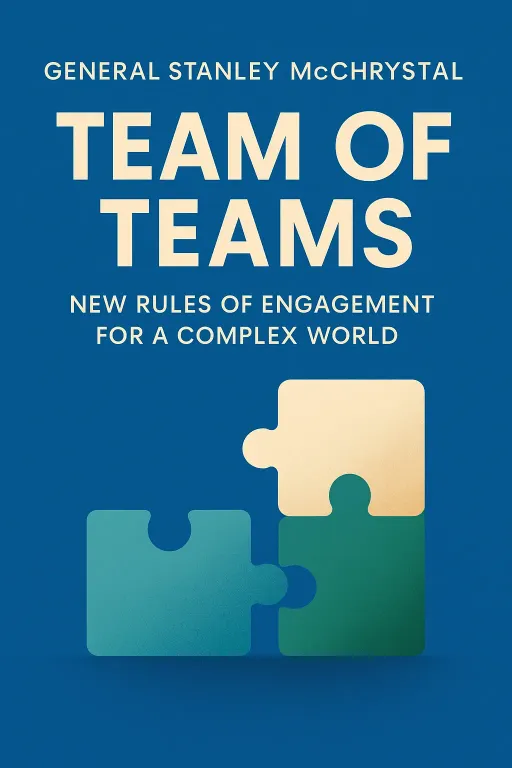
Nova: Well, doomed might be strong, but definitely limited. Today we're dismantling that myth, diving into two incredible books: General Stanley McChrystal's "Team of Teams" and Daniel Coyle's "The Culture Code." And what's fascinating about McChrystal is that he led the Joint Special Operations Command in Iraq, overseeing a transformation that turned a top-down military force into an agile network capable of tackling Al-Qaeda's decentralized insurgency.
Atlas: That’s a serious proving ground. And we're talking about problems that no single brain, no matter how big, can crack, right? Like, the kind of complex, interconnected challenges that plague everything from global supply chains to, well, innovative research.
Nova: Exactly. The kind of problems where the "isolated genius" isn't a hero, but a bottleneck. We’re going to explore why that traditional model fails and how a "team of teams" approach transforms complex problem-solving. Then, we'll discuss the crucial human ingredients—psychological safety, vulnerability, and purpose—that bake successful collaboration into any group. It's about translating individual expertise into collective action.
From Isolated Genius to Networked Intelligence: The 'Team of Teams' Paradigm Shift
SECTION
Nova: So, let's start with this idea of the "isolated genius." It’s deeply ingrained in our cultural narrative, isn't it? The lone inventor in the garage, the brilliant scientist toiling away, the visionary CEO with all the answers.
Atlas: Oh, absolutely. It's the stuff of legends, the hero's journey. And it makes for great movies, but I'm sensing a "but" coming.
Nova: There's definitely a "but." General McChrystal argues that the world has fundamentally shifted. We used to deal with "complicated" problems—think of building a space shuttle. Massive, intricate, but ultimately predictable if you assembled enough experts. You could plan it all out.
Atlas: Right, like a super complex machine. Lots of moving parts, but you know how they all interact.
Nova: Precisely. But now, we're in the era of "complex" problems. These are problems where the variables are constantly changing, the connections are unpredictable, and the environment itself is evolving. Think of fighting a global insurgency, or trying to innovate in a rapidly changing tech landscape, or even bridging something like LPN and electricity. The old hierarchical, command-and-control structures, no matter how brilliant the people at the top, are simply too slow and too rigid to adapt.
Atlas: That makes sense. It’s like trying to navigate a white-water rapid with a supertanker. You need a speedboat.
Nova: A perfect analogy! And McChrystal's compelling case study is how the US Joint Special Operations Command, or JSOC, found itself being outmaneuvered by Al-Qaeda in Iraq. JSOC had the best training, the best equipment, incredible individual talent. But Al-Qaeda was a decentralized, adaptive network. They were faster, more agile.
Atlas: So, the highly skilled, highly resourced Goliath was getting beaten by a nimble David? That’s a powerful lesson right there.
Nova: It truly was. So, JSOC underwent a radical transformation. They realized they couldn't just throw more resources at the problem. They had to become a "team of teams." This involved two core shifts: "shared consciousness" and "empowered execution."
Atlas: Shared consciousness... that sounds like everyone knowing what everyone else is doing. But how do you scale that in an organization of thousands?
Nova: It was revolutionary. They implemented daily video calls with hundreds of participants, from intelligence analysts to operators on the ground. Everyone shared sensitive information, not just with their direct chain of command, but across the entire network. The goal was to create a holistic, real-time understanding of the battlefield. It was about seeing the entire system, not just your piece of it.
Atlas: Wow, that’s intense. And "empowered execution"? Does that mean pushing decision-making down the chain?
Nova: Exactly. Once everyone had shared consciousness, they didn’t need to wait for orders from the top. Small teams on the ground, with the best real-time information, were empowered to make decisions and act quickly. This dramatically increased their operational tempo and effectiveness, turning the tide against the insurgency.
Atlas: Okay, but that's the military. High stakes, clear enemy, a culture built on discipline. How does that translate to, say, a tech startup or a research lab trying to bridge LPN and electricity, where the hierarchy might be less defined, but the problems are still incredibly complex?
Nova: That’s a critical question, Atlas. The principles are universal. In any complex, rapidly evolving field, you need that speed, adaptability, and cross-functional understanding. A research lab trying to combine LPN and electricity, for instance, can't have experts in one silo waiting for approval from another. They need to share insights constantly, understand each other's domain enough to anticipate problems, and be empowered to quickly test new ideas. It’s less about strict orders and more about a shared understanding guiding decentralized action.
Atlas: So it's less about orders, and more like a jazz ensemble where everyone knows the melody but improvises their part within a shared understanding of the overall piece?
Nova: A perfect analogy! And that jazz ensemble only works because the musicians trust each other. Which brings us beautifully to Daniel Coyle's "The Culture Code," and the three skills that build truly cohesive teams.
The Human Operating System: Building Psychological Safety, Vulnerability, and Purpose for High-Performance
SECTION
Nova: So, we've talked about the structural shift, the "team of teams" framework. But even the best structure crumbles without the right human operating system. Coyle identifies three core skills that build cohesive, high-performing groups: building safety, sharing vulnerability, and establishing purpose.
Atlas: Those sound like... soft skills. I imagine for an analyst or builder, someone focused on tangible results, these might feel a bit abstract, maybe even secondary to technical expertise.
Nova: And that's precisely the trap, Atlas! Coyle argues these are not soft skills; they are the fundamental bedrock. Let's start with "building safety." This is about creating an environment where people feel secure enough to take risks, make mistakes, and be themselves without fear of reprisal.
Atlas: Like, I won't get chewed out if my idea doesn't work out? Or if I admit I don't understand something?
Nova: Exactly. Google's Project Aristotle, a massive study into what makes teams successful, found that psychological safety was the number one factor. Not individual brilliance, not team composition, but whether people felt safe enough to speak up, challenge ideas, and admit errors. Without it, innovation dies because people are too afraid to try new things.
Atlas: That's powerful. I imagine for someone in a high-stakes environment, the idea of "vulnerability" might feel... counter-intuitive. Like you're supposed to have all the answers, especially as you move up. How do you actually that without looking incompetent?
Nova: That's the brilliance of Coyle's insight. Vulnerability isn't about weakness; it's about courageous honesty. It’s a leader saying, "I don't have all the answers, and I need your help," or admitting a mistake and asking for input on how to fix it. This doesn't erode respect; it builds profound trust and strengthens bonds. It signals to the team that it's okay to be perfect, which in turn fosters more safety. Think of a senior researcher admitting they're stumped on a particular aspect of an LPN-electricity integration. That admission doesn't make them seem less capable; it opens the door for others to collaborate and contribute.
Atlas: I can see that. It actually humanizes you, makes you more relatable, and invites participation instead of just shutting it down. So, it's a catalyst for collective problem-solving.
Nova: Absolutely. And the third skill is "establishing purpose." This is a clear, compelling, and shared reason for being, that transcends individual tasks. It’s not just "finish the project" or "make money." It's "we are building this to solve for and make."
Atlas: And purpose? Beyond just 'making money' or 'finishing the project'? How do you make that truly resonate, especially in interdisciplinary teams where people might have different motivations, like an LPN expert and an electricity expert? They might be coming from very different places.
Nova: That's where the leader's role is crucial. It’s about connecting the dots for everyone. The LPN expert might be driven by efficiency and data, the electricity expert by power delivery and safety. But their shared purpose could be "to create a sustainable, resilient energy solution for underserved communities." That larger mission gives meaning to their individual contributions and unites them beyond their specific disciplines. It's about finding that overarching "why" that everyone can rally behind.
Synthesis & Takeaways
SECTION
Nova: So, when we bring McChrystal and Coyle together, we see a complete picture. McChrystal gives us the structural imperative—the "team of teams" framework for navigating complexity. And Coyle provides the human operating system—the psychological safety, vulnerability, and purpose that make that framework not just functional, but profoundly effective.
Atlas: So it's not just about getting smart people in a room, it's about making that room a safe, vulnerable, and purposeful space where those smart people can actually and each other's brilliance, right? That's how you bridge those diverse interests and solve problems that seem insurmountable alone.
Nova: Exactly. The myth of the isolated genius is just that—a myth. The future of innovation, especially in interdisciplinary fields, belongs to those who can intentionally build and lead high-performing teams. It's no longer a soft skill; it's the critical advantage.
Atlas: And that brings us to our tiny step for the week. For all our explorers, analysts, and builders listening: look at a current project you're involved in. How can you intentionally foster psychological safety and shared purpose within your project group this week? What’s one small thing you can do to make it safer to speak up, or clearer what the ultimate "why" behind your work is?
Nova: That's a tangible challenge for our explorers, analysts, and builders out there. Embrace the journey of discovery, connect those diverse interests, and turn theory into tangible solutions. Because the next big breakthrough won't come from a lone genius, but from a truly connected, human team.
Atlas: And that, my friends, is how you unlock deeper innovation.
Nova: This is Aibrary. Congratulations on your growth!