The Invisible Hand: How Culture Shapes Your Startup's Destiny
Golden Hook & Introduction
SECTION
Nova: Many founders, many leaders, they pour their hearts and souls into crafting what they believe is a bulletproof strategy. They have the market analysis, the product roadmap, the killer pitch deck. But what if I told you that even the most meticulously designed strategy is often doomed before it even leaves the drawing board?
Atlas: Oh man, that's a tough pill to swallow, Nova. Because I think for so many people, strategy is the holy grail. It’s the grand plan, the logical blueprint. You work hard on it, you execute it, and then success follows. Are you telling me there's something else lurking in the shadows, waiting to trip up even the best laid plans?
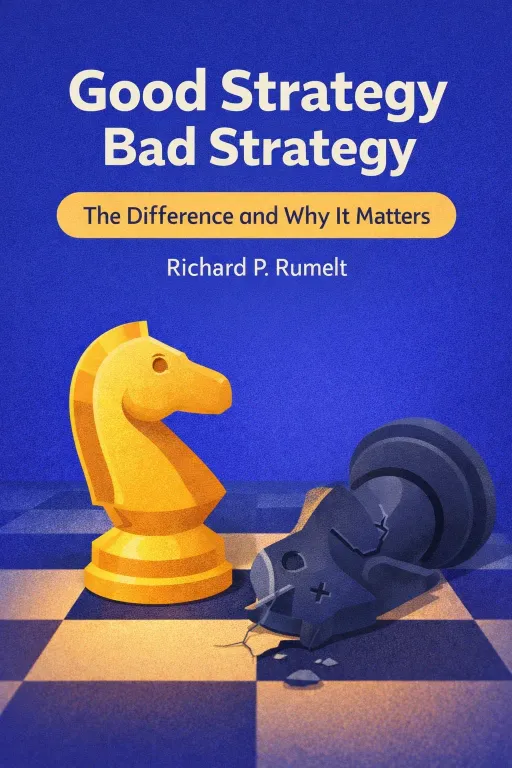
Nova: Absolutely, Atlas. And that something is often the invisible hand of culture. Today, we're diving into this profound connection, drawing insights from two incredible thinkers. First, Richard Rumelt, a long-time professor and consultant whose work on strategy has reshaped how we understand business success. His book, "Good Strategy/Bad Strategy," really dissects what makes a strategy truly effective, and he points out that culture, though often implicit, is a critical component that either supports or undermines strategic intent.
Atlas: Right, like it’s not just about the numbers or the market. There's this whole other layer.
Nova: Exactly. And then we'll turn to Daniel Coyle, whose book, "The Culture Code," takes us inside some of the world's most successful groups to demystify how they build cohesion and trust. Coyle’s work really boils down the 'magic' of great teams into actionable skills. We're talking about how to intentionally shape an environment where your vision doesn't just survive, but truly thrives.
Atlas: That's fascinating. Because I imagine a lot of our listeners, especially early-stage founders, they're constantly thinking about product growth and team building. They're trying to figure out how to get their brilliant ideas off the ground. But if their culture is a blind spot, then they might be fighting an uphill battle they don't even realize they're in.
Nova: That’s precisely the point, Atlas. This isn't just about having a good strategy; it's about having a culture that can actually that strategy. It's about understanding that your operating system for success is your culture.
The Invisible Hand: How Culture Dictates Strategy's Fate
SECTION
Nova: So, let's start with this idea from Rumelt. He defines good strategy as a coherent set of actions underpinned by a clear diagnosis. It's not just a list of ambitions; it’s a specific response to a challenge. But here’s the kicker: he argues that culture, though often unspoken, is the bedrock upon which any strategic initiative either stands or crumbles. Think of it like this: strategy is the beautifully designed ship, and the direction you want it to sail. But culture? Culture is the ocean current. If your current is pushing against you, even the best captain and the strongest engine will struggle.
Atlas: Wow, that's a powerful analogy. You’re saying even a perfect plan is doomed if the team isn't wired for it? But wait, isn't that just a convenient excuse when a strategy fails? Like, "Oh, our culture wasn't ready," instead of "Our strategy was flawed"?
Nova: That's a fair challenge, and it's a common misconception. Rumelt isn't saying culture is an excuse. He's saying it’s a that must be diagnosed and accounted for the strategy itself. It’s part of the reality you're responding to. Let me give you a vivid example. Imagine a tech startup, let's call them "InnovateX." Their strategy is brilliant: disrupt a legacy industry with a groundbreaking, collaborative AI platform. They hire top talent, they secure funding, they have a market-leading vision.
Atlas: Sounds like a winner already. What goes wrong?
Nova: Their culture, unknowingly, is highly individualistic. Their hiring historically prioritized lone genius coders, their reward system celebrated individual achievements, and communication happened mostly through formal channels. The engineers were brilliant, but they weren't used to rapid, cross-functional collaboration. Each team guarded their code, seeing it as their personal domain. They were excellent at their siloed tasks, but the whole point of the AI platform was seamless integration and constant iteration across departments.
Atlas: Ah, I see where this is going. The strategy collaboration and fluid teamwork, but the existing culture individual brilliance and siloed work. That’s a massive conflict.
Nova: Exactly. The strategy required high-trust, rapid information sharing, and collective problem-solving. But the culture was built on individual ownership and a slower, more formal hand-off process. So, deadlines were missed, integration became a nightmare, internal competition flared up, and the launch was delayed, ultimately losing their first-mover advantage. The strategy itself wasn't bad, but the cultural operating system simply couldn't run the program.
Atlas: That’s kind of heartbreaking, actually. All that talent, all that vision, just unraveling because of something nobody explicitly talked about. It makes me wonder, how do you even this "invisible hand" of culture when you're in the thick of it? Especially for a founder who's just trying to keep all the plates spinning.
Nova: That's the blind spot. It feels invisible because it’s the air you breathe, the water you swim in. It's the unspoken rules, the norms, the shared assumptions. Rumelt’s insight is that you have to make these explicit. You have to diagnose your culture just as rigorously as you diagnose your market. Is your culture one of risk-taking or caution? Of collaboration or competition? Of speed or perfection? Because these aren't just 'soft' issues; they are hard strategic realities that dictate what your team can and cannot do effectively.
The Culture Code: Engineering Trust, Cohesion, and Purpose
SECTION
Atlas: Okay, so if culture is this powerful, and it can be a blind spot, how do we actually a good one? Especially when we're just starting out, or trying to course-correct an existing team? It can feel like such an abstract, squishy thing to tackle.
Nova: That's a perfect pivot, Atlas. Because while Rumelt tells us culture is critical, Daniel Coyle in "The Culture Code" tells us to build it. He spent years studying highly successful groups—from Pixar to the Navy SEALs—and identified three core skills that underpin all high-performing cultures: building safety, sharing vulnerability, and establishing purpose.
Atlas: Building safety, sharing vulnerability, establishing purpose. Those sound like... human skills. Not necessarily business skills.
Nova: Precisely. That's the beauty of it. Coyle argues these aren't innate traits; they are learnable skills. Let's break them down. First,. This is about creating an environment where people feel secure, where they know they won't be punished for honest mistakes, for speaking up, or for being themselves. It’s about signaling belonging and connection. Think of a team where people interrupt each other, hoard information, or are quick to blame. That’s a low-safety environment. A high-safety environment is one where even junior members feel comfortable saying, "I think we're going about this the wrong way."
Atlas: For a founder trying to build a team from scratch, how do you even start building safety? Does that mean you can never criticize anyone?
Nova: Not at all. It means you criticize the or the, not the person. And you establish norms upfront. For example, a founder could explicitly say, "We celebrate smart failures here. If you tried something, learned from it, and shared that learning, that’s a win. The only failure is not trying or not sharing." Or making eye contact, active listening, and asking open-ended questions in meetings. These are micro-signals that build safety over time.
Nova: The second skill is. This is about leaders going first, admitting their own mistakes, asking for help, and showing their imperfections. It creates a cascade effect, signaling that it's okay for everyone else to do the same. This isn't about oversharing or therapy; it's about authentic human connection and trust.
Atlas: What does "sharing vulnerability" actually look like in a professional setting without becoming a therapy session? Because I imagine some leaders might think, "I need to project strength, not weakness."
Nova: That’s a common fear. But Coyle's research shows that strength comes from authenticity. It could be a founder saying, "Look, this is my first time scaling a product like this, and I'm going to need your collective expertise to get it right. I don't have all the answers." Or admitting, "I messed up on that last decision, and here's what I learned." It disarms people, encourages them to step up, and builds deep trust. It's about saying, "We're in this together, and nobody's perfect."
Nova: And finally,. This is about creating a shared vision and continually reinforcing it. It's not just a mission statement on a wall; it's connecting every single task, every decision, back to the larger "why." It answers the question, "Why are we doing this, and why does it matter?"
Atlas: And purpose, isn't that just a mission statement on a wall? How do you make that actually and drive daily action?
Nova: It's about weaving it into the fabric of the company. It's not a one-time announcement. It's in the stories you tell, the decisions you make, the feedback you give. It's constantly asking, "Does this project move us closer to our ultimate goal of X?" When people understand their individual contribution to a meaningful collective purpose, they are far more engaged and resilient. It’s what transforms a job into a calling, and a group of individuals into a cohesive team.
Synthesis & Takeaways
SECTION
Nova: So, bringing Rumelt and Coyle together, it becomes clear: your culture isn't some fuzzy, secondary concern. It's the operating system for your strategy. It's the invisible hand that either guides you to success or pulls you off course. And the good news is, it's not some mystical force you can't control.
Atlas: That's actually really inspiring. Because in the chaotic world of an early-stage company, it's so easy to get caught up in the immediate tasks, the product, the funding. But what we're hearing today is that if you neglect the culture, you're building on shaky ground. It’s not just about you build, but you build it. So what's the one thing listeners should really take away from this?
Nova: The ultimate takeaway is this: Your culture isn't happening you; it's happening you. Every interaction, every decision, every unspoken norm is either reinforcing or reshaping your culture. You are building it every single day, whether you realize it or not. So, be intentional. Diagnose it, nurture safety, encourage vulnerability, and clarify your purpose. It's the most powerful strategic lever you have.
Atlas: That’s a profound thought. It puts the power, and the responsibility, squarely in the hands of leaders and founders. It’s about being proactive in shaping the environment that will either enable or hinder your grandest visions.
Nova: Absolutely. And we’d love to hear how these ideas resonate with you. Are there specific cultural elements that have made or broken a strategy in your experience? Or maybe a small action you took that had a big impact on your team's culture? Share your insights with us and the Aibrary community.
Atlas: Let’s keep this conversation going.
Nova: This is Aibrary. Congratulations on your growth!