The Hidden Power of Collaboration: Why Diverse Teams Outperform Lone Geniuses.
Golden Hook & Introduction
SECTION
Nova: Atlas, what if I told you the very thing we're taught to idolize – the brilliant individual, the lone genius – is actually one of the biggest obstacles to solving the world's most complex problems?
Atlas: Whoa, that’s quite the bombshell, Nova. I mean, we've all been conditioned to celebrate the singular visionary, haven't we? The Steve Jobs, the Elon Musks of the world. Are you saying they're not the answer?
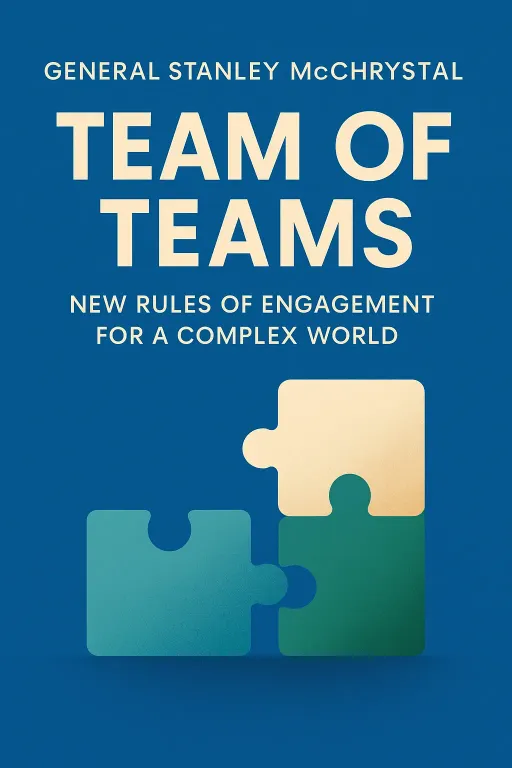
Nova: Not entirely. I'm saying that relying on that individual brilliance, especially in today's rapidly evolving landscape, often leaves teams vulnerable and innovation stifled. It’s a powerful idea, and it’s at the heart of our discussion today, drawing insights from two phenomenal books: General Stanley McChrystal’s "Team of Teams" and Daniel Coyle’s "The Culture Code."
Atlas: Those are some heavy hitters. I know McChrystal transformed the US military’s approach to warfare, which is a pretty high-stakes environment, and Coyle dives deep into what makes cultures tick. So, we're talking about shifting from a singular focus to something far more interconnected and resilient?
Nova: Precisely. McChrystal, coming from the intense, unpredictable world of special operations, saw firsthand how traditional hierarchies were failing. He's a fascinating figure, a four-star general who realized the military's top-down command structure, designed for a different era, was actually hindering their ability to adapt. And Coyle, through his deep dives into successful teams from Pixar to the Navy SEALs, shows us the underlying human dynamics at play.
The Myth of the Lone Genius & The Need for Collective Intelligence
SECTION
Atlas: That makes sense. It’s like the bigger and more complex the challenge, the more obvious the cracks in the "lone hero" approach become. But why does that idea persist so strongly? It feels almost ingrained in our collective psyche.
Nova: It is. We love the story of the individual conquering all odds. But the cold, hard fact is, complex problems rarely yield to individual brilliance alone. Modern challenges demand collective intelligence. Think about the early days of the Joint Special Operations Task Force in Iraq, which McChrystal led. They had the most highly trained, individually brilliant soldiers on the planet. Yet, they were losing the fight against Al-Qaeda in Iraq.
Atlas: Really? That’s surprising given their resources and talent. What was going wrong?
Nova: Their structure. Each elite unit—SEALs, Delta Force—operated in its own silo. They were incredibly effective in their individual missions, but they weren't sharing vital intelligence or coordinating their efforts effectively. An Al-Qaeda operative could move freely because the information about them was stuck in one team's database, not accessible to another. Decision-making was slow; by the time a target was identified and approved through the chain of command, the opportunity was often gone.
Atlas: So, individual brilliance was there, but it wasn't translating into collective success because of the way they were organized. That sounds like a lot of organizations today, especially in fast-paced tech or strategic environments where information silos can cripple progress.
Nova: Absolutely. McChrystal realized they were fighting a decentralized, networked enemy with a centralized, hierarchical force. It was like trying to catch smoke with a net. Their brilliant individual parts weren't forming a cohesive, adaptive whole. This wasn't a failure of individuals; it was a systemic failure of how they were structured to collaborate, or rather, collaborate.
Atlas: That’s a powerful illustration. It really highlights how a rigorous framework, or lack thereof, can dictate outcomes, even with top-tier talent. It makes me wonder, then, if the old way doesn't work, what? How do you even begin to untangle something so ingrained?
Architecting the Collaborative Advantage: Building Safe, Agile, and Purpose-Driven Teams
SECTION
Nova: That’s the million-dollar question, and it's where McChrystal and Coyle give us some incredible blueprints. McChrystal's solution for the JSOTF was to transform it into a "Team of Teams." This meant fostering "shared consciousness" and "decentralized execution."
Atlas: Shared consciousness and decentralized execution. Can you break those down? Because for a lot of our listeners, especially those in more traditional corporate structures, 'decentralized' might sound like chaos, and 'shared consciousness' a little… metaphysical.
Nova: Not at all! Shared consciousness meant radically transparent communication. They started holding daily "Operations and Intelligence" briefings where thousands of people, from strategists in Washington to soldiers on the ground, would share real-time updates. Everyone knew what everyone else was doing, the challenges they faced, and the intelligence they had. This built a collective understanding of the battlefield.
Atlas: So, it's about breaking down those information silos, making sure everyone has access to the same, current picture. That’s a huge shift from a need-to-know basis.
Nova: Exactly. And decentralized execution meant empowering smaller units to make rapid decisions based on that shared consciousness, without waiting for layers of approval. If a small team on the ground saw an opportunity, they had the context and the trust to act. This sped up their decision cycle dramatically and allowed them to adapt much faster than their enemy.
Atlas: That's a massive cultural and structural change. It requires a profound level of trust and psychological safety, doesn’t it? Because if you're empowering small teams, they need to feel safe making decisions, even if they're not always perfect.
Nova: You've hit on precisely where Daniel Coyle's work in "The Culture Code" becomes indispensable. Coyle identifies three key skills that build strong, innovative cultures: building safety, sharing vulnerability, and establishing purpose. Psychological safety, as you mentioned, is foundational. Google's Project Aristotle famously found it was the number one predictor of team success.
Atlas: That’s what I imagine a lot of our listeners struggle with. How do you build safety in an environment where mistakes can have serious consequences, or where innovation is celebrated but failure is often punished?
Nova: Coyle shows us it starts with small signals. Leaders who show their own fallibility, who admit they don't have all the answers, create space for others to do the same. It's about displaying vulnerability. When a leader says, "I messed that up," or "I don't know, what do you think?", it signals that the environment is safe for taking risks and asking questions. It creates a space where people aren’t afraid to speak up if they see a problem or have a new idea.
Atlas: So, it’s not just about a structural change like McChrystal’s, but also the human element, the social glue that allows those structures to thrive. You need the framework, but also the culture.
Nova: Precisely. And the third element Coyle highlights is establishing purpose. When everyone understands they're doing what they're doing, the overarching mission, it provides a powerful unifying force, especially in decentralized teams. It gives context to those rapid, empowered decisions. It's the 'why' that drives the 'what' and 'how.'
Atlas: That’s a great way to put it. So, combining McChrystal's shared consciousness and decentralized execution with Coyle's psychological safety, vulnerability, and purpose… that sounds like the ultimate recipe for an adaptive, high-performing team. It's not just about having smart people, it's about creating the ecosystem where their collective intelligence can truly shine.
Synthesis & Takeaways
SECTION
Nova: Exactly. It's about recognizing that in a world of increasing complexity, the future belongs not to the biggest or the smartest, but to the most adaptive and collaborative. Both McChrystal and Coyle, from very different vantage points, arrive at the same profound insight: human connection, trust, and a shared understanding are not soft skills; they are strategic imperatives. They allow for an agility and resilience that individual brilliance alone could never achieve.
Atlas: That’s actually really inspiring. It reframes what leadership means, moving it from a top-down dictator to an architect of connection and psychological safety. Given all we've discussed, what’s one tiny, practical step our listeners can take this week to start implementing these powerful ideas?
Nova: Here’s a tiny step McChrystal would approve of: Identify just one decision in your team this week that could be decentralized to a smaller, empowered group. It doesn't have to be a huge, mission-critical decision to start with. Delegate it fully, give them the context, and trust them to execute. Then, observe what happens.
Atlas: I love that. A tiny step that could lead to a massive shift in how teams operate. For anyone listening, if you try that, or if you already have a great example of psychological safety or decentralized execution working in your team, we’d love to hear about it. Share your insights and let’s keep this conversation going.
Nova: This is Aibrary. Congratulations on your growth!