The Culture Code: Unlocking Group Dynamics for Better Collaboration
Golden Hook & Introduction
SECTION
Nova: Culture: more than free snacks.
Atlas: Unseen rules, real-world impact.
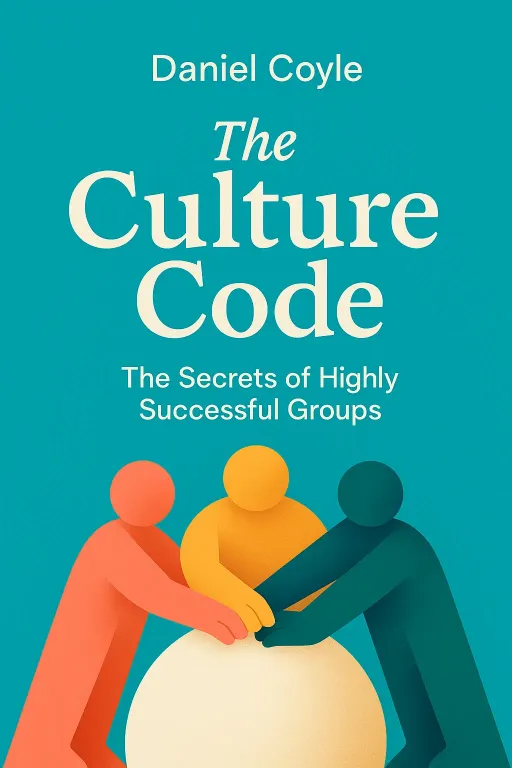
Nova: Exactly! Those five words, Atlas, pretty much sum up what we're diving into today with Daniel Coyle's absolutely brilliant book, "The Culture Code: Unlocking Group Dynamics for Better Collaboration."
Atlas: Oh, I love that title. It suggests there's a secret language to group success, which, let's be honest, feels true for anyone who's ever been part of a team that just... clicks.
Nova: It really does. And what makes Coyle's work so impactful is that he doesn't just theorize. He distills complex sociology and neuroscience into practical, actionable steps. He shows us that culture isn't some mystical, intangible force, but a learnable, deliberate skill.
Atlas: That’s going to resonate with anyone who's ever felt frustrated by a struggling team. It's easy to blame individuals, but it sounds like Coyle points to something deeper, something in the 'code' itself. So, what's the first key to cracking this code, Nova?
The Three Pillars of High-Performing Culture
SECTION
Nova: Well, Coyle identifies three core skills that create high-performing, cohesive cultures. The first, and arguably most foundational, is "Build Safety."
Atlas: Okay, 'build safety.' What does that actually look like in practice? Because I imagine a lot of our listeners hear that and think, 'Oh, we have HR policies, we're safe.'
Nova: It goes much deeper than policies, Atlas. Coyle illustrates this vividly with the U. S. Navy SEALs. During their brutal training, known as 'Hell Week,' they're pushed to their absolute limits. You'd think it would be a hyper-competitive, every-man-for-himself environment.
Atlas: Oh, I've heard stories. It sounds like pure survival.
Nova: It is, but here's the surprising part: the teams that succeed aren't the ones with the strongest individuals. They're the ones who demonstrate the deepest trust and vulnerability. Instead of competing, they're constantly looking out for each other, sharing their last bit of energy, literally carrying teammates. Their leaders intentionally foster an environment where admitting weakness or needing help isn't a sign of failure, but a necessary part of survival. It’s an unspoken agreement: "We will protect each other."
Atlas: Wow. That's a powerful example. So it’s about having each other's backs, even when everything is on the line. But how does an everyday office or project team build that kind of safety without, you know, explosions and life-or-death stakes?
Nova: That leads us directly to Coyle's second skill: "Share Vulnerability." He uses the example of Pixar, the animation studio. They have these legendary "Brain Trust" meetings where senior directors, like John Lasseter and Andrew Stanton, would bring their early-stage films – often messy, incomplete, and deeply personal projects – for critique.
Atlas: That sounds terrifying for a creative. Exposing your half-baked idea to your peers and superiors.
Nova: Exactly! But the key was that the most senior leaders were the first to demonstrate vulnerability. They'd preface their presentations with, "This is rough, I know it. Tell me what's broken." By showing their own imperfections, they created a safe space for everyone else to be equally honest and critical, without fear of reprisal. This isn't about being weak; it's about being open to growth. It's like saying, "I'm not perfect, you're not perfect, let's make this thing better together."
Atlas: I can see how that works for creative genius, where the outcome is a better movie. But it sounds incredibly risky in other contexts. What if that vulnerability gets exploited, or perceived as a lack of confidence in a leader?
Nova: That's where the third skill comes in: "Establish Purpose." Coyle talks about the San Antonio Spurs basketball team under coach Gregg Popovich, a legendary figure. Popovich didn't just focus on winning; he meticulously built a culture around shared values, respect, and a clear identity. Their purpose wasn't just "win games," it was about playing "the beautiful game"—a selfless, team-oriented style where everyone knew their role and supported each other.
Atlas: So it's not just about what you do, but you do it, and who you are while doing it.
Nova: Precisely. They had a clear set of values – "pass the ball to the open man," "make the extra pass," "personal responsibility" – and Popovich constantly reinforced them. This created a powerful sense of belonging and collective direction. Every player understood they were part of something larger than themselves, and that clarity of purpose made the vulnerability and safety feel less like a risk and more like a necessity for achieving their shared goal.
Atlas: So, it's about making it safe to fail, safe to be human, and safe to know why you're even doing it. That's a powerful trifecta. I imagine a lot of our listeners are thinking, "Okay, I get it intellectually, but where do I start?" What's the smallest step someone listening right now could take to foster one of these pillars?
Unseen Forces: Cognitive Biases Shaping Group Dynamics
SECTION
Nova: That's an excellent question, Atlas, and it brings us to the deeper layer of this conversation. Because even with these three pillars – safety, vulnerability, purpose – why do groups still stumble so often? Why does collaboration feel so hard sometimes? This is where Daniel Kahneman's groundbreaking work from "Thinking, Fast and Slow" offers a crucial lens.
Atlas: Oh, Kahneman! The Nobel laureate who fundamentally shifted how we understand decision-making. How does his work on cognitive biases sneak into our carefully constructed cultures? I mean, we're trying to be intentional, and then our brains just... sabotage us?
Nova: Essentially, yes! Our brains are wired for efficiency, using mental shortcuts called heuristics. While often helpful, these can lead to predictable errors in judgment, or biases, especially in group settings. Take "Confirmation Bias." Imagine a team is brainstorming a new product. Once a leader or a particularly vocal member expresses enthusiasm for a certain idea—
Atlas: Everyone starts looking for reasons why that idea is brilliant, right? Even if there are glaring flaws.
Nova: Exactly! People unconsciously seek out information that confirms their existing beliefs or the perceived group consensus, and they downplay or ignore contradictory evidence. This actively erodes the psychological safety Coyle talks about, because challenging the "brilliant idea" suddenly feels like challenging the person who proposed it, or even the group itself.
Atlas: I'm imagining a lot of nodding heads in meetings and not a lot of real debate. It’s like everyone just wants to agree to get out of the room.
Nova: And it gets worse with things like "Groupthink" or the "Availability Heuristic." Groupthink happens when the desire for harmony or conformity in a group results in an irrational or dysfunctional decision-making outcome. People suppress dissenting viewpoints to maintain group cohesion. The Availability Heuristic means we tend to overemphasize information that's easily recalled or recently encountered, even if it's not the most representative or accurate. So if a few vocal members repeat a certain viewpoint, or a recent, vivid anecdote is shared, the group can converge on a suboptimal decision, simply because that information is "available" in their minds, pushing out better, but less immediate, data.
Atlas: It almost sounds like our brains are actively working against building good culture! How do we even begin to fight these unconscious tendencies? It feels like an uphill battle against our own psychology.
Nova: It is an uphill battle, but it's not futile. This is precisely why Coyle's insights are so powerful. The "tiny step" we mentioned earlier – creating a moment of genuine connection or vulnerability – is a direct counter to these biases. When you foster safety, you make it okay to challenge assumptions, to bring up inconvenient facts, to say, "Wait, what if we're wrong?"
Atlas: So, the very human tendencies that make us efficient also make us prone to bad group decisions, and building culture is about consciously overriding those tendencies, creating a space where the unconscious biases don't rule the room. It’s like creating a mental firewall for your team.
Synthesis & Takeaways
SECTION
Nova: That's a perfect analogy, Atlas. What Coyle gives us are the deliberate tools to construct that firewall. He shows us that building safety, sharing vulnerability, and establishing purpose aren't soft skills; they're the hard, deliberate work necessary to counteract our inherent cognitive shortcuts and unlock true group potential. It's about making the invisible visible and then intentionally shaping it.
Atlas: I imagine many listeners, especially those who love exploring new knowledge and enjoy deep thinking, are now seeing their own group interactions, their family dynamics, their book clubs, even, in a completely new light. It's not just about individual talent, it's about the air we breathe together.
Nova: Absolutely. As Coyle essentially tells us, building a strong culture isn't magic; it's a deliberate practice of psychological safety and clear communication, influenced by our inherent thinking patterns. It's the difference between a collection of individuals and a truly cohesive, high-performing group.
Atlas: So, thinking about your own groups, whether at work, in your community, or even with friends, what's one unseen dynamic or cognitive bias you've observed holding you back, and what tiny step can you take this week to acknowledge it, or even gently challenge it?
Nova: Just one tiny step. Because that's where the code truly begins to unravel.
Atlas: This is Aibrary. Congratulations on your growth!