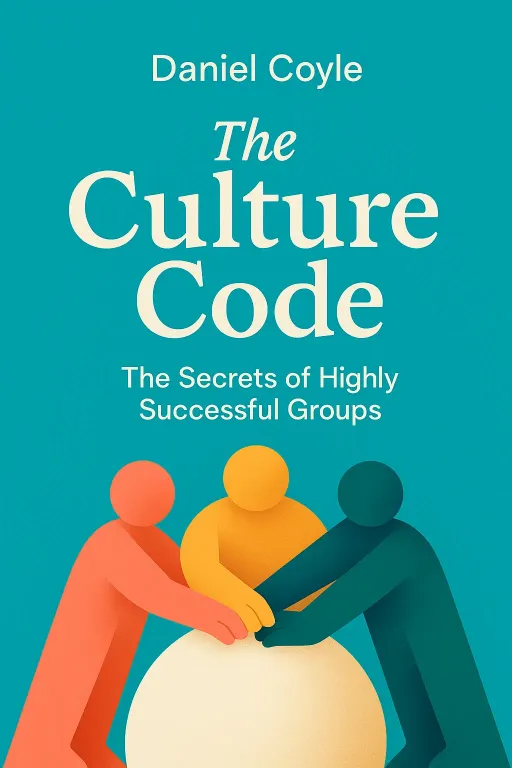
The Culture Code: How Great Groups Build Trust and Adapt
Golden Hook & Introduction
SECTION
Nova: Atlas, quick, what's the first thing that comes to mind when I say 'company culture'?
Atlas: Oh, Nova, probably mandatory fun days and a fruit bowl that's always empty by 9 AM. Or maybe a mission statement nobody remembers. Why, what's your pick?
Nova: Well, what if I told you there's a science to building cultures that actually thrive, not just survive? Today, we're cracking open by Daniel Coyle. Coyle, a seasoned journalist, spent years embedded with some of the world's most successful teams—from Pixar to the Navy SEALs—to uncover the repeatable actions that make them great, not just accidental magic.
Atlas: So he's basically the Sherlock Holmes of high-performing teams, looking for clues beyond the free snacks, right? That's going to resonate with anyone trying to build something that lasts.
Nova: Absolutely. And what he found were not some secret formulas, but rather three fundamental pillars that are the hidden mechanics of any truly great group.
The Three Pillars of a Thriving Culture: Safety, Vulnerability, and Purpose
SECTION
Nova: The first pillar is. Think of it like the nervous system of a team. It’s that unspoken understanding that you can take risks, ask 'dumb' questions, or even admit a mistake without fear of being shamed or punished. It’s what allows people to show up as their full selves.
Atlas: Wait, so you're saying it's not about how smart everyone is, but how safe they feel to be... not smart sometimes? That feels counter-intuitive for high-stakes environments where precision is everything.
Nova: Exactly! It’s not about being reckless; it’s about being safe to. Studies have shown that psychological safety is the number one predictor of team success. Teams that feel safe collaborate better, innovate more, and recover faster from setbacks. It's the foundation for everything else. And that leads us directly to the second pillar:.
Atlas: Vulnerability. Now that’s a word that often gets a bad rap in professional settings. People associate it with weakness.
Nova: And that's the common misconception Coyle dismantles. He defines it as the courage to be imperfect together. He shares this incredible story from a Navy SEAL training exercise. A leader made a critical error during a simulation. Instead of covering it up or deflecting blame, he immediately called out his own mistake to the entire team. He didn't just apologize; he dissected he made it and invited others to learn from his failure.
Atlas: That's incredible. I imagine a lot of our listeners, especially founders or architects of new systems, might see vulnerability as a weakness, not a strength. How does admitting an error actually something stronger, instead of eroding confidence?
Nova: It's a powerful paradox. That leader’s vulnerability didn’t diminish his authority; it amplified it. It signaled to everyone else that it was okay to be human, to make mistakes, and to learn together. It created a deep sense of trust and connection. When leaders show their imperfections, it gives everyone else permission to do the same, fostering a culture of open learning and mutual support. It’s the glue that binds people beyond just tasks. And that collective 'why' brings us to the third pillar:.
Atlas: So it's not just 'do this,' but 'this is we're doing it, and our shared imperfection is part of the journey'? That shifts the entire dynamic from 'being told what to do' to 'being part of something meaningful.' I can see how that cultivates lasting commitment.
Nova: Precisely. Purpose isn't just a mission statement on a wall; it's a deeply shared understanding of the work matters. Coyle describes how the best groups communicate their purpose through vivid narratives, memorable phrases, and symbols that constantly remind everyone of their collective goal. It's about translating abstract ideals into clear, actionable meaning.
From Silos to Shared Consciousness: Adapting and Thriving in Complexity
SECTION
Nova: And that naturally leads us to the second key idea we need to talk about, which often acts as the ultimate test of these three pillars: how do great groups? General Stanley McChrystal's 'Team of Teams' provides a powerful blueprint here, showing how even the most elite military units had to fundamentally rethink their structure in the face of unprecedented complexity.
Atlas: Ah, McChrystal! That sounds like a high-stakes example. For anyone trying to build robust systems, the idea of adapting quickly without chaos is the holy grail. But how do you go from a rigid hierarchy, which seems necessary for military precision, to something more fluid?
Nova: McChrystal realized that the traditional command-and-control structure, while efficient for known problems, was too slow and siloed for modern, decentralized threats. The solution wasn't less control, but a radical shift to "shared consciousness" and "empowered execution." This meant breaking down the walls between different units, fostering radical transparency, and pushing decision-making authority to the very edges of the organization.
Atlas: So it's like, instead of one giant brain, you have a network of highly connected, smaller brains all operating with the same core understanding? That’s fascinating. It sounds like the ultimate scalable architecture for human collaboration. But how do you prevent that from devolving into anarchy? Isn't there a risk of too much freedom?
Nova: That's the critical point: it's not anarchy, but freedom. The shared purpose and the deeply ingrained trust—forged through psychological safety and vulnerability—act as the ultimate guardrails. Everyone understands the overarching goal, and they implicitly trust their teammates to make the right decisions, even if it's not the decision central command have made. It’s about empowering the people closest to the problem to solve it, rather than waiting for distant approval. This cultivates collective intelligence and makes the group antifragile – stronger in the face of disruption.
Atlas: That's a powerful concept – antifragile groups. It sounds like the difference between a brittle structure that breaks under stress and a living system that actually and from it. That's a huge shift in thinking for anyone building for lasting value.
Nova: It truly is. McChrystal's transformation of the military was a testament to how these "soft skills" are, in fact, the hard infrastructure for resilience and innovation. It’s about creating an environment where information flows freely, where people feel safe to challenge assumptions, and where everyone is aligned by a deeply understood purpose.
Synthesis & Takeaways
SECTION
Nova: So, whether you're building a tech startup, a community initiative, or even just a project team, the code is the same: intentional human connection. It's not about charisma; it's about building psychological safety, fostering authentic vulnerability, and relentlessly communicating a shared purpose. These aren't just buzzwords; they're the bedrock of sustained collective success.
Atlas: It really boils down to, you can design the most elegant system, but without the human operating system running on trust, vulnerability, and a shared 'why,' it's just a shell. And for our listeners who are architects and cultivators, building robust systems and vibrant communities, that's a profoundly practical insight. It’s the difference between a structure that stands for a moment and one that endures and evolves.
Nova: Exactly. So, for our tiny step this week, we challenge you to identify just one small action. Could you, as a leader, model a moment of vulnerability by admitting a mistake or asking for help? Or could you create a space where someone feels safer to voice an unconventional idea, knowing they won’t be shut down? Start small, but start intentionally. The impact will surprise you.
Atlas: That's an excellent challenge. Even a tiny crack in the shell can let in a lot of light. And if you're taking that step, or have examples of how you've seen this 'culture code' in action, we'd love to hear about it. Share your insights and experiences. This is Aibrary. Congratulations on your growth!