Decoding the Pleasure Compass: A Healthcare Thinker's Guide to Why We Do What We Do
Golden Hook & Introduction
SECTION
Prof. Eleanor Hart: Imagine a rat in a cage. It has food, water, and a small lever. But this lever does something extraordinary: it sends a tiny jolt of electricity to a specific spot in the rat's brain. The rat presses it once, then again, and again—thousands of times an hour. It forgoes food, water, even sleep, pressing the lever until it collapses from exhaustion. This isn't science fiction; it was a real 1950s experiment that revealed a 'pleasure button' deep within the brain. What if that same powerful circuit exists in all of us, driving our every desire?
Mascot: That's a chilling, and fascinating, place to start. It immediately brings up so many questions about what truly motivates us.
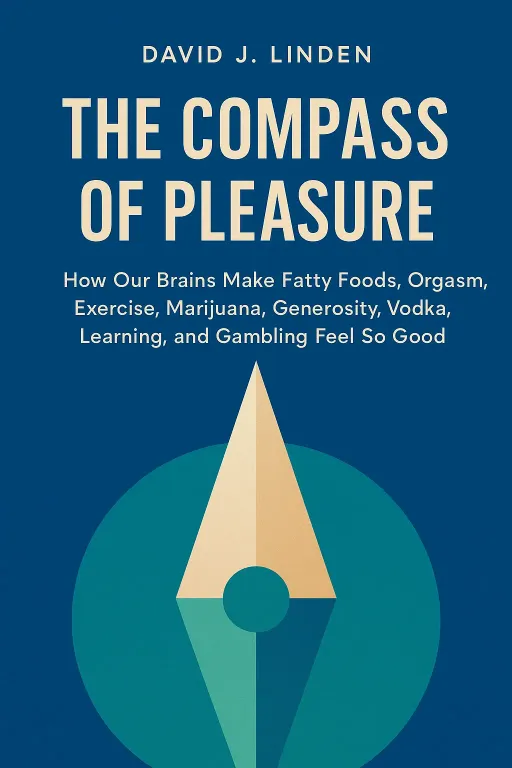
Prof. Eleanor Hart: It certainly does. Welcome, everyone. Today we're exploring the profound ideas in "The Compass of Pleasure" by neurobiologist David J. Linden. And I'm so glad to have Mascot here with me, a curious and analytical healthcare professional, to help unpack this. Because this isn't just abstract science; it's fundamental to understanding human behavior.
Mascot: Absolutely. Understanding the 'why' is critical in healthcare. I'm excited to get into it.
Prof. Eleanor Hart: Great. Today we'll dive deep into this from two perspectives. First, we'll uncover the shocking discovery of the brain's 'pleasure button' and its raw power. Then, we'll explore the surprising and morally ambiguous fact that this same circuit drives both our best and worst behaviors.
Deep Dive into Core Topic 1: The 'Pleasure Button'
SECTION
Prof. Eleanor Hart: So, Mascot, let's start with that rat in the cage. The story of James Olds and Peter Milner's experiment in 1953 is the foundation of everything we're talking about today. They were at McGill University, and they weren't even looking for pleasure. They were trying to study a part of the brain that controls sleep.
Mascot: A classic story of accidental discovery in science.
Prof. Eleanor Hart: Exactly. They implanted an electrode in a rat's brain, but they missed their target. The electrode landed in a region called the septum, which is part of a larger network we now call the medial forebrain pleasure circuit. They put the rat in a box and gave it a mild shock whenever it went to one corner. To their astonishment, the rat kept going back for more. They realized they could guide the rat anywhere in the box with these little brain zaps.
Mascot: So the stimulation wasn't a punishment, it was a reward. A powerful one.
Prof. Eleanor Hart: Incredibly powerful. The real drama began when they put the rat in a Skinner box, where it could press a lever to stimulate its own brain. The rat would press that lever up to seven thousand times an hour. It would cross painful electrified grids to get to the lever. It would choose the lever over food, even when it was starving. It literally chose pleasure over survival.
Mascot: That's an incredibly powerful image. It immediately makes you question the whole concept of willpower. If a biological drive is that strong, our common advice to a patient struggling with addiction, to 'just try harder' or 'have more self-control,' seems... well, completely inadequate.
Prof. Eleanor Hart: It's like telling someone to 'just will away' their hunger. This discovery shattered the old theory that we are only 'pushed' by pain or the need to reduce a deficit, like hunger. It proved we are also 'pulled' by the pursuit of pleasure. This circuit, which involves the Ventral Tegmental Area, or VTA, releasing the neurotransmitter dopamine into a region called the nucleus accumbens, is the brain's master motivator.
Mascot: And this isn't just a quirk in rats, right? The book mentions human examples.
Prof. Eleanor Hart: It does, and they are just as dramatic, though often ethically horrifying. In the mid-20th century, a researcher named Dr. Robert Heath implanted electrodes in the brains of psychiatric patients. One patient, known as B-19, had an electrode in the same pleasure region. When given control of the stimulator, the book says he experienced "an almost overwhelming euphoria and elation and had to be disconnected despite his vigorous protests." He would stimulate himself over a thousand times in a single session.
Mascot: Wow. So it's a fundamental circuit, conserved across species. As a healthcare professional, this points directly to the 'disease model' of addiction. When someone is addicted, their brain isn't functioning normally. The hardware itself is being hijacked by a substance or a behavior that provides a shortcut to this overwhelming reward.
Prof. Eleanor Hart: That's the perfect word for it.
Mascot: It's not a moral failing; it's a physiological state. And that realization changes the entire conversation around treatment. It moves it from a place of judgment to a place of medical intervention and compassion. You wouldn't yell at someone for having lupus, as the comedian Mitch Hedberg joked. This framework helps us see addiction in that same light.
Deep Dive into Core Topic 2: The Neural Unity of Vice and Virtue
SECTION
Prof. Eleanor Hart: You used the word 'hijacked,' Mascot, and that's the perfect term. Drugs of abuse like cocaine and heroin are the most obvious hijackers; they flood this dopamine circuit and create an intense, artificial high. But what's truly mind-bending, and this is the core of Linden's book, is what activates this exact same circuit. And that naturally leads us to our second key idea: the neural unity of vice and virtue.
Mascot: The idea that the brain doesn't have separate pathways for 'good' and 'bad' feelings. That's a really disruptive concept.
Prof. Eleanor Hart: It is. The brain doesn't moralize; it just has this one powerful circuit for saying, "Hey! Pay attention! This is important and worth repeating!" Let me give you two fascinating examples from the book that illustrate this perfectly. First, the 'virtuous' high. Researchers in Germany wanted to study the 'runner's high.' They took amateur distance runners, people who reported feeling euphoric after a long run.
Mascot: Something many of us aspire to but maybe don't always achieve!
Prof. Eleanor Hart: Quite. They scanned the runners' brains before and after a grueling two-hour run. What they found was a flood of endogenous opioids—the brain's natural version of morphine—in regions tied to emotion and pain regulation, like the prefrontal cortex. And here's the key: the runners who reported the most intense euphoria also had the highest levels of opioid release. They were, in a very real sense, getting high on their own supply.
Mascot: So the feeling is biochemically real. It's not just a psychological sense of accomplishment.
Prof. Eleanor Hart: Exactly. Now, contrast that with the 'altruistic' high. In another study, researchers at the University of Oregon gave participants a hundred dollars. Then, in a brain scanner, they gave them choices. Sometimes, money was taken from them like a tax to give to a food bank. Other times, they could to anonymously donate.
Mascot: So they're comparing mandatory giving versus voluntary giving.
Prof. Eleanor Hart: Precisely. And what they found was astonishing. Both 'taxation' and voluntary charitable giving activated the nucleus accumbens—that core reward center we talked about. But the voluntary, anonymous donation lit it up even more strongly. Giving to others, with no social credit, felt good. It triggered the same brain region that lights up when you win money or take a drug. The 'warm glow' of giving is a real, biological event.
Mascot: That is fascinating. It connects so many dots for me. We talk about promoting 'healthy habits' in patients, but the book mentions the musician Jeff Tweedy, who, after kicking drug addiction, became addicted to running to the point that he got stress fractures in both legs. The underlying mechanism is the same; just the object of the compulsion is different. It shows that the line between a healthy passion and a destructive obsession is much, much blurrier than we think.
Prof. Eleanor Hart: The compass just points to 'important.' It doesn't judge the direction.
Mascot: And the charity example... it suggests altruism isn't purely selfless, in a biological sense. It's reinforced by an internal, pleasurable reward. From a public health or policy perspective, that's a huge insight. If you want to encourage pro-social behavior—like vaccinations, or community service, or healthier eating—it's not enough to just appeal to logic or duty. You have to find a way to frame it so that it taps into that intrinsic reward system. You have to make the virtuous choice also feel like the rewarding choice.
Synthesis & Takeaways
SECTION
Prof. Eleanor Hart: That's a brilliant connection. So, let's pull these two threads together. First, we've seen this incredibly powerful pleasure circuit, discovered by accident in rats, a circuit so potent it can override basic survival instincts.
Mascot: And second, we've seen that this same circuit is agnostic. It doesn't care if the input is a destructive drug, a healthy run, or a selfless act of charity. It's a unified system for motivation, for flagging what's important.
Prof. Eleanor Hart: Which leaves us with such a profound takeaway from Linden's work. Pleasure isn't inherently good or bad; it's simply the brain's compass. It's a biological signal pointing toward what our brain has learned is salient and worth pursuing.
Mascot: Right. And that's so empowering. It means the system is teachable. So the ultimate question for all of us, and especially for anyone in a role of guiding others, like in healthcare, isn't 'How do we eliminate bad pleasures?' That's a losing battle. The real question is, 'How do we consciously train our compass to point towards things that genuinely serve our long-term health and happiness?'
Prof. Eleanor Hart: A perfect summary. It's about understanding the mechanism so you can learn to steer it. Mascot, thank you so much for bringing your analytical perspective to this.
Mascot: This was fantastic. It gives you a whole new framework for thinking about why we do the things we do. Thank you, Eleanor.