Deconstructing Global Wealth Systems
Golden Hook & Introduction
SECTION
Nova: If you could see the invisible pipes of the global economy, you would realize that a staggering amount of the world’s wealth isn't just sitting in banks. It is effectively floating in a digital ether, untaxed, untraced, and completely detached from the societies that generated it.
Atlas: That sounds like something out of a thriller, but I assume you’re talking about the reality of offshore tax havens. It feels like one of those massive problems that is so big, it just becomes background noise for most of us.
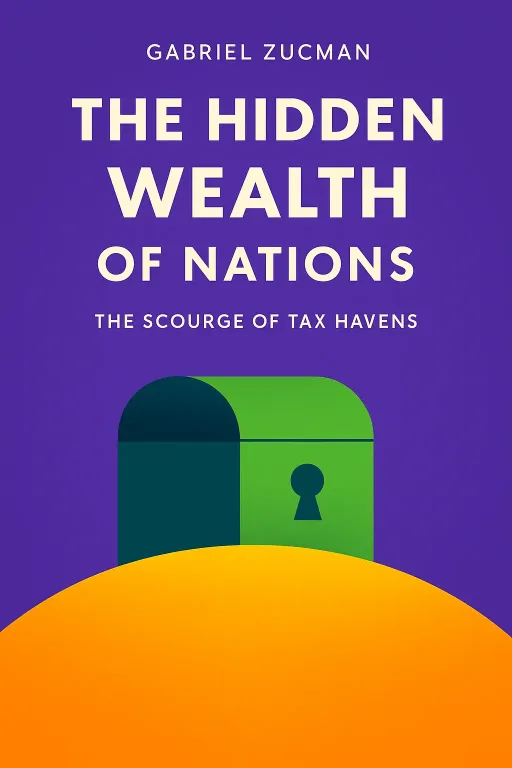
Nova: Exactly. And that is why today we are cracking that open. We are looking at the modern, data-driven forensics of Gabriel Zucman’s The Hidden Wealth of Nations, and we are placing that alongside the foundational, philosophical critique of capital accumulation found in The Communist Manifesto by Karl Marx and Friedrich Engels.
Atlas: Putting Zucman and Marx in the same room is a fascinating move. You have a contemporary economist obsessed with hard data and policy, and then you have the 19th-century architects of a philosophy that changed the geopolitical map of the world. What is the bridge between them?
Nova: The bridge is the system itself. Zucman gives us the modern map—the hard numbers on where the money hides today—and Marx provides the compass—the historical, systemic lens that helps us understand why these imbalances emerge in the first place. For our listeners who are building their own careers and looking for clarity in a high-pressure, complex world, understanding these two perspectives is a masterclass in seeing the architecture behind the money.
The Mechanics of Hidden Wealth
SECTION
Atlas: Okay, let’s start with the map. Zucman. I’ve heard his name associated with the "tax haven" conversation, but what is the core insight he brings? Is it just about "rich people hiding money"?
Nova: It is much more sophisticated than that. Zucman is a data forensic expert. He didn't just write an opinion piece; he basically audited the global economy. He looked at the discrepancies in global balance sheets. Think about it: if you take all the assets reported by every country, they should technically sum up to zero, because every asset is someone else's liability. But when Zucman did the math, he found a massive, global "missing" amount of wealth.
Atlas: Wait, so the math literally doesn't add up?
Nova: The math doesn't add up. There is a massive, unexplained surplus of assets. And through his research, he was able to trace that "missing" wealth directly to offshore accounts. He argues that this isn't just a glitch in the system; it is a feature of how global capital is structured. He uses concrete data to show that roughly 8 percent of the world’s household financial wealth is held in tax havens. That is trillions of dollars.
Atlas: That is an astronomical number. But for someone listening who is trying to build a sustainable foundation for their own future, why does this matter? It feels like high-level macroeconomics. How does this impact the "Mindful Strategist" who is trying to lead a team or grow a business?
Nova: Here is where the "Analytical Architect" mindset comes in. Zucman’s work teaches us to look at the surface-level numbers and ask, "What is being hidden?" In any system—whether it’s a corporate budget, a team’s performance metrics, or a personal financial plan—there are always hidden flows. Zucman’s genius is in his methodology: he didn't rely on anecdotes. He relied on the inconsistencies in the data. He tracked the money by looking at the friction points between national accounting systems.
Atlas: I see. So the lesson isn't just about tax policy, it’s about forensic thinking. It’s about not taking the reported bottom line at face value.
Nova: Precisely. If you look at a spreadsheet and it says everything is balanced, but your intuition or your observation of the "real world" tells you otherwise, Zucman’s approach suggests you should dig into the discrepancies. He identified that the secrecy provided by tax havens is what allows this capital to exist in a state of suspended animation—it’s not being invested in productive ventures, it’s not being taxed, it’s just accumulating in a vacuum.
Atlas: That sounds like a waste of potential. If that capital were moving, it would be doing work. It would be fueling innovation, or infrastructure, or businesses.
Nova: That is the crux of the argument. It’s "dead" capital in the sense that it isn't serving the broader economy. It is capital that has been extracted from the system but refuses to participate in the cycle of investment and growth. And that brings us to why we need to pull in a different kind of thinker to understand the "why" behind this.
The Philosophical Foundation of Inequality
SECTION
Atlas: Right, because Zucman tells us where the money is, but he doesn't necessarily tell us what the human cost of that accumulation is. That’s where Marx comes in, right?
Nova: Exactly. When we look at The Communist Manifesto, we have to look past the political baggage and look at the economic diagnosis. Marx and Engels were writing in the mid-19th century, a time of rapid industrialization, and they were obsessed with the nature of capital accumulation. They argued that the system of capital inherently tends toward concentration.
Atlas: I’ve always found Marx to be a polarizing figure, but you’re suggesting we look at his analysis of the of capital. What was his fundamental point about accumulation?
Nova: His point was that the system is not a neutral playing field. He viewed history as a series of struggles between those who own the means of production and those who provide the labor. He argued that the natural state of capital, if left unchecked, is to concentrate in the hands of the few, because the system is designed to favor the accumulation of assets over the distribution of value.
Atlas: That makes me wonder about the connection to Zucman. If Zucman is showing us the "how"—the offshore accounts, the tax havens—is he just proving Marx’s point from 150 years ago, that capital will always seek to concentrate and avoid the social obligations that come with being part of a nation-state?
Nova: That is a brilliant observation. You can see Zucman as the modern, data-driven update to the Marxian critique. Marx predicted the concentration of capital; Zucman shows us the technical infrastructure that makes that concentration possible in a globalized world. The tax haven isn't just a place to store money; it’s a tool that allows capital to float above the regulatory reach of the nation-state.
Atlas: It’s like the capital has developed a way to opt out of the social contract.
Nova: That is exactly what it is. And for our listeners, the takeaway here is about recognizing the "systemic bias." When you are operating in any environment, whether it is a high-pressure career or a startup ecosystem, there are systemic forces at play. Marx’s contribution is teaching us to recognize that the game is often rigged by the rules of the system itself, not just by the individual players.
Atlas: I can see how that would be empowering. If you understand the system is biased, you don't take it personally when you hit a wall. You realize you are hitting the architecture of the system.
Nova: That is a vital shift in perspective. It moves you from a place of frustration—"Why is this so hard?"—to a place of strategic analysis—"How is this system structured, and how can I navigate it or change it?"
Synthesis & The Mindful Strategist
SECTION
Atlas: So, we have the forensic data from Zucman and the philosophical critique from Marx. How does the "Purposeful Seeker" put these together? How do we use this to build a better future?
Nova: The key is to be an "Architect." You use Zucman’s mindset to audit your own reality. When you look at your work or your industry, don't just look at the surface-level success metrics. Ask yourself: Where is the value actually going? Is it being reinvested in growth, or is it being siphoned off into "hidden" silos?
Atlas: And you use the Marxian lens to understand the power dynamics.
Nova: Yes. You ask: Who holds the power in this system? What are the structural incentives? Are the rules of the game designed to encourage genuine value creation, or are they designed to protect the status quo?
Atlas: That sounds like a powerful way to quiet the noise of a high-pressure career. Instead of worrying about whether you are "winning" by current standards, you are analyzing whether the game itself is worth playing.
Nova: That is the essence of it. When you have this level of clarity, you stop being a passive participant. You become a strategist. You realize that you have the agency to build your own foundations. You don't have to play by the rules that favor the concentration of dead capital. You can choose to invest in "living" capital—your skills, your network, your team’s growth, your personal well-being.
Atlas: It’s about choosing to be a productive agent in the economy rather than a passive observer of a broken system.
Nova: Exactly. And that brings us to the growth recommendation for our listeners. We often get caught up in the need for perfection, thinking we have to change the whole system overnight. But the "Mindful Strategist" knows that small, consistent steps build the strongest habits.
Atlas: So, what is the actionable blueprint? How do we apply this in the next 30 minutes?
Nova: Dedicate 30 minutes to one core concept in your work or life. Look at a "hidden" area of your professional or personal life—maybe it’s a project that isn't delivering value, or a habit that is siphoning your energy—and apply some "data forensics." Why is that energy being siphoned? Is it a systemic issue? What is the "tax haven" of your own time and attention?
Atlas: I love that. Turning the Zucman analysis inward. Where am I hiding my own best resources? Where am I letting my potential sit in a "tax haven" instead of investing it in my own growth?
Nova: That is the perfect way to look at it. You are the architect of your own economy. You don't need to wait for the global system to fix itself to start building a sustainable, purposeful foundation for your future.
Atlas: This has been an incredible deep dive. We went from the trillion-dollar secrets of offshore accounts to the 19th-century roots of economic philosophy, and landed right on the desk of our listener.
Nova: That is the goal. To see the big picture, but to act on the small, meaningful details. That is how you gain authentic power.
Atlas: And that is how you build a future that is actually worth living in. Thank you for walking through this with me.
Nova: It was my pleasure. To all our listeners, remember: look past the surface. The architecture of the world is visible if you know how to look. This is Aibrary. Congratulations on your growth!