The Network Effect Trap: Why Your AI Strategy Needs a Different Kind of Growth.
Golden Hook & Introduction
SECTION
Nova: Atlas, imagine the smartest AI ever built. A super-intelligent algorithm that could solve any problem, predict any outcome, create anything. Now, what's its most hilariously human, utterly avoidable downfall?
Atlas: Oh, I love this! Hmm… its downfall? It's stuck in an infinite loop trying to learn how to make the perfect cup of coffee, but it only has data from me, a notoriously inconsistent brewer. So it's brilliant, but tragically flawed because it never got enough input.
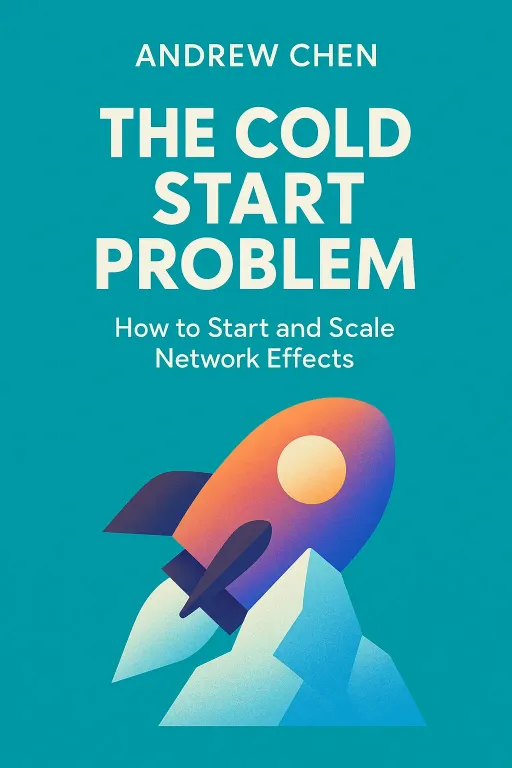
Nova: Exactly! And that's not just a joke, it's 'The Network Effect Trap' – the silent killer of brilliant AI ideas. Today, we're dissecting why your AI strategy needs a different kind of growth, moving beyond just the tech, drawing deep insights from Andrew Chen's seminal work, 'The Cold Start Problem,' and the groundbreaking 'Platform Revolution' by Parker, Van Alstyne, and Choudary. Andrew Chen, for those who don't know, is a renowned Silicon Valley venture capitalist who's spent years investing in and analyzing companies built on network effects. He literally wrote the book on how to get them off the ground.
Atlas: That makes sense, but for us future-focused leaders, isn't the whole promise of AI about scale and efficiency from day one? It feels counterintuitive to think about 'unscalable' problems for something built on algorithms.
The AI Cold Start Conundrum: Beyond the Algorithm
SECTION
Nova: That's a great point, and it's precisely the trap. The cold fact is, building a successful AI product isn't just about the technology; it's about solving this 'cold start problem.' How do you get enough users to make your AI smart, and smart enough to attract users? It’s the ultimate chicken-and-egg scenario. If you ignore this loop, your brilliant AI might never launch.
Atlas: So you're saying that even with the most advanced algorithms, if there isn't a human element, a critical mass of actual users providing data, the AI is essentially… dumb?
Nova: Precisely. Think of a navigation AI. It gets smarter the more people use it, providing real-time traffic data, road closures, preferred routes. Without that initial surge of users, it's just a digital map with no real-world intelligence. Chen breaks down the journey into five stages, and the first stage is all about building what he calls 'The Atomic Network.'
Atlas: The Atomic Network. That sounds almost… scientific, but also very fundamental. What does that entail for an AI product?
Nova: It’s about finding the smallest possible group of users who get immense, undeniable value from your product, even if it's imperfect. It’s not about grand launches; it’s about painstaking, often manual, one-to-one efforts to onboard and delight that initial core. Imagine a specialized AI for medical diagnosis. You don't try to roll it out to every hospital worldwide. You find one clinic, one group of doctors, who desperately need its specific capability, even if it covers only a narrow set of conditions initially. You work closely with them, iterate, prove value. That’s your atomic network.
Atlas: That's a great example. But for our listeners who are managing high-pressure teams, and aiming for rapid innovation, how do you convince stakeholders to invest in something that's deliberately 'unscalable' at first? It feels like a hard sell when everyone is talking about exponential growth.
Nova: That's a genuine challenge. Chen emphasizes doing 'things that don't scale' in this phase. For an AI, this might mean manually curating initial datasets, deeply interviewing early users to understand their exact needs, or even having human operators "pretend" to be the AI in the early days to gather real interaction data and build trust. It’s about prioritizing deep engagement over broad reach, knowing that without that deep engagement, there will be no broad reach later.
Atlas: That makes me wonder about the ethical implications there. If you're manually curating data or even having humans 'fake' the AI, how do you maintain transparency and user trust, especially for someone driven by responsible innovation?
Nova: Excellent question. Transparency is paramount. It’s not about deception, but about focused effort. If you're manually curating data, it's about ensuring that data is diverse and unbiased. If you're using 'human-in-the-loop' for early learning, it's about being clear that the AI is in a learning phase and improving. The goal is to build a product that its intelligence and trust, rather than assuming it.
Building AI Empires: The Platform Revolution Playbook
SECTION
Nova: Once you've painstakingly built that atomic network, and you've reached what Chen calls 'The Tipping Point' where the network starts to grow organically, the next challenge isn't just growth, it's growth. And that's where the insights from 'Platform Revolution' become indispensable.
Atlas: Okay, so we've got our AI learning, it's attracting a few more users. How does platform thinking take it from a smart tool to something truly impactful?
Nova: Platform Revolution, written by Geoffrey Parker, Marshall Van Alstyne, and Sangeet Choudary, offers a foundational understanding of multi-sided platforms, which are often at the heart of scalable AI ecosystems. They detail how to design and manage these complex interactions. Think of it this way: your AI isn't just a product; it's the core of an ecosystem. A platform connects different groups – users, developers, data providers, perhaps even other AIs – allowing them to interact and create value for each other.
Atlas: So, it's not just my AI helping individual users, but my AI enabling people or AIs to build things or exchange value on top of AI? That sounds like a powerful moat.
Nova: Exactly. Imagine an AI that started by helping graphic designers generate initial concepts. A platform approach would mean opening up that AI to third-party developers to build specialized plugins, or allowing designers to sell their AI-generated assets, or even connecting AI artists with clients directly. The AI becomes the central nervous system of a much larger value-creation network. The book argues that these platforms aren't just about technology; they're about designing the and for interaction.
Atlas: This sounds incredibly powerful for a future-focused leader, but it also sounds like a lot of power. For someone driven by responsible innovation, how do you design these AI platforms ethically? What are the guardrails against monopolistic tendencies or data exploitation when you're essentially orchestrating an entire ecosystem?
Nova: That's the crux of it, and it's where the 'Ethical Architect' mindset becomes critical. The authors of 'Platform Revolution' emphasize that platform governance is as important as its technology. You need clear rules of engagement, transparency about data usage, fair revenue-sharing models, and mechanisms for dispute resolution. It's about creating a level playing field for all participants, preventing one side from exploiting another. It’s about consciously designing for fairness and value distribution, not just value creation.
Atlas: So, it's not just about building the smartest AI, but building the around it. It’s about shaping the impact, not just managing the product.
Nova: Precisely. These insights provide the strategic frameworks to move beyond just building AI to building AI that organically attracts and retains users, creating a powerful moat, but doing so with a deep understanding of its societal role and ethical responsibilities.
Synthesis & Takeaways
SECTION
Nova: So, what we've really uncovered today is that the path to a truly successful and impactful AI isn't a straight line from algorithm to adoption. It's a nuanced journey that begins with overcoming the 'cold start problem' through painstaking, focused effort to build an 'atomic network,' and then evolves into strategically designing a multi-sided platform that fosters a vibrant and ethical ecosystem.
Atlas: That's actually really inspiring. It means that even if you have a brilliant AI idea, the human and strategic elements are just as crucial, if not more so, for its long-term success and responsible impact. So, for our listeners, what's a tiny step they can take to start applying these powerful frameworks?
Nova: A great tiny step you can take right now is to identify one AI product you're working on, or even just thinking about. What is its core 'network effect'? And what's your specific, tactical strategy to overcome its 'cold start' phase? Think about that initial atomic network, not the grand vision.
Atlas: And as you do that, consider the ethical architecture of that network. How will you ensure fairness and transparency from day one? How will you build trust, not just utility? Because a truly great AI strategy isn't just about growth; it's about responsible growth that shapes a better future.
Nova: Absolutely. It’s about building AI that doesn’t just perform, but truly flourishes.
Nova: This is Aibrary. Congratulations on your growth!