The Network Effect: How to Build Unstoppable Growth for Your EdTech Startup.
Golden Hook & Introduction
SECTION
Nova: Atlas, what's the first thing you think about when I say 'EdTech startup growth'?
Atlas: Oh, Nova, probably the soul-crushing silence of a freshly launched platform with zero users. Followed by the frantic search for a magic wand.
Nova: Exactly! That deafening silence, the 'cold start problem.' It’s the ultimate chicken-and-egg dilemma for any new platform, especially in EdTech. You need users to attract more users, but you have no users to start with!
Atlas: It’s a paradox that keeps growth officers like me up at night. You’ve got this brilliant educational tool, but if no one's experiencing it, it might as well not exist.
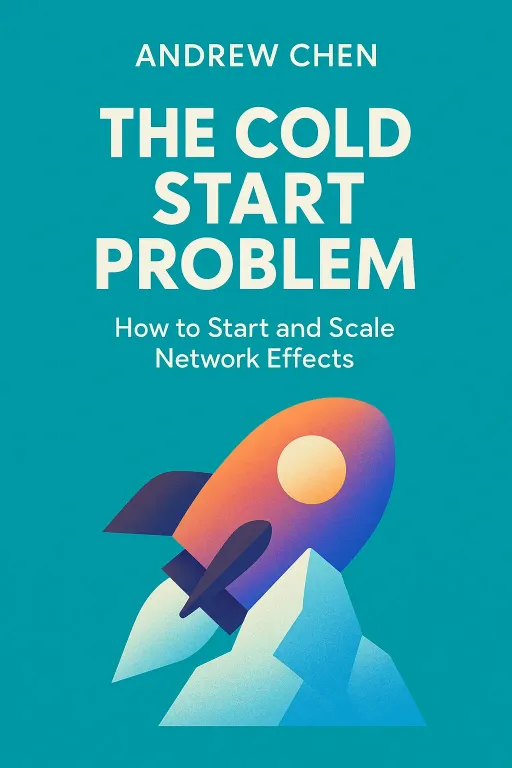
Nova: Well, today, we're tackling that head-on. We're talking 'The Network Effect: How to Build Unstoppable Growth for Your EdTech Startup,' drawing insights from two titans in the field. First, Andrew Chen, who was instrumental in scaling Uber’s growth, with his book "The Cold Start Problem." And then, Geoffrey A. Moore, whose seminal work "Crossing the Chasm" has guided countless tech companies through the treacherous waters of market adoption for decades.
Atlas: Those are heavy hitters. So, we're essentially getting the playbook for not just getting off the ground, but actually flying?
Nova: Precisely. We're exploring how to not just survive the cold start, but to strategically engineer network effects that lead to sustainable, vibrant learning communities.
Igniting the Network: Overcoming the Cold Start Problem
SECTION
Nova: Let's dive into Andrew Chen's world first. He argues that the biggest hurdle isn't building a great product; it's getting that initial traction, that "atomic network." Think of it like trying to throw the best party ever. You've got the perfect venue, the best music, but if no one shows up, it's just you awkwardly dancing alone.
Atlas: Oh, I know that feeling. So, how do you get people to come to the party when it's just you and a disco ball?
Nova: Chen suggests you don't try to fill the whole ballroom at once. You focus on the smallest viable network. He calls it an 'atomic network' – the absolute minimum number of people required for the network to be useful and self-sustaining. For an EdTech platform, that might be two students collaborating on a project, or one teacher and their small class.
Atlas: So you're saying, don't aim for a million users, aim for five highly engaged ones first? That feels counter-intuitive for someone building 0-1 growth strategies. We're always pushed for scale.
Nova: It’s about quality over quantity, especially at the start. You identify a 'hard problem' for a specific, underserved group, and then you solve it incredibly well for them. Take Duolingo's early strategy, for instance. They didn't try to teach every language to everyone simultaneously. They initially focused on making language learning accessible and gamified for individuals. Their atomic network was an individual learner and the system itself, with the network effect coming from shared progress and competition within small circles. The incentive was clear: free, fun language learning.
Atlas: That's a great example. They solved a clear problem for a specific user. But how do you design that 'specific incentive' for those first five members in an EdTech context? Because "free" isn't always sustainable or unique.
Nova: Absolutely. The incentive needs to be deeply valuable. Imagine an EdTech platform designed to help students master complex math concepts. Instead of launching to all high schoolers, you identify a small group of students struggling with calculus in one specific school. Your incentive isn't just "free access"; it's "personalized, one-on-one coaching for an entire semester, access to our cutting-edge AI tutor, completely free, for the first five students who commit." You're solving their urgent, painful problem directly.
Atlas: That makes sense. You're creating an undeniable value proposition for a very specific, desperate need. It's not just a product; it's a solution tailored so precisely that they to try it. And then, Nova, what happens? How do those five turn into fifty?
Nova: Ah, that's where the magic of "hard side" and "easy side" users comes in. For many EdTech platforms, you might have teachers and students. Chen emphasizes focusing intensely on the harder side first, giving them disproportionate value. If you get a few passionate teachers, they bring their students. They become your evangelists. The network effect then starts to ripple outward.
Scaling Beyond Early Adopters: Crossing the Chasm in EdTech
SECTION
Nova: Once you've got that spark, that initial, vibrant atomic network, the next challenge emerges: how do you light a wildfire? How do you move beyond those early, enthusiastic users to the broader market? This is where Geoffrey A. Moore's "Crossing the Chasm" becomes indispensable.
Atlas: Right, because the people who jump on new tech the moment it's released are very different from the people who wait until everyone else is using it.
Nova: Exactly. Moore describes a chasm between the 'early adopters' – the visionaries and tech enthusiasts who love new things for their own sake – and the 'early majority' – the pragmatists who need proof, social validation, and a complete solution before they commit. Many EdTech startups get stuck in this chasm. They've delighted their early adopters, but then they hit a wall.
Atlas: I can definitely see that. You get a few innovative teachers excited, but then the rest of the school district says, "Prove it works, and make it easy for us."
Nova: Precisely. The early majority doesn't care about your cool tech; they care about solving their problems reliably and with minimal disruption. Moore's solution is to pick a "beachhead" market. Instead of trying to serve everyone, you focus intensely on one very specific niche within the early majority and dominate it.
Atlas: A beachhead? So, like, invading a small, defensible territory before trying to take over the whole country?
Nova: A perfect analogy! For an EdTech platform, this might mean focusing all your resources on becoming the absolute best solution for, say, AP Physics students in suburban school districts, or supplemental learning for elementary school reading comprehension. Not just offering a tool, but offering a "whole product" solution for that specific group. This includes customer support, training, integrations with existing systems – everything they need to succeed.
Atlas: So, it's not just the core product, but the entire ecosystem around it that makes it irresistible to this specific segment? That’s interesting, because many EdTech startups just focus on the 'product' part.
Nova: And that's often why they fail to cross the chasm. Take Khan Academy, for example. While they eventually broadened, their initial, powerful beachhead was making quality math education accessible. They built trust, demonstrated impact, and provided a clear, whole solution for students needing help with specific subjects. They didn't try to revolutionize the entire school system overnight. They focused on delivering undeniable value to a specific, pragmatic user base.
Atlas: That’s a powerful lesson. It’s about building deep trust and solving every ancillary problem for one group, rather than shallowly trying to appeal to everyone. So, the journey from zero to unstoppable growth isn't a straight line; it's about igniting an atomic network, and then strategically conquering beachheads?
Nova: That’s a fantastic way to put it, Atlas. It's a deliberate, strategic dance between solving specific problems for specific people, and then expanding that success incrementally.
Synthesis & Takeaways
SECTION
Nova: So, bringing it all together: Andrew Chen gives us the blueprint for that initial spark, the 'cold start,' by finding your atomic network and solving a 'hard problem' for them. Moore then shows us how to turn that spark into a sustainable fire, by strategically crossing the chasm and dominating a specific beachhead market.
Atlas: It really underscores that growth isn't just about a great product, but about understanding human behavior and network dynamics. It's about designing an ecosystem where value naturally attracts more value.
Nova: Exactly. Sustainable growth in EdTech isn't just about acquiring users; it's about cultivating vibrant learning communities that grow organically because they're deeply valued. It's about creating an environment where the learning experience itself becomes the most powerful marketing tool.
Atlas: That's actually really inspiring. It frames growth as community building, which feels far more aligned with the mission of education.
Nova: It’s the difference between a fleeting trend and a lasting institution. And for our listeners building 0-1 growth strategies, the tiny step today is crucial: identify your smallest viable network. Then, design one specific, irresistible incentive to attract its first five members.
Atlas: Start small, make it undeniable, and watch the network grow. That's a plan I can get behind.
Nova: This is Aibrary. Congratulations on your growth!