The Soul of Your Space: Unlocking Your Personality to Conquer Clutter
Golden Hook & Introduction
SECTION
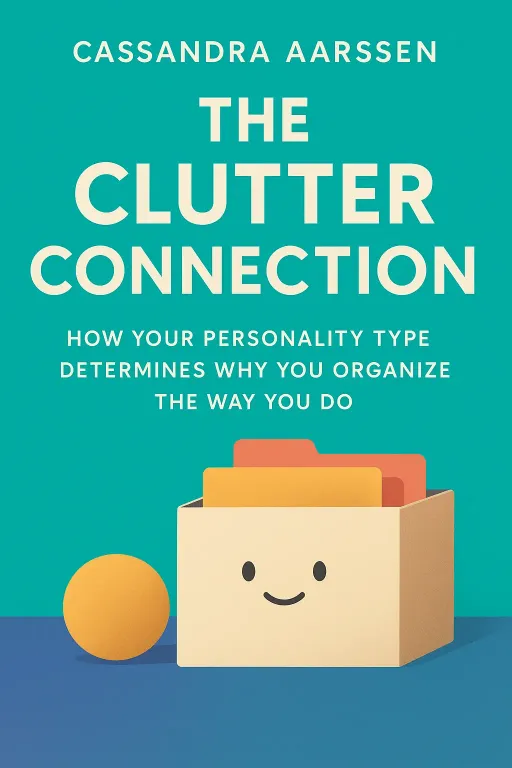
Nova: Deanna, have you ever spent an entire weekend cleaning, only to look around on Wednesday and wonder if a clutter-bomb went off? You start asking yourself, "Am I just a messy person? Am I lazy?" It's a heavy feeling. But what if I told you that according to our book today, Cassandra Aarssen's, you're not messy? You're just a fish being judged on your ability to climb a tree.
Deanna: That's a powerful idea. It immediately takes the shame out of the equation. That label, "messy," carries so much weight, so much negative self-judgment.
Nova: It really does. And the book quotes Albert Einstein, saying, "If you judge a fish by its ability to climb a tree, it will live its life believing that it is stupid." That's the feeling so many of us have about our homes. We're fish trying to climb the tree of someone else's organizing system.
Deanna: And we fail, and then we internalize that failure as a core part of our identity. It's a vicious cycle.
Nova: Exactly! And that's our whole focus today. We want to break that cycle. Today we'll dive deep into this from two perspectives. First, we'll shatter the 'messy myth' and explore why your organizing struggles aren't your fault. Then, we'll decode the 'Clutterbug' personality types and discover how this knowledge can bring harmony not just to your home, but to your relationships.
Deanna: I'm excited. This feels less like a cleaning manual and more like a guide to self-acceptance.
Deep Dive into Core Topic 1: The Liberation from the 'Messy' Label
SECTION
Nova: It absolutely is. So let's start with that first idea, because it's the foundation of everything. The book argues there's no such thing as a 'naturally lazy' or 'messy' person. There are only people using the wrong organizing system for their unique personality.
Deanna: Which is a revolutionary thought for anyone who's been told their whole life to just 'try harder' or 'be more disciplined.'
Nova: Right? And the author, Cassandra Aarssen, she lived this. She's incredibly open about her past, calling her former self a 'Super Slob.' This wasn't just a bit of mess. She was a stay-at-home mom with ADHD, and she describes her home as having literal paths carved through waist-high piles of clothing and trash. She was always late, always broke, and felt like a complete and utter failure as a mother and a person.
Deanna: Wow. That's a very vulnerable thing to admit. But it's also incredibly relatable for anyone who's felt that sense of being completely overwhelmed by their own space.
Nova: It is. And she tried everything. She read all the organizing books, bought all the containers, tried to implement these perfect, detailed systems she saw in magazines. And nothing worked. It only made her feel worse.
Deanna: And that feeling of failure is so corrosive to your self-confidence, isn't it? It becomes a self-fulfilling prophecy. You believe you're a mess, so you stop trying, which of course creates more mess. It's a downward spiral that has very little to do with the actual 'stuff' and everything to do with your mindset.
Nova: Precisely! Her breakthrough, her 'aha' moment, came when she just gave up. She stopped trying to copy other people's systems—the tiny labels, the complex files, the perfectly folded shirts. And instead, she just asked herself, 'What's the absolute easiest, laziest way for to put this away?'
Deanna: I love that. She gave herself permission to be 'lazy.'
Nova: Yes! And for her, the answer was big, open baskets. No lids. No complicated categories. Just a basket for 'toys,' a basket for 'mail,' a basket for 'shoes.' She stopped beating herself up and embraced what she calls a 'good enough' approach. And slowly, miraculously, her house started to stay clean.
Deanna: That's a profound mindset shift. It's moving from a place of self-criticism to a place of self-compassion. It's not about forcing a new habit through sheer willpower; it's about designing a habit that requires almost no willpower at all because it aligns with your true nature. That's the secret to any sustainable change, whether it's with diet, exercise, or, in this case, clutter.
Nova: You've hit the nail on the head. It's about working with your brain, not against it. It's a form of radical self-care. And once she figured this out for herself, she realized this could help others.
Deep Dive into Core Topic 2: Decoding Your 'Clutterbug' DNA for a Happier Home
SECTION
Nova: And that leads us perfectly to the second, more practical part of this. Once you accept you're not messy, the logical next question becomes, 'Well, what am I?' So, Aarssen developed a system of four 'Clutterbug' personality types.
Deanna: A classification system. As an analytical thinker, I love a good framework.
Nova: You'll love this. It's based on two simple questions. First, do you prefer to have your things visible or hidden? And second, do you prefer simple, big-category organization or detailed, micro-organization? This creates a 2x2 grid with four types: The Ladybug, the Cricket, the Bee, and the Butterfly.
Deanna: Simple, yet it probably explains so much.
Nova: It really does. We won't go through all four, but I want to focus on one that really highlights the relationship aspect you're interested in: The Butterfly.
Deanna: The Butterfly. Sounds lovely and maybe a bit flighty?
Nova: Exactly! A Butterfly is a visual person. For them, 'out of sight, out of mind' is a literal, biological reality. They also need simple, big-picture, or 'macro' organization. So, they are the people who leave things on the counter, not because they're messy, but because they are genuinely afraid they'll forget about them if they're put away in a drawer.
Deanna: Oh, I can see immediately how that would cause friction in a relationship. If one person is a Butterfly and their partner is, say, someone who needs clear surfaces to feel calm and in control, it's a constant battle. And it's probably never framed as a personality difference. It's framed as, 'Why are you so messy?' versus 'Why are you so controlling?'
Nova: You've just described thousands of household arguments! It's not about one person being 'right' and the other 'wrong.' It's a clash of fundamental needs. And the book has this perfect story about it. The author talks about her own sister, Jen, who is a classic Butterfly. Jen is a successful, brilliant therapist, a great mom, but her home was chaotic. And she carried this deep, painful shame about it.
Deanna: She probably felt like a hypocrite. Helping others get their lives in order, but unable to manage her own home.
Nova: That's exactly it. The author went to help and realized Jen's main issue wasn't laziness; it was a paralyzing fear of failure. She'd tried and failed at traditional organizing so many times that she just stopped trying. So, instead of creating complex systems, the author did two simple things. She hung a big bulletin board by the door for all the incoming papers and mail. And for the kids' toys, she got big, open bins and put a picture of what went inside on the front.
Deanna: So the solution wasn't to 'be tidier.' It was to make tidiness visual and effortless. That's an act of empathy. You're not just organizing a space; you're addressing the underlying emotion—the fear—and designing a system that provides security and ease. That is a complete game-changer for relationships.
Nova: It is! Because now, the partner of a Butterfly can understand, 'Oh, you're not leaving your keys on the counter to annoy me. You're doing it so you don't forget them. Let's get a beautiful hook or a pretty bowl and put it right by the door.' The solution becomes collaborative, not combative.
Deanna: It changes the entire conversation from accusation to problem-solving. It's about honoring how the other person's brain works. That's a deep form of love and respect, and it goes so far beyond just cleaning the house. It's about creating an emotional environment where both people feel understood and supported.
Synthesis & Takeaways
SECTION
Nova: It really is. So, to bring it all together, we've seen that being 'messy' is a myth that we need to let go of for our own self-confidence. And that understanding your organizing style, like being a Butterfly, is the key to creating systems that actually last. It's about self-awareness first, action second.
Deanna: And it reframes the entire goal, which I think is so important. The goal is not to achieve a perfect, magazine-worthy home that you see on social media. The goal is to create a space that gives you a sense of control and ease. That, in itself, is a fundamental form of self-care. It's about reducing daily friction so you have more energy for the things that truly matter.
Nova: I couldn't agree more. So, for everyone listening, who might be feeling that spark of hope, here's the challenge. Deanna, what's one small, manageable step someone could take today, based on these ideas?
Deanna: I love the book's idea of just observing. For one day, or even one week, don't try to fix anything. Don't judge. Just notice your own patterns. When you come in the door, where do your keys and mail naturally land? Are you a 'piler' who makes neat stacks, or a 'stuffer' who shoves things in drawers? Do you feel anxious when you can't see your to-do list?
Nova: I love that. No pressure, just observation.
Deanna: Exactly. Think of it as gathering data for your own personal, creative project of designing a life that fits you. It's not a test you can fail. It's the first step in a conversation with yourself, and that's a beautiful, empowering place to start.
Nova: Gathering data for a creative project. That is the perfect, most encouraging way to put it. Deanna, thank you. This has been so insightful.
Deanna: It was my pleasure. This is a topic that clearly connects with so much more than just clutter.
Nova: It certainly does. And for everyone listening, we hope this gives you permission to be a little kinder to yourself, and a lot more curious about the soul of your own space.