Power, Rebellion, and Systemic Transformation
Golden Hook & Introduction
SECTION
Nova: Most professionals believe corporate politics is just a battle of individual personalities, but history shows we are actually swimming in deep, invisible economic currents.
Atlas: That sounds like a recipe for a massive headache, or perhaps the ultimate cheat code for understanding how power actually works in our careers.
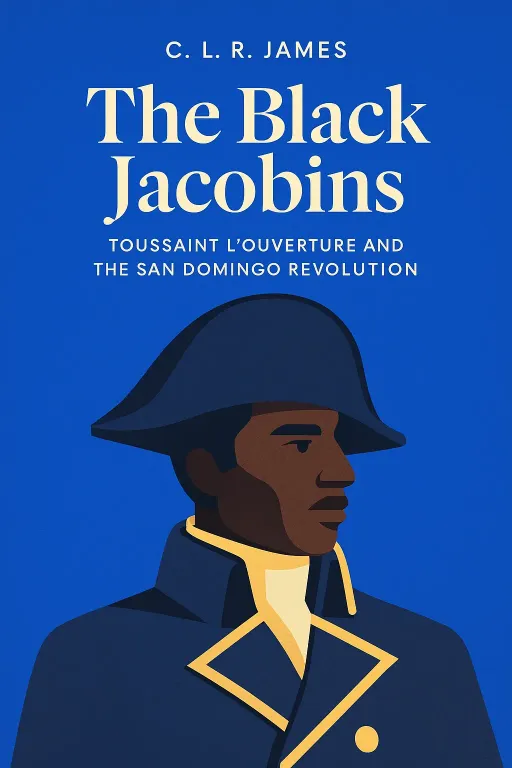
Nova: Today we are exploring two monumental works that pull back the curtain on these invisible currents. First, we have The Black Jacobins by C. L. R. James, a masterpiece written in 1938 by a brilliant Trinidadian historian who completely transformed how the world views the Haitian Revolution. And second, we are looking at The Communist Manifesto by Karl Marx and Friedrich Engels, an 1848 pamphlet that became one of the most influential political texts in human history.
Atlas: Absolutely, and while those might sound like purely historical or political texts, they actually give us a masterclass in how systems of power operate, how they change, and how we can find our own agency within them.
Nova: James wrote his book during a time of global colonial upheaval, and he wanted to show that the oppressed are not just passive victims of history, but active agents of their own destiny. He focused on Saint-Domingue, which was the wealthiest colony in the world at the time, driven by brutal slave labor.
Atlas: That makes me wonder about the sheer scale of the system they were up against. It was not just a local issue; it was a massive global economic engine.
Nova: It was the crown jewel of the French empire, producing massive amounts of sugar and coffee. The wealth generated there literally fueled the French bourgeoisie. Yet, a collective organization emerged that completely dismantled this formidable system.
Atlas: Oh, I know that feeling of looking at a massive, entrenched industry structure and thinking, there is no way anyone can change this. How did they even begin to organize under such extreme oppression?
Nova: That is the core of what James documents. The breakthrough came when individual, isolated acts of resistance transformed into a highly organized, disciplined military and political force. And the catalyst for this transformation was clear, strategic leadership, most notably embodied by Toussaint Louverture.
The Power of Collective Organization
SECTION
Nova: Toussaint Louverture was a self-educated former slave who understood both the brutal reality of the plantation system and the geopolitical rivalries of the European superpowers. He realized that to defeat a systemic power, you must build a system of your own.
Atlas: That sounds incredibly challenging, especially when the people you are trying to organize have been systematically kept divided and uneducated. How did he bridge those gaps?
Nova: He began by organizing secret networks across plantations, using shared cultural practices and languages that the French overseers did not understand. He did not just call for a rebellion; he built a structured army. He trained his soldiers in European military tactics while leveraging their deep knowledge of the local terrain.
Atlas: Wow, so he essentially combined local agility with the structured discipline of the very empire they were fighting. That is a brilliant strategic play.
Nova: He also understood that military force alone would not guarantee long-term success. He constantly negotiated with the French, the British, and the Spanish, playing them against each other to secure resources, weapons, and political recognition. He took an unorganized, traumatized population and forged them into a disciplined, self-governing entity.
Atlas: I can see how that applies to modern organizations. When we want to drive change in our industries, we often try to do it through sheer force of will or individual excellence, but the real power comes from building structured alliances and organizing collectively.
Nova: Exactly. James emphasizes that Toussaint's genius was his ability to see the larger historical forces at play. He did not view the revolution as a personal vendetta against specific plantation owners. He saw it as a systemic struggle against the entire economic structure of colonialism.
Atlas: That is a great way to put it. It shifts the focus from fighting individuals to redesigning the system itself. But what happened when the system fought back? Because surely the French did not just hand over the keys.
Nova: The French sent their most elite troops under Napoleon's brother-in-law to reinstate slavery. It was a brutal, devastating war. But by that point, the collective consciousness of the Haitian people had completely changed. They had tasted autonomy, they had a highly organized military structure, and they were willing to burn their own cities to the ground rather than return to chains.
Atlas: That gives me chills. The level of commitment required to burn your own infrastructure to protect your autonomy is intense. It shows that once a collective mindset shifts, the old system cannot easily force people back into their old roles.
Nova: That is the ultimate takeaway from James's work. Systemic change requires a combination of deep collective alignment and highly strategic, organized leadership. Without the organization, the rebellion would have been crushed. Without the shared vision, the organization would have fallen apart under pressure.
Atlas: Let let me check if I got that right. The lesson here is that individual talent or isolated efforts are easily absorbed or crushed by a powerful system, but when you build a structured, disciplined collective that understands the broader landscape, you can actually force the system to bend.
Nova: You have got it perfectly. And this idea of structural forces shaping our reality leads us directly to the theoretical framework laid out by Marx and Engels.
Economic Structures and Power Dynamics
SECTION
Nova: While James shows us this theory in action on the ground in Haiti, Marx and Engels provide the analytical tools to understand why these systems exist in the first place. In The Communist Manifesto, they argue that all human history is the history of class struggles.
Atlas: That sounds a bit heavy for a Monday morning, but I can definitely see how the basic concept of class struggle translates to the modern workplace. We all feel the tension between those who set the rules and those who have to follow them.
Nova: The core of their argument is historical materialism. They suggest that the economic base of a society, meaning how goods are produced, who owns the tools, and how wealth is distributed, completely dictates the superstructure. The superstructure includes our laws, our politics, our culture, and even our professional hierarchies.
Atlas: Oh, that is a fascinating way to look at it. So the way we work, the metrics we are judged by, and the paths to promotion in our careers are not just random or natural. They are direct products of the underlying economic model of our industry.
Nova: Precisely. Marx and Engels analyzed how the transition from feudalism to industrial capitalism created two primary classes: the bourgeoisie, who own the means of production, and the proletariat, who must sell their labor to survive. In this setup, the owners of capital naturally hold all the power, and they structure society to maintain that power.
Atlas: That sounds rough, but it explains so much about modern corporate dynamics. For example, if you look at the tech industry, the venture capitalists and founders who own the intellectual property and the platforms hold the ultimate decision-making power, while the developers and creators are essentially selling their highly skilled labor.
Nova: That is a brilliant modern application. The developers might be paid very well, but they still operate within a system where they do not own the ultimate product of their labor. Their professional autonomy is strictly bounded by the financial goals of the owners of capital.
Atlas: So how do Marx and Engels suggest we navigate this? Because if the economic structure is that powerful, it feels almost impossible for an individual to have any real control over their professional destiny.
Nova: They argue that capitalism contains the seeds of its own destruction because it forces workers into close proximity, which naturally fosters communication and collective consciousness. As industries grow, workers realize their shared interests and begin to organize, first into trade unions, and eventually into a political force.
Atlas: Right, like how we are seeing modern gig workers or tech employees starting to organize because they realize that individual negotiation does not work when you are dealing with a massive, algorithm-driven platform.
Nova: Yes, the platform itself becomes the modern equivalent of the factory floor. It brings people together and highlights the shared nature of their struggles. Marx and Engels argue that the key to systemic progress is recognizing these class dynamics and moving from individual competition to collective action.
Atlas: I guess that makes sense, but it also sounds incredibly difficult in a culture that constantly promotes individual achievement and competition. We are taught to climb the ladder, not to rewrite the rules of the ladder.
Nova: That is the power of the superstructure. It shapes our minds to believe that individual competition is the only natural way to exist. But when we look closely, we see that the people at the top of the system are highly organized. They have industry groups, lobbying firms, and shared investment strategies. They understand the power of collective organization.
Atlas: Wow, that is a massive realization. The owners of capital are already acting collectively to protect their interests, while the workers are encouraged to compete against each other for crumbs.
Nova: That is exactly the imbalance that Marx and Engels wanted to expose. Once you see that power is structural, you realize that trying to solve systemic problems through purely individual effort is like trying to empty the ocean with a spoon.
Systemic Transformation and Professional Autonomy
SECTION
Atlas: Okay, so let us bring this down to earth for our listeners who are navigating their careers right now. If we accept that our industries are governed by these deep economic structures, how does that affect our professional autonomy and our leadership styles?
Nova: The first step is developing systemic awareness. You need to look at your industry and ask: Where does the capital flow? Who owns the critical assets, whether that is data, distribution networks, or intellectual property? And how do those financial realities shape the behavior of your company's leadership?
Atlas: That makes perfect sense. If you are a leader in a company that is funded by short-term venture capital, your leadership style is going to be heavily pressured to deliver rapid growth, even if that means burning out your team. The structure dictates your behavior.
Nova: Exactly. If you do not understand that pressure, you might blame yourself or your boss for the toxic culture, when the real culprit is the financial model of the business. Once you recognize this, you can make more strategic decisions about where to invest your time and energy.
Atlas: That sounds like a great way to regain some agency. It allows you to choose which systems you want to participate in, rather than just blindly accepting the default rules of whatever company you happen to join.
Nova: And it also changes how you lead. A systemic leader does not just manage individual performance; they design environments that support their team's autonomy. They act as a buffer between the harsh demands of the external economic structure and the internal culture of their team.
Atlas: Oh, I like that concept of a leader as a buffer. It is like Toussaint Louverture protecting his people from the global colonial powers while building their internal strength and organization.
Nova: That is a beautiful connection. A great leader today can protect their team from the short-term pressures of the market to allow them to do deep, meaningful work. They build a micro-system within the larger macro-system that operates on different, healthier principles.
Atlas: But what about the professional who feels completely trapped by the structure of their industry? Let us say they are in a field like corporate law or investment banking, where the billable hour or the extreme work culture is the absolute law of the land.
Nova: In those cases, the challenge is to look for leverage points. Can you build specialized skills that make you indispensable, giving you the power to dictate your own terms? Can you transition to a different part of the value chain where the economic pressures are different? Or can you collaborate with peers to start shifting the industry norms?
Atlas: That is where the collective aspect comes back in. We are seeing a lot of professionals starting to build independent communities, masterminds, or cooperative businesses where they can share resources and build collective leverage outside of the traditional corporate structures.
Nova: Yes, the growth of the creator economy and independent consulting is a direct response to people seeking more autonomy. They are using modern digital tools to build their own micro-means of production, bypassing the traditional gatekeepers.
Atlas: That is incredibly empowering. It shows that while the economic structures are powerful, they are not permanent. They can be navigated, bypassed, or transformed if we are strategic enough to see them clearly and organized enough to act.
Synthesis & Takeaways
SECTION
Nova: As we wrap up this deep dive into power and systemic transformation, the core message connecting C. L. R. James's historical narrative and Marx's theoretical framework is that true professional autonomy is never just handed to us. It must be actively built through structural awareness and strategic organization.
Atlas: Exactly, and for anyone listening who wants to elevate their career or leadership style, the challenge is to stop looking at your professional challenges as purely personal struggles. Start looking at them as systemic design problems.
Nova: When you understand the underlying economic forces of your industry, you can stop reacting to the symptoms and start designing real solutions. You transition from being a passive player in someone else's system to being an active architect of your own destiny.
Atlas: That is such a powerful shift in perspective. It takes us from feeling helpless to feeling strategic and focused.
Nova: If this episode found you, you are likely at a point where you are ready to stop just climbing the ladder and start questioning who built the ladder in the first place. Take some time this week to analyze the invisible architecture of your industry. Knowledge is the first step toward transformation.
Atlas: This is Aibrary. Congratulations on your growth!