Personalized Podcast
Golden Hook & Introduction
SECTION
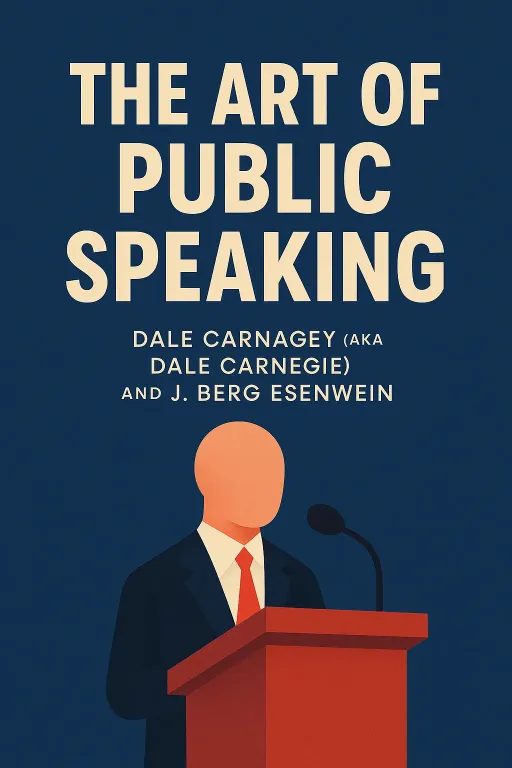
Nova: Imagine standing before a crowded room, all eyes on you, and instead of rushing to fill the silence, you deliberately stop. You look at your audience, let the quiet hang for three full seconds, and only then do you begin to speak. That silence isn't a mistake. It's actually the ultimate power move. Today, we're unpacking Dale Carnegie and J. Berg Esenwein's timeless classic,, but we're doing it through a very special lens: how quiet, analytical minds can step into world-class leadership. We're going to tackle this book from three distinct angles. First, we'll explore the architecture of the pause and how to conquer monotony. Second, we'll dive into what Carnegie calls reserve power—why what you don't say makes what you do say incredibly magnetic. And finally, we'll look at the chemistry of feeling, showing how to bridge the gap between analytical data and emotional persuasion. I'm Nova, and joining me today is Victor, a data analyst in the education sector who is on a mission to redefine what leadership looks like. Welcome, Victor!
Victor: Thanks, Nova. It's great to be here. You know, when I first picked up this book, I was a bit skeptical. As a data analyst, and honestly, as someone who leans toward the quieter, more reflective side of things, I always thought public speaking was about being this loud, theatrical showman. But Carnegie's approach is different. It's deeply psychological. It made me realize that leadership communication isn't about changing who you are; it's about projecting your inner conviction more clearly.
Nova: Oh, I love that! Projecting your inner conviction. That is so beautifully put, Victor. And it's incredibly encouraging because so many of us feel like we have to put on a mask to speak in public. But Carnegie argues the exact opposite. He says the most effective speaking is natural, conversational, and grounded in who you actually are. So, let's start with that first major hurdle we all face: how do we actually command a room without feeling like we're putting on a fake performance?
The Architecture of the Pause and Conquering Monotony
SECTION
Victor: That brings us right to Carnegie's chapters on monotony and the power of the pause. In my day job, I look at data patterns all the time. And in communication, monotony is just a flatline pattern. It's a single, unvarying tone that puts the brain to sleep. Carnegie calls monotony the ultimate sin of public speaking. He explains that the human mind naturally craves variety. If your pitch, your pace, and your volume never change, the audience's attention just drifts away.
Nova: It's like driving on a long, straight highway with no turns and no scenery changes. You just zone out! So, how do we add those turns and scenic overlooks to our speech?
Victor: Well, Carnegie points to a few tools, but the most underutilized one is definitely the pause. He has this wonderful line where he says, "By pausing, you give the audience time to digest what you've said, and you give yourself time to prepare for what's next." It's a double-sided benefit.
Nova: Yes! And it creates this incredible sense of suspense, doesn't it? It's like, what is she going to say next? But for a lot of us, silence feels terrifying when we're on stage. We feel this intense pressure to fill every millisecond with sound, even if it's just "um" or "uh."
Victor: Exactly. We treat silence as a void, a failure. But historically, the greatest leaders treated silence as a tool of gravity. Take Abraham Lincoln, for example. I've been reading a lot about his delivery style. Lincoln wasn't a naturally polished, booming orator. When he started speaking, his voice was actually quite high-pitched and sometimes a bit shrill. But he was incredibly deliberate. He used slow pacing and massive, intentional pauses. During his famous Cooper Union address, he didn't rush. He let his points land. He used silence to let the weight of his arguments settle into the minds of his listeners. That contrast between his quiet pauses and his moments of intense emphasis is what made him so commanding.
Nova: That is such a powerful image, Victor. Lincoln, this towering figure, just standing there, letting the silence do the heavy lifting. It shows that the pause isn't just a lack of sound; it's a physical presence. It's like punctuation in a sentence. Without periods and commas, a paragraph is just a chaotic wall of text. The pause is the period.
Victor: Right, and as an analyst, I think of it as data chunking. If I present a complex chart to an educator, I can't just throw fifty data points at them in one breath. I have to present a trend, pause, let them look at the visual, and then explain the implication. In public speaking, the pause is where the audience does the cognitive processing. If you don't pause, you're essentially overloading their bandwidth.
Nova: Oh, "overloading their bandwidth" is the perfect way to describe it! We've all been on the receiving end of that. So, if we want to avoid that, we have to practice varying our pace. We speed up when we're excited, we slow down to emphasize a key point, and we pause before and after our most important ideas. It sounds so simple, but it takes real courage to stand in front of a group and just be quiet for a moment, doesn't it?
Victor: It really does. It requires you to be comfortable with your own thoughts. And that actually ties directly into Carnegie's ideas on concentration. He says that when you are speaking, you shouldn't be thinking about how you look or what the audience thinks of you. You should be entirely concentrated on the present thought you are delivering. If you are fully present in the idea, the pauses will come naturally because you are actually thinking on your feet, not just reciting a script.
Nova: Yes! It's the difference between reading a grocery list and telling a story about a wonderful meal you just had. When you're in the moment, your voice naturally inflects, your pace changes, and you pause to remember a detail. It's alive.
Reserve Power and Right Thinking
SECTION
Victor: And that aliveness is deeply connected to the second big concept I wanted to talk about, which is reserve power. This is probably my favorite chapter in the book. Carnegie defines reserve power as the strength that comes from knowing much more than you actually say. He writes that a speaker who only knows what they are currently uttering is always on the verge of bankruptcy. But the speaker who has a well-stocked mind, who has read widely, observed deeply, and thought thoroughly, projects an aura of unshakeable confidence.
Nova: Ooh, "reserve power." That sounds like a secret superpower! Tell us more about how that works in practice.
Victor: Think about Albert Einstein. He was famous for his ability to explain incredibly complex physics using simple, everyday analogies, like riding a bicycle or watching a train. He could do that because his reserve power was immense. He understood the mathematics so deeply that he could afford to leave ninety-nine percent of the complexity out of his public explanations, leaving only the pure, elegant essence. When you speak from a place of reserve power, the audience can feel the weight of your unspoken knowledge. It gives your words a magnetic gravity.
Nova: That is so true. You can always tell when someone is speaking at the absolute limit of their knowledge versus when they are just sharing the tip of an iceberg. There's a relaxed authority in the iceberg speaker. They aren't defensive; they aren't rushing. They have nothing to prove because they have a whole reservoir of understanding backing them up.
Victor: Exactly. And for someone in my position, as a data analyst, this is incredibly liberating. Sometimes I worry that if I don't present every single spreadsheet, every methodology, and every outlier, I'm not doing my job. But Carnegie's concept of reserve power taught me that my preparation isn't meant to be dumped on the audience. My preparation is meant to build my own internal anchor. The data gives me the confidence to stand on stage, but my speech should only deliver the most impactful insights, simplified for the listener.
Nova: That is a massive shift in perspective! Your preparation is your anchor, not your script. It reminds me a bit of Socrates and his dialectic method. He didn't just lecture people; he had this deep reservoir of philosophical inquiry, but he communicated through simple, targeted questions. He guided people to the truth rather than hitting them over the head with it.
Victor: Yes! Socrates was the master of reserve power. He claimed he knew nothing, but his deep, structured thinking allowed him to dismantle complex arguments with just a few gentle questions. That's a form of leadership we don't talk about enough. It's not about being the loudest voice in the room; it's about having the clearest mind. And that clear mind comes from what Carnegie calls right thinking. He emphasizes that your character, your daily thoughts, and your mental attitude are the true foundation of your persuasiveness. You can't separate the speech from the speaker.
Nova: Right! You can't just memorize a few rhetorical tricks and expect to be influential if, deep down, you don't care about your audience or your subject. People have a very high-functioning radar for insincerity, don't they? They can feel if you're just trying to manipulate them or if you genuinely believe in what you're saying.
Victor: Absolutely. Carnegie says that if you want to speak with force and enthusiasm, you have to enter into the spirit of your subject. You have to cultivate a genuine sympathy for humanity. For me, working in education, that means remembering the students behind the data points. When I talk about graduation rates or test scores, I'm not just talking about numbers on a screen. I'm talking about young people's lives and futures. If I keep that connection alive in my mind, my delivery naturally gains warmth and sincerity. I don't have to manufacture enthusiasm; it's just there.
The Chemistry of Feeling and Suggestion
SECTION
Nova: That is the perfect bridge to our third topic: the chemistry of feeling and suggestion. Carnegie has these wonderful chapters on how we actually influence people. And he makes a very bold claim. He says that we like to think of ourselves as logical creatures, but in reality, we are largely driven by feeling and suggestion. If you want to move people to action, you have to appeal to their emotions and their high motives.
Victor: This is a really challenging area for analytical thinkers. We love logic. We love arguments, evidence, and proofs. But Carnegie points out that logic alone rarely changes behavior. He talks about how suggestion bypasses conscious reasoning and goes straight to our feelings. He notes that we are highly susceptible to suggestion through things like authority, environment, and our natural desire to follow the line of least resistance.
Nova: It's so true. Think about Oprah Winfrey. She is an absolute master of this. When Oprah speaks, she doesn't just present facts; she shares deeply personal stories, she uses vivid descriptions, and she speaks with immense emotional vulnerability. She creates this environment of trust where the audience feels safe and understood. Her suggestions don't feel like commands; they feel like shared revelations. She moves millions of people not by out-arguing them, but by connecting with them on a human level.
Victor: Yes, and Mother Teresa did something very similar but in a completely different style. Her power didn't come from high-energy showmanship; it came from a quiet, absolute moral conviction. When she spoke, she appealed to the highest motives of humanity—compassion, love, and duty to the poor. She didn't use complex theological arguments. She used simple, concrete descriptions of the people she was helping. She painted vivid pictures with her words, and that directness made her suggestions incredibly potent. You couldn't argue with her because her life and her words were in perfect alignment.
Nova: That is such a beautiful contrast, Victor. Oprah with her warm, expressive connection, and Mother Teresa with her quiet, moral gravity. Both of them were incredibly influential, but they did it by tapping into that chemistry of feeling rather than just dry exposition. It shows there isn't just one way to be an inspiring leader. You can be quiet, you can be expressive, but you must be authentic.
Victor: Exactly. And Carnegie actually breaks down how to do this technically in his chapters on exposition, description, and narration. He says that if you want to make an idea stick, you have to make it visual. You have to use figures of speech, anecdotes, and biographical facts. As a data analyst, I've started applying this by using what I call data storytelling. Instead of just saying, "We saw a fifteen percent increase in student engagement," I'll tell a quick story about a specific classroom where a teacher used a new method and saw a quiet student suddenly raise their hand for the first time. That story makes the fifteen percent real. It gives the data a heartbeat.
Nova: "Giving the data a heartbeat." Oh, I am writing that down! That is a brilliant phrase, Victor. It perfectly captures how we can bridge the analytical and the emotional. It's not about ignoring the data; it's about translating it into a language that the human heart can understand.
Victor: Right. And Carnegie also talks about crowd psychology, which is fascinating. He explains that when people are in a group, they tend to think and feel collectively. A leader's job is to unify that crowd around a shared, universal idea. If you can tap into those universal values—like growth, hope, or community—you can align a diverse group of people toward a common goal. For an INFJ like me, who naturally values harmony and deep connection, this is a very comfortable space to operate in once you realize that public speaking is just a way to facilitate that collective alignment.
Synthesis & Takeaways
SECTION
Nova: This has been such an incredibly rich conversation, Victor. We've covered so much ground, from the strategic use of silence to the depth of reserve power, and finally, to the emotional chemistry of leadership. If you had to synthesize all of this into a few key takeaways for our listeners—especially those who might be quiet, analytical thinkers looking to step into leadership—what would they be?
Victor: I think it boils down to three main principles. First, embrace the pause. Silence is not your enemy; it is your punctuation. Use it to let your ideas breathe and to give your audience time to digest your message. Second, build your reserve power. Do the deep preparation, read widely, and know your subject inside and out, but use that knowledge as an anchor for your confidence, not as a data dump for your audience. And third, give your message a heartbeat. Connect your facts and data to human stories and high motives. Speak from a place of genuine sympathy and conviction.
Nova: Those are incredibly powerful, actionable steps. And for our listeners today, we want to leave you with a quick challenge. The next time you have to speak in a meeting, even if it's just a quick update, try what we call the Three-Second Pause Challenge. Before you answer a question or start your update, take three full seconds of silence. Look at your colleagues, breathe, and then speak. Notice how that silence changes the energy in the room and how it shifts your own internal state from rushed to grounded.
Victor: And if you want to build your reserve power, start a Reserve Power File. Whenever you read an interesting article, find a great historical anecdote, or observe a powerful human interaction, write it down. Over time, you'll build a rich reservoir of stories and insights that will naturally inform your speaking, giving your voice a depth and gravity that people will instinctively trust.
Nova: I love that idea so much. A Reserve Power File. That is a practice we can all start today. Victor, thank you so much for sharing your insights, your analytical perspective, and your heart with us today. You are redefining what leadership looks like, and it is incredibly inspiring.
Victor: Thank you, Nova. It's been an absolute pleasure.
Nova: And to all our listeners, thank you for tuning in. Remember, public speaking isn't about wearing a mask; it's about letting your true voice be heard. Until next time, keep pausing, keep preparing, and keep speaking from the heart.