The Vital Few: Decoding the 80/20 Principle for AI-Powered Growth
10 minGolden Hook & Introduction
SECTION
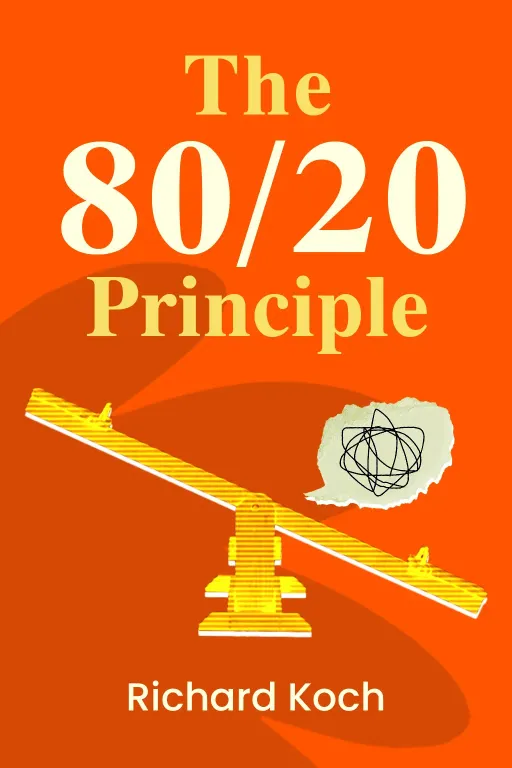
Socrates: Frank, as a startup founder, you live and die by efficiency. But what if I told you that 80% of your company's profits are likely coming from just 20% of your customers? And that, even more shockingly, 20% of your customers might actually be you money? This isn't just a catchy phrase; it's a fundamental law of the universe, and most businesses get it dead wrong. This is the world of Richard Koch's 'The 80/20 Principle'.
Frank Wu: It’s a terrifying and exhilarating thought. You know, it’s the kind of imbalance you feel intuitively, but you're often too busy putting out fires to actually measure it.
Socrates: Exactly. And Koch’s book is the fire extinguisher and the blueprint all in one. He argues that the universe is predictably unbalanced, and our job is to find out how the dice are loaded and use it to our advantage.
Frank Wu: I love that. It's the very premise we're building on at Aibrary—that learning and growth can be exponentially more effective if we can just filter for that vital 20% of ideas.
Socrates: Precisely. So today we'll dive deep into this from two powerful perspectives. First, we'll put on our CEO hat and use the 80/20 principle as an X-ray to find the hidden profit engine in any business. Then, we'll turn that lens inward, exploring how to hack our own personal operating system for success and happiness, guided by the surprising wisdom of being 'intelligent and lazy'.
Frank Wu: I'm ready. Let's load the dice.
Deep Dive into Core Topic 1: The 80/20 X-Ray
SECTION
Socrates: Perfect. So, Koch argues that most business strategies are flawed. They're too broad. He says strategy shouldn't be a grand 'overview,' but a detailed 'underview'—a peek beneath the covers to see what’s really going on. To illustrate this, he tells the story of a company he calls Electronic Instruments Inc.
Frank Wu: Okay, I’m listening.
Socrates: So, this company was like many others. They had sales figures, they knew their gross margins, and they thought they were doing okay. But they didn't have a clue about the net profitability of their different products. They just assumed more sales equals more profit.
Frank Wu: A classic, and often fatal, assumption.
Socrates: Right. So they undertook this painful but revealing analysis. They allocated every single overhead cost—sales effort, marketing spend, administrative time—to each product group. And the results were staggering. They found that three product groups, let's call them A, B, and C, accounted for only 20% of their total sales, but a whopping 53% of their profits.
Frank Wu: The vital few.
Socrates: The vital few. But here's the kicker. They also found two product groups, G and H, that were making massive losses. They were pouring resources into products that were actively draining the company's lifeblood.
Frank Wu: Wow. So they were essentially using the profits from their best products to subsidize their worst ones.
Socrates: Precisely. And it got even more interesting when they applied the same logic to their customers. They discovered that their most profitable customers were small, direct accounts that were easy to service. Their profitable customers, who were actually losing them money, were the huge, prestigious manufacturing clients who demanded tons of technical support and special treatment.
Frank Wu: That is so painfully relatable. It's a gut-wrenching process, but the clarity it provides is incredible. It’s the business equivalent of turning on the lights in a messy room.
Socrates: So what does this look like in your world, Frank? In the world of software and AI?
Frank Wu: Oh, it's everywhere. In the SaaS world, this is our obsession with cohort analysis and LTV-to-CAC ratios—that's Lifetime Value to Customer Acquisition Cost. We might have 100,000 free users, which looks great on a slide deck, but if the 2,000 paying 'power users' are our 'Product Group A', then that's where our real value is. They generate 80% of the revenue, and just as importantly, they provide the most valuable feedback.
Socrates: So the 'trivial many', the 80% of other users, aren't just less profitable, they can actively distract you from your core mission?
Frank Wu: Exactly. They pull your support team into low-value tasks, they request features that don't align with your core vision. Koch's suggestion to 'fire' an unprofitable customer sounds brutal, but in our world, it might mean sunsetting a free plan or not building a niche feature for a loud minority. It's really about freeing up your best resources—your engineers, your designers—to better serve your customers. It’s not just about profit; it’s about maintaining your strategic direction.
Socrates: You're protecting the 20% that defines your future.
Frank Wu: You have to. That 20% is your company.
Deep Dive into Core Topic 2: The 'Intelligent and Lazy' Revolution
SECTION
Socrates: And freeing up resources is the perfect segue. Because the 80/20 principle isn't just for companies; it's for the people running them. Koch challenges the entire 'hustle' culture with a fascinating and provocative model he borrows from a German general, Von Manstein. Are you ready for this?
Frank Wu: I'm intrigued. A German general's advice on productivity? Let's hear it.
Socrates: Von Manstein categorized his officers on two axes: intelligence and industriousness. This created a 2x2 matrix. First, you have the lazy and stupid. He said, "Leave them alone, they do no harm."
Frank Wu: Okay, I can see that. Benign neglect.
Socrates: Then, the hard-working and stupid. He called them a menace. They must be fired at once because they create irrelevant work for everybody.
Frank Wu: We've all worked with that person. They make everyone busy, but nothing important gets done.
Socrates: Third, the hard-working and intelligent. He said they make excellent staff officers, the perfect chief of staff. They ensure every detail is properly considered and executed flawlessly.
Frank Wu: The reliable engine room of any organization.
Socrates: But they weren't his pick for the top job. For the highest command, he wanted the fourth type: the intelligent and lazy. These are the people, he argued, who have the mental clarity to focus only on what is absolutely essential, and the inherent laziness to delegate, automate, or ignore everything else.
Frank Wu: I love that. It is so profoundly counter-cultural, especially in the startup world. Silicon Valley's entire mythology is built on the 'hard-working and intelligent' archetype. It's the baseline expectation. But Von Manstein is saying that's the recipe for great middle management, not visionary leadership.
Socrates: So the CEO's job isn't to do more, but to do less, but better?
Frank Wu: Exactly. The CEO's job is to be 'intelligent and lazy'. It’s to identify the one or two critical, needle-moving priorities for that quarter and then empower the team to execute, getting out of their way. It's about strategic as much as it is about action. It's knowing what not to do.
Socrates: That's a powerful reframe. So how does one cultivate this 'intelligent laziness'? It doesn't sound like something you can just decide to be.
Frank Wu: I think it's about building systems. It's the reason we build software. It's the core philosophy behind why I'm building Aibrary. The goal of our Agentic AI is to perform the 80% of grunt work in learning—finding the right book, reading the whole thing, extracting key ideas, connecting them to your goals. We do that so the user can be 'intelligently lazy' and just spend their time engaging with the core 20% of insights that will actually change their life. We're trying to build a tool that enables 'intelligent laziness' for personal growth.
Socrates: You're building a Von Manstein machine for the mind.
Frank Wu: I've never put it that way, but yes! And you know, on a personal level, as a dad to a three-year-old, you learn this lesson fast. You simply can't be present and perfect for every single moment. You'd burn out. You have to become 'intelligently lazy'. You have to trust that focusing your energy on the 20% of moments that truly matter—the bedtime stories, the weekend adventures, the deep conversations—is what builds 80% of the bond. You can't optimize everything. You have to choose.
Synthesis & Takeaways
SECTION
Socrates: That brings it all together so beautifully. We have these two powerful applications of one single principle. First, a ruthless, analytical X-ray for your business to focus on the vital few products and customers. And second, a personal philosophy of 'intelligent laziness' to focus your own precious energy on what truly creates success and happiness.
Frank Wu: They're absolutely two sides of the same coin. You simplify the business to free up organizational resources, and you simplify your own focus to deploy your personal resources with maximum impact. It’s a complete operating system for effectiveness.
Socrates: A perfect summary. So, for everyone listening, and for you, Frank, here's the challenge that Richard Koch leaves us with. It's a simple exercise in 80/20 thinking. What is the one 20% activity in your work this week that you know will generate 80% of the results?
Frank Wu: Hmm. That's a great question. It forces you to be honest with yourself.
Socrates: And the second part is just as important. What is the one 80% activity—that time-consuming, low-impact task—that you can consciously decide to stop doing, to delegate, or to just let go of, even if it feels uncomfortable?
Frank Wu: That's the real challenge. Letting go. But it's where the freedom is. It’s about choosing your 20%, and in doing so, choosing your future.
Socrates: Choosing your future. I can't think of a better place to end. Frank, thank you.
Frank Wu: This was fantastic. Thank you.