

The PM's Playbook: Decoding Team Dynamics with 'Surrounded by Idiots'
Golden Hook & Introduction
SECTION
Socrates: Imagine this. You're in your mid-twenties, you're a consultant, and you're interviewing the founder of a company, a man named Sture. One of the first things he tells you is, "My problem is... I'm surrounded by idiots." He claims the sales team are fools, the finance department are morons, and the people on the factory floor are completely useless. He even has a warning light installed at the entrance so people know when he's in a bad mood and can avoid him. After an hour of this, you finally ask the one question that seems obvious: "Who hired all these idiots?"
Wilson : Oh, I can only imagine how that went over.
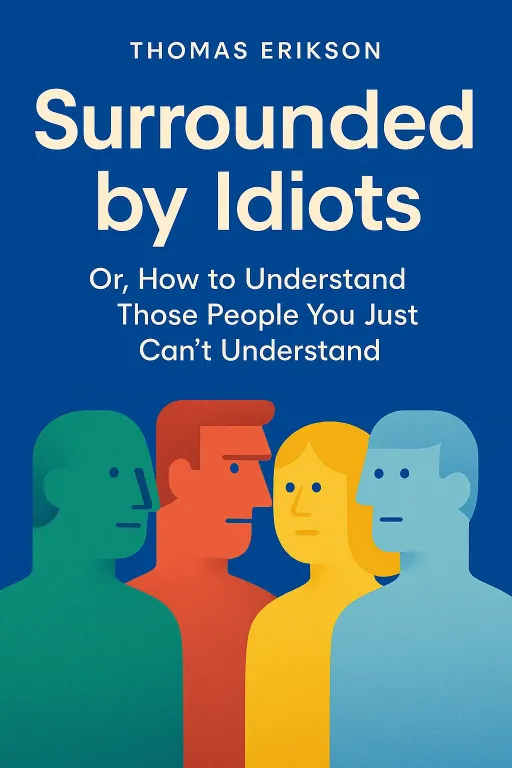
Socrates: He threw him out of the office! That real-life encounter is the spark for the book we're exploring today, Thomas Erikson's "Surrounded by Idiots." And it raises a powerful question for anyone who leads a team: are they really idiots, or are we just speaking different languages? Wilson, as a project manager in tech, does that feeling of being 'surrounded by idiots' ever resonate?
Wilson : It's a bit more nuanced, but the feeling of total miscommunication? Absolutely. You're in a sprint planning meeting, and it feels like the stakeholder, the designer, and the lead engineer are all operating in different universes. You're the translator in the middle, and sometimes you feel like you're the only one with the full dictionary.
Socrates: Exactly. And that's our goal today. The book suggests we're not dealing with idiots, but with different behavioral 'operating systems.' Today we'll dive deep into this from two perspectives. First, we'll explore the four fundamental 'personality colors' and what makes each one tick. Then, we'll zero in on the most challenging pairings and discuss the power of adaptation to turn potential conflict into a team's greatest strength.
Deep Dive into Core Topic 1: The Four 'Operating Systems' of Your Team
SECTION
Socrates: So, let's open the user manual. Erikson simplifies behavior into four colors. First up, the Reds. These are the alphas. They're dominant, ambitious, task-oriented, and they move fast. The book tells this great story about a Red CEO who plays in the company's annual soccer tournament. He's so competitive he flattens anyone who gets in his way. When someone finally confronts him, he's genuinely confused. He says, "It's a tournament. Tournaments are competitions, and if you compete, you are in it to win. Simple!"
Wilson : That is painfully familiar. That's the stakeholder who sees the launch date not as a team goal, but as a personal challenge to be conquered. They're not trying to be difficult; their entire operating system is geared towards winning and forward momentum. Any discussion about delays or technical debt is perceived as weakness or an obstacle to their goal. It's not personal, it's just... their programming.
Socrates: Precisely. Now, let's meet their polar opposite in many ways: the Yellows. They are the optimists, the social butterflies, the creative visionaries. They're relationship-focused and full of energy. The author tells a story about his friend Micke, a classic Yellow. Micke has had a tough life—divorce, job losses, car accidents. One day, he crashes his old car into a lamppost. The author calls, worried, and Micke just cheerfully says, "It was fine! I just got out the other door!" He's unshakable.
Wilson : That's our UX/UI designer. The one who comes into a meeting, full of passion, and says "I had this amazing idea in the shower! We need to rebuild the entire user flow! It'll be incredible!" They bring the energy and the vision that's essential for innovation. But they're not always thinking about the backend implications or the QA timeline. Their value is in the spark, the possibility.
Socrates: A perfect contrast to our next color: the Blues. Blues are the analysts, the perfectionists. They are cautious, detail-oriented, and value accuracy above all else. The book gives this incredible example of a consultant trying to sell a leadership program to a Blue CEO. The consultant submits a 35-page proposal. The CEO says, "I need more material." The consultant comes back with an 85-page version. The CEO says, "Still not enough." Finally, the consultant just gives him the entire 300-page training manual. The CEO reads it, looks up, and asks... "Is there any more material?" For him, the process of analysis was more important than the decision.
Wilson : You've just described every senior backend engineer I've ever worked with. And I say that with the utmost respect. They are the quality gate. They are the ones who prevent us from shipping a buggy product because the 'Yellow' designer had a cool idea. Their obsession with details, with 'why,' with process—it's not to slow things down. It's to ensure the foundation is solid. They're building a skyscraper, and they need to be sure the rebar is perfect before they pour the concrete.
Socrates: A fantastic metaphor. And that leaves the final color, the Greens. They are the most common type. They are the stabilizers, the team players. They're calm, reliable, supportive, and deeply conflict-averse. They are incredible listeners. The book tells a story about Maja, a Green consultant who was so helpful, she'd say yes to everything—helping colleagues, covering reception, remembering birthdays—often to the point of being overloaded herself. She prioritized the group's harmony over her own needs.
Wilson : As an ISFJ, the book's description of Green felt like reading my own diary. The biggest misconception is that because we're quiet and agreeable, we don't have strong opinions. We do. We just run a constant, subconscious calculation: "Is sharing my opinion worth the potential disruption to the group's harmony?" As a PM, that's both a strength and a weakness. It makes me a good mediator, but I have to consciously push myself to raise red flags, because my instinct is to keep the peace.
Deep Dive into Core Topic 2: When Systems Crash
SECTION
Socrates: And that is the perfect transition. Because we have these four distinct types, but the real test for a project manager, for any leader, is when they collide. The book highlights two particularly volatile pairings. Let's start with the one you just touched on: Red versus Green.
Wilson : The immovable object and the unstoppable force.
Socrates: Exactly. The Red wants to move fast, break things, and make decisions now. The Green wants stability, predictability, and to make sure everyone feels heard. The Red sees the Green as slow and indecisive. The Green sees the Red as a reckless, tyrannical bulldozer. The book says giving negative feedback to a Red requires a "Kevlar vest and fire-resistant hair." So, as a Green, how do you tell a Red leader that their pet project is behind schedule?
Wilson : You absolutely cannot frame it as a problem with their idea or a failure of the team. That's a direct challenge, and a Red will meet that with force. You have to frame it in their language: the language of the goal. You say, "I am 100% committed to hitting our target. To ensure we win, I've identified a critical risk that could cause us to lose. Here's my plan to mitigate it, but I need your decision on this trade-off." You make it about protecting the goal, not about complaining. You're not an obstacle; you're their most strategic soldier.
Socrates: That's a brilliant adaptation. You're speaking Red. Now, what about the other classic clash: Yellow versus Blue? The visionary versus the analyst. The Yellow says, "Let's launch this amazing new feature!" and the Blue responds, "But the API documentation isn't complete and we haven't tested it on these 47 edge cases." The book describes a team like this where they end up working in separate, resentful silos. As the PM, you're the bridge. How do you stop that from happening?
Wilson : You have to give both of them what they need. You create a process that honors both styles. For the Yellow, you hold an exciting, high-energy kickoff and brainstorming session. You let them dream big and get everyone inspired. But—and this is for the Blue—that session has a structured output. The ideas are captured, prioritized, and put into a clear requirements document. You tell the Blue, "Your job is to be the 'Chief Reality Officer.' Poke holes in this. Find the risks." You give the Yellow a stage for their creativity and you give the Blue a mandate for their critical analysis. You make them allies in creating a better product, not adversaries.
Socrates: So you're not just managing a project; you're architecting a conversation between two different operating systems.
Wilson : That's the job. It's human-centered design, but for your own team.
Synthesis & Takeaways
SECTION
Socrates: This is the core insight of the book, isn't it? It's not about putting people in boxes and saying, "You're a Blue, so you're stuck." It's about understanding your own default settings and the default settings of others, so you can consciously choose to adapt.
Wilson : Exactly. It's empathy as a strategic tool. The moment you stop seeing someone as 'difficult' and start seeing them as 'Blue,' your entire approach changes. You're no longer frustrated; you're problem-solving. You're asking, "What does this person need to hear from me to feel understood and be effective?"
Socrates: The book offers a simple, powerful piece of advice for when you're in a new situation and unsure of the 'color' of the person you're dealing with. It says: "Simply act Green if you are unsure." Listen more than you talk. Be supportive. Ask questions. Build consensus.
Wilson : I love that. As a 'Green' myself, it validates my natural style. But it also reframes it. My tendency to create psychological safety isn't just a 'nice-to-have' soft skill; in tech and innovation, it's the absolute foundation for creativity and risk-taking. So the takeaway for me is twofold. First, how can I use my natural Green style more intentionally as a leadership tool? And second, how can I get better at 'speaking' a little Red or a little Blue when the project demands it?
Socrates: A perfect summary. And that leaves us with a final question for our listeners. Think about your own team. Who is the one person you find most 'difficult' to communicate with? Now, based on what we've discussed, what color might they be? And what's one small way you could adapt your very next conversation with them to speak their language?









