The Subtraction Advantage: How Innovators Win by Taking Away
Golden Hook & Introduction
SECTION
Dr. Celeste Vega: chengzi353, have you ever looked at a product, a process, or even your own to-do list and thought, 'This has gotten way too complicated'?
chengzi353: All the time. It feels like the natural state of things is to move towards more complexity, not less. My calendar, my project plans... they always seem to expand.
Dr. Celeste Vega: Exactly. We instinctively try to fix things by adding more—more features, more steps, more tasks. But what if the most powerful move, the secret of innovators like Steve Jobs, isn't adding at all... but subtracting?
chengzi353: That’s a fascinating premise. The idea that improvement comes from removal.
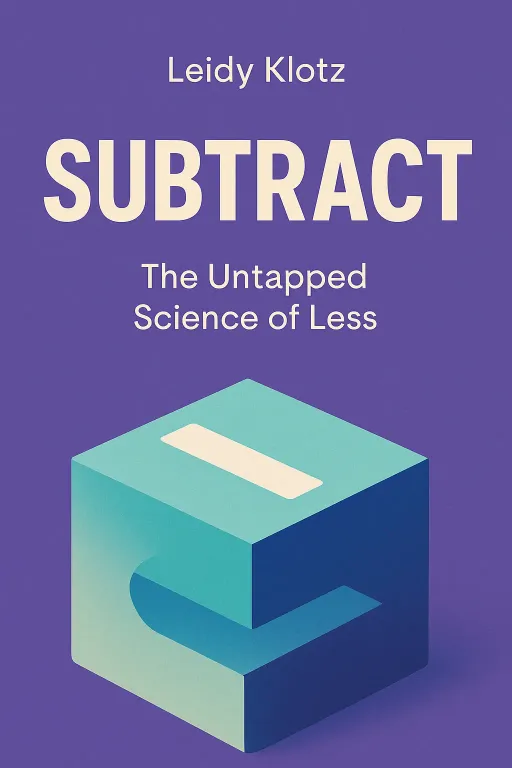
Dr. Celeste Vega: It's a game-changer. And that's what we're exploring today, through the lens of Leidy Klotz's brilliant book, "Subtract: The Untapped Science of Less." Today we'll dive deep into this from two perspectives. First, we'll uncover the fascinating science behind why our brains are hardwired to 'add' when faced with a problem.
chengzi353: And then, I'm guessing, we'll look at how to fight that instinct?
Dr. Celeste Vega: Precisely. Then, we'll explore how the most creative minds flip this script and use 'subtraction' as a secret weapon for innovation. This is a mental model upgrade I think you, and our listeners, will find incredibly useful.
Deep Dive into Core Topic 1: The Adding Instinct
SECTION
Dr. Celeste Vega: So let's start with that first idea: our instinct to add. Leidy Klotz, the author, has this fantastic story about his son, Ezra, that perfectly captures it. Picture this: Klotz is in his living room, building a Lego bridge with his three-year-old. They've built two support towers, but one is taller than the other, so the bridge piece won't lie flat.
chengzi353: Okay, I can see it. A classic engineering problem.
Dr. Celeste Vega: Right. And Klotz, a professor of engineering, does what most of us would do. His hand automatically goes to the pile of extra Legos to find a block to add to the shorter tower to make it level. But just as he's reaching, his son Ezra, without a word, reaches over to the tower... and simply removes a block.
chengzi353: Ah! So simple. And faster. And it uses fewer resources.
Dr. Celeste Vega: Exactly! In that one moment, the toddler solved the problem more elegantly than the professor. It was this "aha" moment for Klotz that sparked the entire book. He realized we have this deep, often unconscious, bias to solve problems by adding, and we neglect the power of taking away.
chengzi353: That's such a perfect illustration. It makes me think of 'feature creep' in software and technology. The default is always to add another button, another menu, another notification to solve a user's problem. We rarely have meetings about what features we can to make the user experience cleaner and more intuitive.
Dr. Celeste Vega: You've nailed it. And the book shows this isn't just an anecdote. Klotz and his colleagues ran a series of brilliant experiments to prove it. In one, they gave participants a Lego structure that was unstable. It had a wide base, but a single, thin block supporting the top platform. They put a stormtrooper minifigure under it and told people they’d get a dollar if they could modify the structure to hold a heavy masonry brick without crushing the stormtrooper.
chengzi353: And what was the catch?
Dr. Celeste Vega: The catch was that every Lego block they cost them ten cents. But removing a block was free. The best solution, by far, was to simply remove that one wobbly block and place the top platform directly on the sturdy base.
chengzi353: So what did people do?
Dr. Celeste Vega: The vast majority started adding blocks! They built buttresses and supports, spending their money, making the structure more complicated. Only a small fraction saw the subtractive solution. But here's the kicker: in a second version of the experiment, they added a simple cue. They told participants, "Keep in mind, you can add pieces, but you can also take them away, and taking them away is free."
chengzi353: And that little reminder was enough?
Dr. Celeste Vega: It made a huge difference! The number of people who chose to subtract shot up. It proves that it's a cognitive blind spot. We don't even subtraction as an option unless we're prompted. As a leader, that 'prompt' is everything. It's about creating a culture where simplifying is as celebrated as building something new.
chengzi353: It also connects so strongly to personal habits. We're always looking for the next productivity app, the next workout routine to add to our day. But we rarely ask, "What meeting can I decline? What subscription can I cancel? What task can I just... stop doing?" We're trying to add our way to a simpler life, which is a paradox.
Dr. Celeste Vega: A paradox we're all living in. And that's the perfect transition to our next point.
Deep Dive into Core Topic 2: The Subtraction Advantage
SECTION
Dr. Celeste Vega: You've hit on it, chengzi353. If our default is to add, how do we consciously shift to this 'subtraction advantage'? The book is full of inspiring examples of how this creates real innovation. Let's talk about bikes. For decades, how did we teach kids to ride?
chengzi353: With training wheels. You add two extra wheels to the bike.
Dr. Celeste Vega: A classic solution. It adds stability, but it doesn't actually teach the core skill of riding, which is balance. In fact, it teaches bad habits, like leaning the wrong way in a turn. Then along comes an inventor named Ryan McFarland. He looked at his own toddler struggling and asked a different question. Not "What can I add to a bike?" but "What is the essential skill, and what can I remove to teach it?"
chengzi353: He focused on balance.
Dr. Celeste Vega: Exactly. So he took a small bike and subtracted everything non-essential to balance. He removed the pedals, the chain, the cranks—the entire drivetrain. He created the Strider bike, or what we now call a balance bike. Kids just sit on it and push with their feet, instinctively learning to balance and glide.
chengzi353: And they learn to ride a real bike much faster afterward, because they've already mastered the hardest part. That's brilliant. McFarland didn't just make a simpler bike; he redefined the problem. He subtracted the 'bike' part to get to the 'balance' part.
Dr. Celeste Vega: Yes! And that’s the essence of subtractive innovation.
chengzi353: This is a huge lesson for anyone in a creative or leadership role. It’s not about incremental additions, but about questioning the fundamental components of a problem. It's what Steve Jobs was famous for, right? He was a master subtractor. He removed the physical keyboard from the phone to create the iPhone. He removed the floppy drive from the iMac. He insisted on a mouse with only one button. His genius was often in his courage to take things away.
Dr. Celeste Vega: Precisely! And it's not just in tech. The book talks about Bruce Springsteen while he was making his iconic album 'Darkness on the Edge of Town.' He was in a creative frenzy, and he recorded over fifty songs. But he knew the album needed a specific, gritty, focused feel. So he started subtracting.
chengzi353: He didn't use them all?
Dr. Celeste Vega: Far from it. He subtracted them down to just ten. He gave away songs that became hits for other artists. He stripped down the instrumentals. He omitted needless words from his lyrics. He carved and carved until he was left with this incredibly powerful, focused work of art. He made 'Darkness' visible by subtracting everything that wasn't darkness.
chengzi353: That speaks to the discipline of creativity. It's not just about the explosion of generating ideas, but the quiet, careful work of curating and culling them. The wisdom is in what you leave out. And it takes real self-confidence to present something simpler, because our culture, as the book points out, often equates 'more' with 'more effort' or 'more value'. A leader who cuts a project or simplifies a strategy might be seen as doing less, when in fact they've done the harder, more valuable work.
Dr. Celeste Vega: That is so well put. It’s the courage to believe that less can be more.
Synthesis & Takeaways
SECTION
Dr. Celeste Vega: So we have these two powerful, connected ideas. A natural, almost invisible, bias towards adding that clutters up our lives and our work. And a counterintuitive, but immense, creative power in deliberate subtraction.
chengzi353: It's a complete mindset shift. It’s moving from asking 'What can I build?' to 'What can I carve away to reveal the masterpiece?' And that question applies everywhere, whether you're leading a team, designing a product, or just trying to manage your own life.
Dr. Celeste Vega: And for anyone listening who feels inspired by this, the book gives us a wonderfully practical tool to start. It's not a to-do list. It's a 'stop-doing list.'
chengzi353: A subtractive to-do list. I love that. It’s an active process of pruning.
Dr. Celeste Vega: It is. You simply ask: what are the tasks, the meetings, the habits, the subscriptions that are no longer adding real value? What's just clutter?
chengzi353: It’s a powerful exercise. So, for everyone listening, here's the challenge: This week, don't add a new goal. Instead, identify just one thing you can to free up space for what truly matters. It's a small act of subtraction that can lead to a big addition of clarity and focus.
Dr. Celeste Vega: A perfect way to start practicing the subtraction advantage. chengzi353, thank you for adding so much insight to this conversation.
chengzi353: Thank you, Celeste. It was a pleasure to subtract some complexity from the world with you today.