Personalized Podcast
Golden Hook & Introduction
SECTION
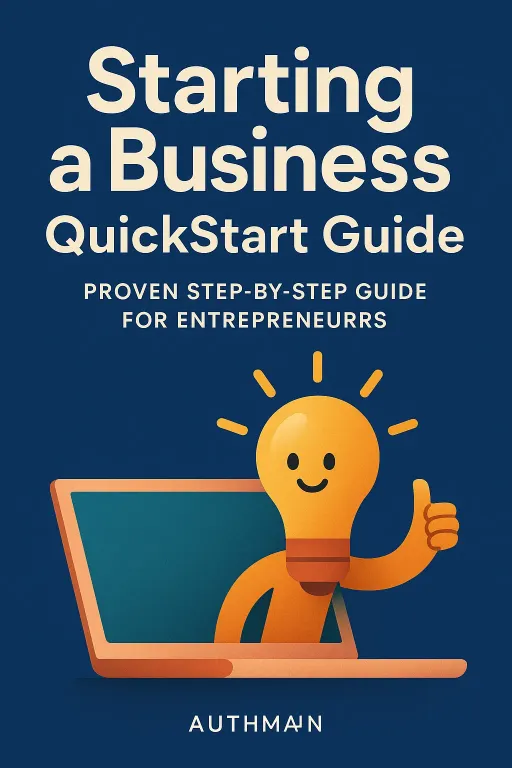
Orion: Why do some brilliant business ideas crash and burn within months, while seemingly simple concepts turn into thriving global empires? The secret isn't luck, and it certainly isn't just hard work. It's the transition from a raw idea to a cultivated opportunity. Welcome to the podcast. I'm Orion, and today we are dissecting Ken Colwell's masterwork, the Starting a Business QuickStart Guide. Joining me is Precious, an analytical powerhouse, retail e-commerce founder, and sales manager. Today, we are going to tackle this book from three different angles. First, we'll look at how to uncover your unique entrepreneurial thumbprint. Second, we'll map out the operational value chain and the power of strategic outsourcing. And finally, we'll reveal why a business plan is actually a living, breathing tool for survival, not just a piece of paper. Precious, it is fantastic to have you here.
Precious: Thanks, Orion. It is great to be here. You know, as an INTJ, I tend to view the business world as a giant, interconnected system. When I read Colwell's guide, what really resonated with me was this emphasis on systematic, strategic thinking. It's not about the hype or the hustle. It's about building a structured, repeatable engine that delivers real value.
Orion: Exactly. Order and logic are the foundations of any successful venture. Let's start right there, with the very first step of the journey: the spark.
Deep Dive into Core Topic 1
SECTION
Orion: In Chapter One, Colwell makes a very sharp distinction that I think many aspiring entrepreneurs miss. He distinguishes between an idea and an opportunity. He writes that ideas are cheap. They are essentially just electrochemical reactions in the brain. They have no inherent value. An opportunity, on the other hand, is actionable. It has the potential to provide real, sustainable value to both the customer and the entrepreneur. The difference, quite simply, lies in execution.
Precious: That is a crucial point, Orion. In my work with HOG Exotic Caps and Forge Global Network, I see so many young leaders fall in love with their ideas. They treat their idea like a precious heirloom that they have to protect and hide. But an idea is just a hypothesis. Until you test it against the harsh realities of the market, you don't have a business. You just have a daydream.
Orion: To illustrate this, Colwell shares a couple of fantastic case studies. Let's look at the failure of the ESPN Phone in 2005. ESPN wanted to capitalize on its massive brand recognition. They developed a branded mobile phone that delivered up-to-the-minute sports alerts. It sounds like a cool idea, right? But they completely failed to provide tangible benefits that justified the high price tag, the restrictive contract terms, and the mediocre hardware. Meanwhile, users could still get sports news through other carriers. It was a classic case of an overzealous feature set without a real, underlying customer problem being solved. They shut it down after just nine months.
Precious: Yes, it was a classic solution in search of a problem. They assumed that brand loyalty would blind consumers to a poor value proposition. Now, contrast that with Judi Sheppard Missett and the creation of Jazzercise in 1969. Judi was teaching traditional dance classes in Chicago and noticed a massive dropout rate. She talked to her students and realized they didn't want to become professional dancers. They just wanted to have fun and get fit. So, she stripped away the intense technical training, cranked up the music, and focused entirely on fun fitness. She solved a very specific, real-world pain point. That is how a simple observation became a global fitness phenomenon.
Orion: That is the essence of what Colwell calls cultivating an opportunity. It is not a passive process. You don't just sit around waiting for a lightning bolt of inspiration. You actively shape it using what he calls your entrepreneurial thumbprint. This is your unique blend of background, talent, insight, and perspective. Precious, how did your own thumbprint shape the launch of HOG Exotic Caps?
Precious: Well, Orion, my background is in retail sales management, and I have a deep passion for self-expression and style. When I looked at the headwear market, I saw plenty of generic caps, but very little that spoke to people who wanted something truly unique, bold, and premium. My thumbprint—combining my sales experience, my understanding of e-commerce, and my personal aesthetic—allowed me to see a gap in the market. I didn't just say, I want to sell hats. I said, I want to solve the problem of mundane headwear by creating a curated, exotic collection that empowers people to stand out. That is a cultivated opportunity.
Orion: It is a highly structured approach to a market gap. You identified a strategic space that wasn't too crowded and executed with a clear competitive advantage. Colwell defines competitive advantage as the sum of conditions that put your business in a superior position over rivals. It must be valuable, rare, hard to imitate, and hard to substitute. For a startup, that agility and specialized knowledge are your best weapons.
Precious: Absolutely. And once you have identified that competitive advantage, you have to build the operational engine to deliver it. That brings us to the practical mechanics of running the business.
Deep Dive into Core Topic 2
SECTION
Orion: Yes, let's move into Chapter Nine, which focuses on operations. Colwell defines operations as everything a business does daily to deliver value to its customers. And the framework he uses to analyze this is the Value Chain. Think of the value chain as the physical and digital journey that raw inputs take to become a finished product that a customer is eager to buy. Every single step in that chain must add value. If an activity doesn't add value, it is simply a cost that drains your profit margin.
Precious: This is where my analytical mind really kicks into high gear. In retail e-commerce, your value chain is your lifeblood. You have primary activities, like sourcing your raw materials, manufacturing, warehousing, marketing, and customer service. Then you have support activities, like your technology platform, your legal structure, and procurement. The magic happens when you analyze the linkages between these activities to find efficiencies.
Orion: Colwell introduces a brilliant tool for this called the Outsourcing Decision Matrix. It helps you decide what to keep in-house and what to outsource based on two variables: how critical the activity is to your competitive advantage, and its operational impact. For example, look at payroll processing. It is a high-impact activity because if your employees don't get paid, operations grind to a halt. But is it critical to your unique competitive advantage? No. A customer doesn't buy your products because you have an amazing in-house payroll system. Therefore, payroll is a prime candidate for outsourcing to a specialized firm. It is cheaper, easier, and frees up your time.
Precious: Exactly. For HOG Exotic Caps, our distinctive competency is brand design, curation, and customer relationship management. That is what makes us unique. We keep that strictly in-house. But manufacturing the caps, or using a third-party logistics provider for warehousing and shipping? Those are activities we can outsource to world-class partners. It allows us to stay incredibly lean. We don't have to own massive factories or warehouses. We convert what would be high fixed costs into variable costs.
Orion: That is a highly sophisticated operational strategy. It directly addresses one of the biggest risks startups face, which Colwell warns against: the danger of premature expansion. He tells a cautionary story about entrepreneurs who get a little bit of initial success and immediately rush out to rent a fancy office space and hire a bunch of full-time staff. They dramatically spike their fixed costs. But if sales slow down even slightly, they suddenly find themselves with a massive burn rate and a rapidly shrinking runway.
Precious: It is a fatal mistake, Orion. I always tell the young entrepreneurs I mentor through Forge Global Network that you must protect your runway at all costs. Runway is the amount of time your business can survive before your cash reserves run out. By staying lean and utilizing strategic outsourcing, you maintain the flexibility to pivot when the market changes. If you are locked into a five-year commercial lease and a massive payroll, you are essentially steering a container ship. If you are lean, you are a speedboat. You can turn on a dime.
Orion: Speed and agility are the ultimate advantages of a startup. But to navigate that speedboat, you need a map. You need a way to measure your progress and anticipate obstacles. And that brings us to the highly debated question: do you actually need a business plan?
Deep Dive into Core Topic 3
SECTION
Orion: In Chapter Fourteen, Colwell tackles this head-on. Many modern startup gurus claim that the traditional business plan is dead. They say the world moves too fast, and a plan is obsolete the moment it is printed. But Colwell argues that this is a dangerous misconception. He writes that the value of a business plan isn't actually the final document itself. The real value is the process of writing it. It is a tool for discovery, communication, and measurement.
Precious: I couldn't agree more. As an INTJ, I love planning, but I view a business plan as a living, breathing document, not something carved in stone. The process of writing a plan forces you to confront your assumptions. It forces you to move away from what Colwell calls WAGs—wild-ass guesses—and move toward data-driven projections. It is a feasibility test. If your business model doesn't work on paper, where the stakes are low, it certainly won't work in the real world where you are burning real cash.
Orion: Let's look at the story of Sarah, an entrepreneur who launched a mobile coffee cart in Austin, Texas, back in 2018. Sarah had years of experience in the coffee industry, so she assumed she knew everything she needed to know. She skipped the business planning process entirely. She bought a cart, secured a coffee supplier, and set up shop downtown. But almost immediately, she was hit with a barrage of surprise costs. Her coffee bean vendor had hidden fees she hadn't negotiated. The prime rental locations she wanted were either completely unavailable due to local zoning laws or cost three times what she expected. And because she hadn't mapped out a detailed marketing plan, she struggled to attract daily customers. She spent her first six months constantly fighting fires and bleeding money, simply because she hadn't done the upfront strategic planning.
Precious: That story is so common, Orion. A comprehensive business plan would have forced Sarah to research those zoning laws, analyze vendor contracts, and calculate her exact break-even point before spending a single dollar. It is about risk management. In my businesses, I always run a sensitivity analysis as part of our financial planning. You have to ask: what happens to our cash flow if our sales are thirty percent lower than projected? What happens if our supply chain costs increase by fifteen percent? If you haven't modeled those scenarios, you are playing checkers, not chess.
Orion: Playing chess, not checkers. I love that metaphor. It is about thinking several moves ahead. And a key part of that strategic depth is building the right team to execute the plan. Colwell notes that in the venture capital world, there is a famous saying: I would rather invest in an A team with a B idea than a B team with an A idea. Why do you think investors are so obsessed with the team over the product, Precious?
Precious: Because a great team can pivot. If the market rejects the initial product, a highly capable, cohesive team will analyze the feedback, adapt, and find a new way to deliver value. But a weak team will fail to execute even the most brilliant idea. When you are building a founding team, you need complementary skills. If you are the visionary, you need a technical lead who can build the product, and a sales expert who can drive revenue. You also need to formalize your agreements early on. You have to discuss the tough questions: how is equity distributed? What happens if a co-founder decides to leave after a year? If you don't put those structures in place when everyone is happy, it will tear the company apart when things get stressful.
Orion: Order, structure, and clear agreements. They prevent emotional chaos and keep everyone aligned on the same SMART goals—specific, measurable, achievable, relevant, and time-bound. When your team is aligned, and your operations are optimized, you are finally ready to introduce your venture to the world.
Synthesis & Takeaways
SECTION
Orion: We have covered a massive amount of ground today, Precious. From the initial spark of cultivating an opportunity, to mapping out a lean operational value chain, to using a business plan as a dynamic roadmap for survival. If you had to distill Colwell's guide into a single, core philosophy for our listeners, what would it be?
Precious: I would say it is this: entrepreneurship is the ultimate creative act, but it must be grounded in rigorous, logical execution. Passion and vision are the fuel, but strategy, structure, and adaptability are the steering wheel. You must understand your unique entrepreneurial thumbprint, build a lean value chain that protects your runway, and treat your business plan as a living guide that evolves with the market.
Orion: Beautifully put. For our listeners today, here is your actionable takeaway: sit down this week and write out your entrepreneurial thumbprint. Ask yourself: what is your unique blend of skills, connections, and industry insights? And most importantly, what is the specific, real-world customer problem you are uniquely positioned to solve? Don't just chase a cool idea. Cultivate a true opportunity. Precious, thank you so much for sharing your incredible insights with us today.
Precious: It was an absolute pleasure, Orion. To all the aspiring entrepreneurs and young leaders out there: keep analyzing, keep planning, and remember to play chess, not checkers.
Orion: And that is our show for today. Stay structured, stay analytical, and we will see you next time.