The Echo of Injustice: How Social Movements Forge Change
Golden Hook & Introduction
SECTION
Nova: What if I told you that many of the glaring social inequalities we see today, the ones we often blame on individual prejudice or simply 'how things are,' were actually designed? Not just allowed to happen, but meticulously engineered by the very governments sworn to protect us all.
Atlas: Whoa, "designed"? That’s a strong word, Nova. It sounds almost conspiratorial. I imagine a lot of our listeners, myself included, think of segregation or systemic disadvantages as organic, or at least unintended consequences. What do you mean by designed?
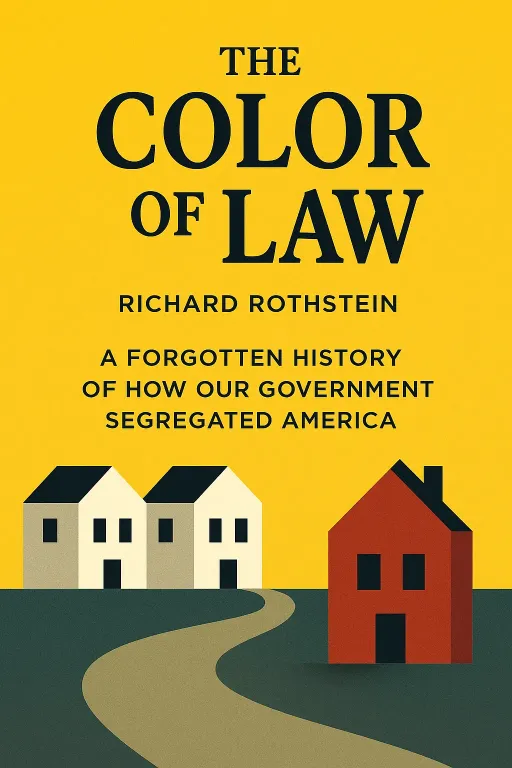
Nova: I mean deliberately, Atlas. We're talking about a historical blind spot that has kept us from truly addressing the root causes of injustice. Today, we're diving into two groundbreaking books that pull back the curtain on this uncomfortable truth: Richard Rothstein's "The Color of Law" and Ibram X. Kendi's "Stamped from the Beginning." Rothstein, a distinguished fellow at the Economic Policy Institute, spent years meticulously researching government archives to compile irrefutable evidence. His work directly challenged decades of legal precedent and popular belief by proving that residential segregation was a result of explicit state action.
Atlas: So, it wasn't just people choosing to live apart, or some nebulous economic forces? It was the government? That really shifts the perspective, especially for anyone trying to understand the historical roots of current disparities. How does that change our starting point for understanding social issues?
Nova: Exactly. It forces us to confront this foundational truth. And that’s where we start our journey today, unraveling the actual blueprints of inequality.
The Architecture of Inequality: How Government Policy Built Segregation
SECTION
Nova: Richard Rothstein’s "The Color of Law" isn't just a book; it’s a meticulously documented indictment of federal, state, and local governments for creating and enforcing racial segregation. He shows us, with overwhelming evidence, that the residential landscape of America wasn't an accident. It was a conscious construction.
Atlas: Hold on, I thought the common narrative was "de facto" segregation – that it just kind of happened, maybe people preferred to live with their own kind, or economic factors led to it. Are you saying that's wrong?
Nova: Absolutely. Rothstein meticulously dismantles that myth. He demonstrates that "de facto" segregation is a polite fiction. What we had was "de jure" segregation—segregation by law and government policy. Think about federal housing programs in the mid-20th century. The Federal Housing Administration, or FHA, explicitly refused to insure mortgages for Black families in white neighborhoods, or even for white families in neighborhoods near Black communities.
Atlas: So the government literally drew lines on maps, saying, "Black people can't get loans here, and white people can't get loans if they live too close to Black people"? That's incredibly direct.
Nova: It gets even more specific. One powerful example Rothstein details is the development of Levittown, the quintessential American suburb. The federal government underwrote the mortgages for these homes, but only on the condition that they were sold exclusively to white families. The contracts even included explicit clauses prohibiting resale to African Americans. This wasn't local prejudice; this was federal policy dictating racial exclusion.
Atlas: Wow. So the dream of homeownership, this cornerstone of American wealth-building, was explicitly withheld from an entire segment of the population, by design. That's not just unfair; it’s a direct wealth transfer away from Black families for generations.
Nova: Precisely. And it wasn't just about refusing loans. Government agencies actively promoted restrictive covenants, which were clauses in property deeds that legally barred non-white people from owning or occupying homes. Even when the Supreme Court ruled these covenants unenforceable in 1948, the FHA continued to encourage them for years afterward. Public housing projects were often deliberately placed to separate races or even used to demolish integrated communities to create segregated ones.
Atlas: That’s a staggering level of intentionality. For anyone who looks at societal problems analytically, this completely reframes the discussion. It means we're not just dealing with the lingering effects of old biases; we're dealing with the enduring legacy of deliberate, state-sanctioned injustice. It makes me wonder, how did they even justify such blatant discrimination? Did people just accept it?
Nova: That's an excellent leading question, Atlas, because it brings us to our second core idea. While "The Color of Law" reveals the of policy, Kendi's "Stamped from the Beginning" examines the —the intellectual scaffolding that supported and justified these very policies.
Ideas as Instruments: The Co-Evolution of Racist Thought and Discriminatory Policy
SECTION
Nova: Ibram X. Kendi, a leading historian of race, won the National Book Award for "Stamped from the Beginning" by offering a groundbreaking intellectual history. He argues that racist ideas are not the root cause of discrimination, but rather a of it. They are constructed and propagated to justify discriminatory policies, creating a sinister feedback loop.
Atlas: That’s a mind-bender. So, you're saying that racist policies came first, and then the ideas to explain and defend them followed? I always thought it was the other way around: racist ideas led to racist policies.
Nova: That's the common, comforting misconception. Kendi challenges that by showing how powerful interests, often economic or political, would implement discriminatory policies for their own benefit – say, slavery for economic gain. Then, to quell moral objections or justify the injustice, they would construct elaborate racist narratives and pseudoscientific theories about the inherent inferiority of the oppressed group.
Atlas: So, how exactly does an idea get "stamped" onto society to justify something like redlining, which we just talked about? Can you give an example of that feedback loop in action?
Nova: Absolutely. Think about the post-Civil War era. After slavery was abolished, new policies like Jim Crow laws emerged to maintain a racial hierarchy. To justify these laws, which legally stripped Black Americans of rights and opportunities, new racist ideas were heavily promoted. For instance, the idea that Black people were inherently lazy, unintelligent, or prone to criminality became widespread. These weren't just personal prejudices; they were ideas actively disseminated through media, education, and even scientific circles to rationalize the new social order.
Atlas: So, the ideas weren't just floating around, waiting to be picked up. They were actively to serve a political or economic purpose. That completely redefines how we understand the fight against racism. It’s not just about changing individual hearts and minds, but dismantling the structures and narratives that create and perpetuate those ideas in the first place.
Nova: Precisely. Kendi’s work shows that racist ideas are like intellectual weapons, deployed to protect discriminatory power. They allow society to blame the victims for their own oppression, obscuring the systemic forces at play. It's a powerful and disturbing insight because it means we can’t just educate our way out of racism if the underlying policies that create the need for justification remain.
Atlas: That’s a profound shift in perspective. For anyone driven by truth and justice, this means focusing on policy change and deconstructing these justifying narratives is as critical as confronting individual biases. It’s about understanding the entire ecosystem of injustice.
Synthesis & Takeaways
SECTION
Nova: So, by bringing together the insights from Rothstein and Kendi, we see a much clearer, albeit starker, picture. Systemic inequalities are not accidental. They are the deliberate, often meticulously crafted outcomes of policy—as Rothstein shows with housing segregation—and the ideas used to justify them, as Kendi meticulously documents.
Atlas: That fundamentally answers the deep question about how recognizing governmental origins shifts our perspective on social justice movements today. It moves the focus from individual bad actors or cultural prejudice to systemic design. It means movements need to be historians and analysts, not just activists.
Nova: Exactly. Understanding these policy roots empowers social justice movements to deconstruct systemic inequalities more effectively. It’s about targeting the laws, regulations, and institutional practices that create the disparities, and simultaneously challenging the racist ideas that are constructed to defend them. It’s a two-pronged attack on injustice.
Atlas: It makes me think that historical literacy becomes a form of activism. Knowing these systems were built is the first step to knowing how to dismantle them. It's a call to profound understanding for every citizen who cares about progress.
Nova: Indeed. This isn't just history; it's the blueprint for present-day inequities and the roadmap for meaningful change. It encourages us to look beyond surface-level explanations and demand accountability from the systems themselves.
Atlas: Powerful stuff. It definitely leaves me with a lot to reflect on.
Nova: And that’s the goal. This is Aibrary. Congratulations on your growth!