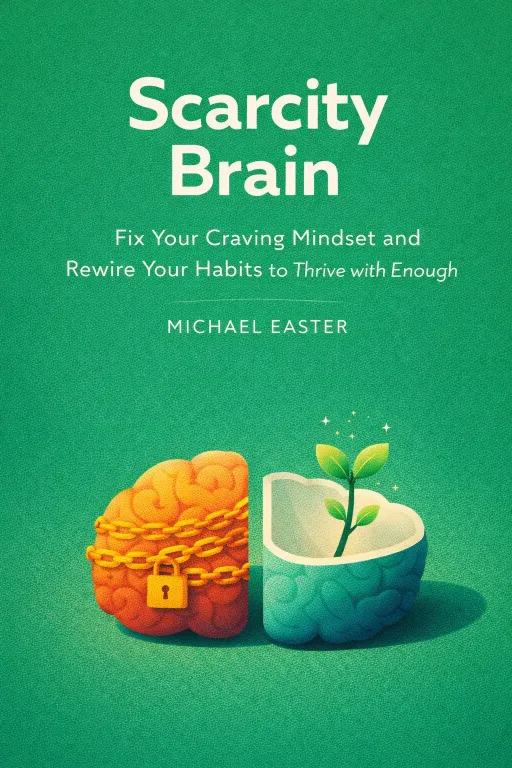
The Scarcity Brain
Introduction
Narrator: Imagine walking into a 7-Eleven in Las Vegas. Past the Slurpee machine and the hot dogs, a man sits transfixed before a glowing video poker screen. He’s so absorbed that he’s having a large pizza delivered directly to his slot machine stool. When asked if this is normal, the cashier shrugs, "Oh yeah. He's a regular." This scene, both absurd and strangely common, captures a profound question about modern life: Why do we get stuck in repetitive, often counterproductive, behaviors? Why do we compulsively check our phones, overspend on things we don't need, or binge-watch shows until 3 a.m.? The answer, according to science journalist Michael Easter in his book The Scarcity Loop, lies in a powerful, ancient survival mechanism that is now being systematically exploited.
The Anatomy of Addiction: Deconstructing the Scarcity Loop
Key Insight 1
Narrator: The foundation of many of our modern compulsions is a three-part behavioral engine Easter calls the "scarcity loop." This loop consists of opportunity, unpredictable rewards, and quick repeatability. Nowhere is this engine more perfectly engineered than in a modern slot machine. For decades, slots were seen as boring, mechanical contraptions. That changed in the 1980s thanks to a man named Si Redd. Redd, an entrepreneur, digitized the slot machine, transforming it from a simple game of chance into a psychological masterpiece.
He introduced multiple betting lines, so players felt like they were constantly on the verge of winning. He added flashing lights and celebratory sounds even for "losses disguised as wins"—payouts smaller than the original bet. Most importantly, he made the rewards completely unpredictable. This combination created a powerful feedback loop. The player has the constant opportunity to pull the lever, receives unpredictable rewards that trigger a dopamine rush, and can quickly repeat the action, all within seconds. This loop is so effective that slot machines now generate more revenue in the United States than movies, books, and music combined. The book argues that this isn't just about gambling; it's a blueprint for how to capture human attention.
The Scarcity Brain: An Evolutionary Mismatch
Key Insight 2
Narrator: The scarcity loop is so powerful because it taps directly into our "scarcity brain," an evolutionary inheritance from a time when resources were dangerously scarce. For our ancestors, survival depended on relentlessly seeking food, information, and status. This drive was fueled by the thrill of the unpredictable hunt.
Psychologist Thomas Zentall demonstrated this with a fascinating experiment on pigeons. He gave them two choices. The first was a "sure thing": peck a light and get a food pellet 50% of the time. The second was a "gamble": peck another light and get a larger reward, but only 20% of the time. Rationally, the first option was far better, providing more food over time. Yet, the pigeons overwhelmingly preferred the gamble. Zentall explains that the uncertainty of the reward was far more exciting to their brains. The dopamine system, which drives motivation, peaks not when we get a reward, but when the outcome is uncertain. Our brains evolved to find this uncertainty compelling because it kept our ancestors exploring and foraging. In today's world of abundance, this same wiring makes us vulnerable to the artificial, and often meaningless, uncertainty of slot machines, social media feeds, and online shopping deals.
The Loop Unleashed: How Modern Tech Hijacks Our Brains
Key Insight 3
Narrator: Once a mechanism confined to casinos, the scarcity loop is now embedded in nearly every corner of our digital lives. Companies have realized that this model is the key to engagement and profit. Social media is a perfect example: the opportunity to scroll is constant, the reward (a compelling post, a like, a message) is unpredictable, and the action is quickly repeatable.
This design is intentional. Dating apps like Tinder use the swipe-match mechanism to create an unpredictable reward game that hooks users on the possibility of connection. Gig work platforms like Uber use gamified cues and unpredictable surge pricing to nudge drivers to work longer hours, chasing the next fare. Shopping apps like Temu are engineered as a whirlwind of escalating offers, limited-time discounts, and free gifts, creating a sense of urgent opportunity that drives impulsive buying. The book reveals that this isn't an accident; it's a business model. The goal is to hook the user in a scarcity loop and then, often, charge them to either enhance their chances of a "win" or to escape the frustration the loop itself creates.
The Cognitive Bias for More: Why We Add and Rarely Subtract
Key Insight 4
Narrator: Our vulnerability to the scarcity loop is compounded by a deep-seated cognitive bias: we systematically overlook subtraction as a solution. Engineer Leidy Klotz stumbled upon this while building a Lego bridge with his young son. When the bridge was uneven, Klotz, the PhD engineer, immediately reached for more Legos to prop up the shorter side. His three-year-old son, however, simply removed a block from the taller side, creating a perfect, stable bridge more efficiently.
This "aha" moment led Klotz to conduct a series of experiments. Whether participants were asked to improve an essay, a travel itinerary, or a miniature golf hole, they almost always chose to add elements, even when subtracting was the better, simpler, and sometimes cheaper solution. Our brains default to "more." This is an evolutionary hangover; in a world of scarcity, acquiring more resources was almost always the right answer. Today, this additive bias makes us susceptible to the allure of the scarcity loop, which always promises that the solution to our problem is one more spin, one more purchase, or one more scroll. We rarely consider that the best solution might be to remove the distraction altogether.
Escaping the Loop: From 'Stuff' to 'Gear' and Finding 'Enough'
Key Insight 5
Narrator: If the scarcity loop is so pervasive, how do we escape it? The book argues the answer isn't simply deprivation, which can trigger its own scarcity mindset. Instead, it's about consciously redirecting the loop toward meaningful goals. This is powerfully illustrated by the life of survivalist Laura Zerra. Zerra lives a minimalist life, owning only what she can carry and what serves a purpose. She distinguishes between "stuff"—mindless acquisitions—and "gear." Gear is a tool that enables a larger, more meaningful experience, like a good knife for building a shelter or a sturdy backpack for exploring the wilderness.
By focusing on "gear, not stuff," Zerra transforms the scarcity loop. The opportunity isn't to buy, but to go on an adventure. The unpredictable reward isn't a package at the door, but finding an animal track or a stunning view. The quick repetition isn't scrolling, but taking the next step on a trail. She harnesses the loop's motivational power for activities that build resilience, health, and a sense of purpose. This shift requires us to ask a difficult question: what is the purpose of our consumption? Is it to accumulate stuff, or is it to acquire the gear we need to live a more engaged and fulfilling life?
Conclusion
Narrator: The Scarcity Loop reveals that our modern anxieties are not a sign of personal failure, but a predictable outcome of an evolutionary mismatch. Our ancient brains, wired for a world of scarcity, are struggling to navigate a new world of overwhelming abundance, and powerful forces are exploiting that struggle for profit. The book's most critical takeaway is that awareness is the first step to freedom. We cannot escape our wiring, but we can understand it. By recognizing the loop of opportunity, unpredictable rewards, and quick repetition in our own lives, we can begin to consciously choose which loops we engage with.
The ultimate challenge the book leaves us with is to move beyond the mindless pursuit of more and to instead define what is enough. It asks us to look at our habits—from our screen time to our spending—and question whether they are merely "stuff" that fills a void, or "gear" that helps us build a more meaningful existence.