The Slot Machine in Your Pocket
Golden Hook & Introduction
SECTION
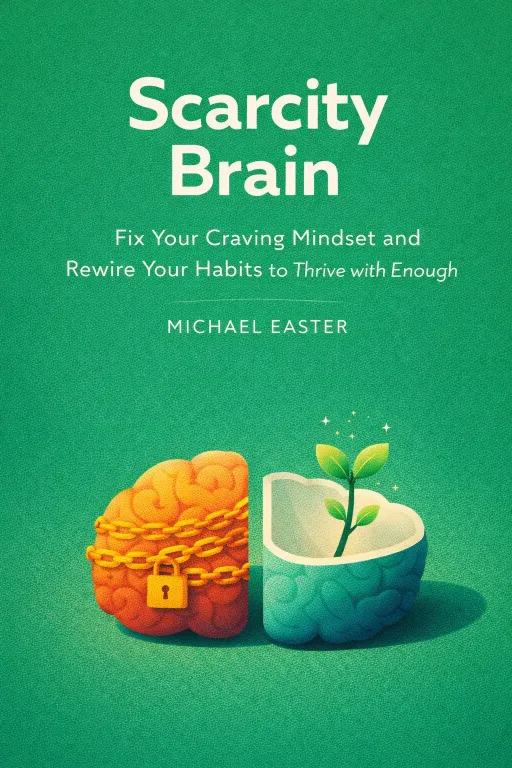
Michelle: Alright, Mark, quick pop quiz. You're looking at your closet. What percentage of your clothes do you think you actually wear on a regular basis? Mark: Oh, wow. Putting me on the spot. I like to think I'm pretty efficient. I'd say... maybe 50 percent? I mean, there are seasonal things, special occasion things... but yeah, half. Final answer. Michelle: Fifty percent. That's optimistic. A study cited in the book we're talking about today found that for the average person, it's only about 10 percent. We use a tiny fraction of what we own. Mark: Ten percent? Come on. That means 90 percent of my closet is just... decoration? That's both depressing and sounds alarmingly accurate, now that I’m really thinking about it. Michelle: That feeling of having a closet full of 'nothing to wear' is exactly what author Michael Easter tackles in his bestselling book, Scarcity Brain. Mark: Michael Easter... isn't he that guy who does those insane adventures for his research? Like, he doesn't just read studies, he goes and lives them. Michelle: Exactly. For this book, he went from a Benedictine monastery to the streets of Baghdad to the middle of the Amazon. He's a journalism professor who believes you can't understand a problem like scarcity until you've felt it firsthand. And he argues that our brains, which evolved for a world of constant lack, are fundamentally mismatched for our modern world of overwhelming abundance. Mark: An ancient brain in a digital world. I feel that in my bones every time I open my email.
The Scarcity Loop: Our Ancient Brain in a Modern Casino
SECTION
Michelle: Well, to understand this mismatch, Easter introduces a powerful concept he calls the 'scarcity loop.' He says it has three simple parts: an opportunity to get something of value, an unpredictable reward, and the ability to repeat the action quickly. Mark: Opportunity, unpredictable rewards, quick repetition. Okay, that sounds suspiciously like a slot machine. Michelle: You nailed it. That's his primary example. He tells this incredible story about a man named Si Redd, the so-called "king of slot machines." Before the 1980s, slots were seen as these boring, mechanical toys for the wives of the real gamblers. They were clunky and rarely paid out. Mark: Right, just a way to pass the time. Michelle: Exactly. But Si Redd, who came from the world of pinball and jukeboxes, saw the potential of video games like Atari. He digitized the slot machine. Suddenly, you could bet on multiple lines at once. He added flashing lights, exciting sounds, and most importantly, he engineered what are called 'losses disguised as wins.' Mark: Hold on. 'Losses disguised as wins'? How do you disguise a loss? You either win money or you don't. Michelle: That's the genius of it. Let's say you bet a dollar on five lines. The machine might pay you back 50 cents on one of those lines. You've still lost 50 cents overall, but the machine erupts in celebration—lights flash, bells ring, coins jingle. Your brain gets a little hit of dopamine, the reward chemical, even though you just lost money. It feels like a win. Mark: Wow. So he basically gamified losing money? That's brilliant and absolutely terrifying. It sounds exactly like opening a loot box in a video game or refreshing your Instagram feed hoping for likes. Michelle: It's the same psychological engine. And Easter shows just how powerful this loop is by taking it to one of the most extreme environments on earth: post-invasion Iraq. He went there to investigate the rise of a drug called Captagon, a cheap, methamphetamine-like pill. Mark: Why there? Michelle: Because in a place of immense trauma, poverty, and uncertainty—true, life-or-death scarcity—this drug offered a perfect scarcity loop. It provided an opportunity to escape, an unpredictable high, and it was cheap and easy to take again and again. He saw how the same loop that keeps a retiree glued to a slot machine in Vegas could fuel a drug epidemic among soldiers and civilians in a war zone. It shows this isn't some minor cognitive bias; it's a primal, powerful force. Mark: That really raises the stakes. It's one thing to lose a few bucks at a casino, but it's another to see it driving addiction on that scale. It’s the same software running on completely different hardware.
The Pervasiveness of the Loop: How Everything Became a Slot Machine
SECTION
Mark: Okay, casinos and war zones, I get it. The loop is powerful in those extreme situations. But Easter's not just talking about that, right? He argues this is happening to us every day, in much more subtle ways. Michelle: That's the core of his argument. The scarcity loop has escaped the casino and become the dominant business model of the 21st century. It's been engineered into almost every aspect of our digital lives. Mark: Give me an example. Where am I seeing this and not realizing it? Michelle: Think about online shopping. He points to apps like Temu, which he describes as being cornered by an AI salesperson ushering you past "endless tables of assorted goods" with escalating special offers, limited-time discounts, and constant notifications. Every scroll is pulling the lever on a slot machine of stuff. Will the next item be the perfect thing I never knew I needed? It’s a constant, unpredictable stream of opportunities. Mark: The endless scroll. It's the 'quick repeatability' part of the loop. There's no natural stopping point. Michelle: Precisely. Or think about dating apps. The inventor of Tinder's swipe feature, Brian Norgard, openly called it an "unpredictable reward game." Swipe, swipe, swipe... nothing. Swipe... Match! Oh my God, that was amazing! Your brain gets that jolt of validation, and you're immediately back to swiping, chasing the next unpredictable reward. Mark: Oh man, the 'doomscrolling' loop on news sites and social media is real. You know you should stop, but you keep thinking the next article, the next tweet, will be the one that finally explains everything or gives you that hit of outrage or validation. It’s a slot machine for information. Michelle: And the data backs this up. Easter cites research showing that about 90 percent of news is negative, because our brains are more attentive to unpredictable, threatening information. The race for our attention is a "race to the bottom," rewarding the most lurid and outrageous content because it hooks our scarcity brain most effectively. Mark: That's a bleak thought. But I have to ask, is this loop always a bad thing? Isn't the hope of an unpredictable reward what makes life exciting? It’s why we explore, why we take risks, why we fall in love. Michelle: That's such an important question, and Easter addresses it directly. The loop itself isn't inherently evil; it’s an ancient survival mechanism that drove us to find new food sources and explore new territories. The problem is that its modern, commercialized form has been weaponized. It’s designed to exploit our psychology for profit, often without providing any real, lasting value. It gives us the thrill of the hunt without the nourishment of the catch.
Escaping the Loop: From 'More' to 'Enough'
SECTION
Michelle: And that leads us to the million-dollar question, which is where Easter's solutions get really interesting. His answer isn't about becoming a monk and renouncing everything. It's about fundamentally changing how we approach problems and possessions. Mark: So it’s not just 'buy less stuff, delete your apps.' Michelle: Far from it. He tells this wonderful story about an engineering professor named Leidy Klotz who was building a Lego bridge with his three-year-old son. The bridge was wonky because one support pillar was taller than the other. Klotz, the PhD engineer, immediately started looking for more Legos to add to the shorter pillar to make it even. Mark: Of course. That's what I would do. Build it up. Michelle: It's what most of us would do. But his toddler, Ezra, did something different. He just walked over and pulled a block off the taller pillar. And just like that, the bridge was perfectly level. It was a faster, more efficient, and more elegant solution. Mark: Wow. The kid solved it by subtracting. That's fantastic. My instinct is always to buy a new app or a new gadget to solve a problem, not to delete something or simplify. Michelle: Exactly. Klotz's research found that humans have a powerful, systematic bias against subtraction. We equate 'more' with 'better' and overlook subtraction as a solution, even when it's the superior choice. Easter argues that escaping the scarcity loop begins with consciously learning to subtract—to remove the unnecessary from our lives, not just to add more. Mark: I love that. It's a real mental shift. What else? Michelle: The other key idea is shifting your mindset from 'stuff' to 'gear.' He tells the story of Laura Zerra, an incredible survivalist who lives a minimalist life. She has a simple rule for everything she owns: "It must earn its weight." Mark: 'Earn its weight.' I like that. Michelle: It means every item has to have a clear purpose and, ideally, multiple functions. It's not just a possession; it's a tool for an activity. A cool jacket is 'stuff.' A waterproof, lightweight shell that allows you to hike in the rain is 'gear.' A collection of books you never read is 'stuff.' A library card that gives you access to endless stories is 'gear.' Mark: But wait, isn't 'gear' just a cooler, more masculine-sounding word for 'stuff'? Am I just trading my online shopping addiction for a high-end camping gear addiction? Michelle: That's the perfect challenge, and it gets to the heart of the distinction. Easter argues that 'stuff' is about passive ownership and feeds the scarcity loop of acquisition. 'Gear,' on the other hand, is intrinsically linked to an action or a purpose. You can't just own gear; you have to use it. A kayak isn't just a thing you own; it's a tool that pushes you to go to the lake. It forces you into what he calls an 'abundance loop' of experience, skill-building, and engagement with the real world. Mark: I see. So the focus shifts from the object itself to the experience it enables. The goal isn't to have the kayak; the goal is to be a kayaker. Michelle: You've got it. It's a way of hijacking the scarcity loop for our own benefit. You're still seeking a reward, but the reward is an experience, a skill, a memory—not just another dopamine hit from a purchase.
Synthesis & Takeaways
SECTION
Michelle: So ultimately, the book's message is that we're all living with this ancient, powerful 'scarcity brain' that's being constantly hijacked by the modern world. But we can fight back. The path out isn't about deprivation or trying to force ourselves to want 'less.' It's about consciously choosing 'enough' by being smarter about what we want. Mark: It’s about shifting from a life of passive consumption, of being the person things happen to, to a life of active purpose, where you're the one making things happen. From being a player at the slot machine to being the adventurer using their gear. Michelle: That's a perfect way to put it. It's about recognizing the loops that trap us and intentionally building new loops that free us. It's a profound and, I think, very hopeful message. Mark: It really makes you look at your own habits. It poses a great challenge for everyone listening: What's one 'scarcity loop' in your life—whether it's checking email constantly, scrolling social media, or browsing online stores—that you could replace with a 'gear'-based activity this week? Michelle: That's a fantastic challenge. Instead of scrolling, pick up that dusty guitar. Instead of browsing, use your running shoes. We'd love to hear what you come up with. Find us on our socials and share your thoughts. Michelle: This is Aibrary, signing off.