The Science of Sustainable Growth
Opening
SECTION
Nova: What if everything you thought about growing your business was actually holding you back? We're often told to chase growth, but what if true scaling isn't about getting bigger, but about getting... and sometimes, more focused?
Atlas: Hold on, more focused? That sounds like business heresy! I thought the whole point was to expand, dominate, grow, grow, grow. Bigger, better, more!
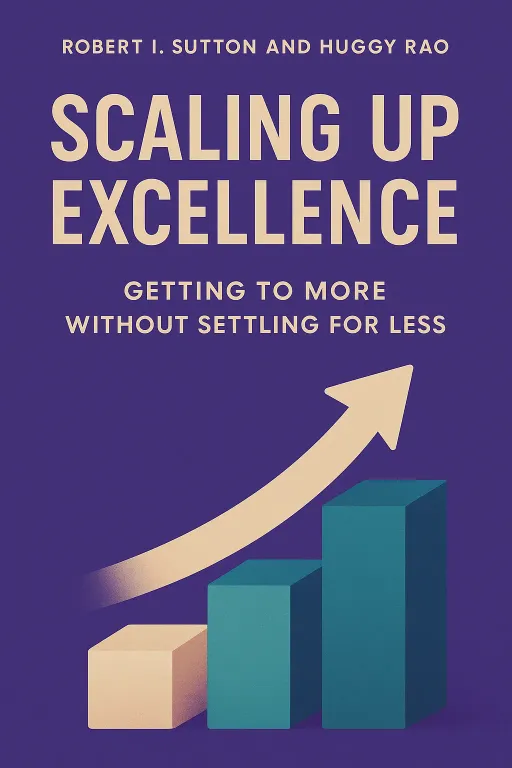
Nova: Exactly. That's the myth we're busting today, or at least deeply re-examining. We're diving into the fascinating world of sustainable growth, drawing insights from two powerful books: Robert I. Sutton and Hayagreeva Rao's "Scaling Up Excellence," and Rich and Kathy Fettke's "Scaling Smart."
Atlas: So, academic rigor meets real-world grit. Sutton and Rao, both renowned Stanford professors, bring decades of organizational behavior research, while the Fettkes offer a wealth of entrepreneurial wisdom from building their own highly successful, system-driven ventures. I like that combo.
Nova: It’s a powerful pairing. And what emerges from their work is this idea that scaling is less about a simple formula and more about a nuanced, intelligent approach. Because if you just keep adding more people or more projects without the right foundations, you're not scaling a business, you're often just creating a bigger, more complex job for yourself.
Atlas: That's a problem I imagine a lot of our listeners, the pragmatic learners and focused achievers, are probably feeling. They've built something successful, but now it feels like a monster that demands all their time. They want a stable future, not just a busier present.
Nova: Precisely. And that leads us perfectly into our first big insight, from Sutton and Rao, who argue that scaling is fundamentally a 'ground war' that requires spreading a mindset of excellence through every layer of an organization.
The Ground War of Scaling Excellence
SECTION
Atlas: A 'ground war'? That sounds intense. When I think of scaling, I usually think of process flows, automation, maybe hiring more people. What does a "ground war of excellence" actually look like on the battlefield of business?
Nova: It’s intense because it’s human. Sutton and Rao, with their deep academic backgrounds in organizational behavior, emphasize that true excellence isn't just a directive from the top; it's a deeply embedded cultural phenomenon. Think of a championship sports team or a highly effective special forces unit. Their excellence isn't just about individual talent, it's about shared values, rigorous training, communication, and a collective mindset that permeates every single player, every single member.
Atlas: So, it's not just about copying what works, but understanding it works and getting everyone to buy into that 'why'? That's a much harder sell than just handing out a new operations manual.
Nova: Absolutely. They talk about "hot spots" of excellence within an organization – those areas where things are already working exceptionally well, where people are performing at their peak. The ground war is about identifying those hot spots, dissecting what makes them excellent, and then that practice and the underlying mindset throughout the rest of the organization. It's messy, human-centric work, not just a top-down mandate. It requires leaders to be "evangelists" and "architects" of culture, not just strategists.
Atlas: I see. So, if I have a sales team that's crushing it in one region, it's not just about cloning that team in another region. It's about understanding the specific behaviors, the shared belief system, the ways they problem-solve and support each other, and then figuring out how to cultivate that elsewhere.
Nova: Exactly. And critically, it's about resisting the urge to just impose rigid, one-size-fits-all solutions. The "ground war" acknowledges that every team, every department, every individual might need to adapt those core principles in a slightly different way for their specific context. It's about spreading the of excellence, not just the letter of a rulebook.
Atlas: That makes sense. It’s like trying to teach someone how to cook a great meal. You can give them a recipe, but the true excellence comes from understanding the ingredients, the nuances of temperature, the timing, the of it, and adapting when something isn't quite right. That's a mindset.
Nova: Beautiful analogy. And this idea of adapting core principles rather than rigidly cloning them is a perfect bridge to our second big insight, from Rich and Kathy Fettke. Because if you just keep adding more people without the right to support that adaptable excellence, you're not scaling a business, you're just creating a bigger, more demanding job for yourself.
Scaling Smart: Building an Asset, Not a Job
SECTION
Atlas: Okay, so the "ground war" ensures the of what we’re scaling. Now, how do we make sure that quality can actually grow without crushing the founder? Many of our listeners are entrepreneurs who've built something successful, but now they're working 80-hour weeks. They've built a job, not an asset. How do Rich and Kathy Fettke help us escape that trap?
Nova: The Fettkes' core concept in "Scaling Smart" is brilliant in its simplicity: the goal isn't just to grow revenue or head count; it's to build systems and processes so robust that the business can run efficiently and effectively without the constant, direct intervention of the founder. It becomes an asset that generates value, rather than a personal time sink.
Atlas: So, it’s about creating a machine that runs itself, at least to a significant degree. Can you give an example?
Nova: Think of a highly successful solo consultant who is absolutely swamped with work. They're making great money, but every client, every project, every deadline depends solely on their personal input. They the business. Now, compare that to a consulting that has systematized client acquisition, project management, service delivery, and even thought leadership. The principals in the firm can focus on strategy, innovation, or even step away for periods, because the systems and teams are in place to execute. The solo consultant has a very lucrative job; the firm has a valuable, scalable asset.
Atlas: That’s a powerful distinction. For anyone driven by progress and building a stable future, the idea of creating a self-sustaining asset rather than just a bigger workload is incredibly appealing. So, how do the Fettkes recommend we actually do that? Is it just about delegating tasks?
Nova: It goes far beyond simple delegation. It's about for autonomy. It involves meticulously documenting processes, creating clear roles and responsibilities, leveraging technology to automate repetitive tasks, and critically, fostering a team that can make decisions and solve problems independently within those established frameworks. It's a shift from being the primary to being the primary and. They emphasize identifying "leverage points" that multiply effort, so a small input yields a large output.
Atlas: So, this is where the "Buddhist scaling model" from our takeaway really comes into play, isn't it? Maintaining those core principles of excellence that Sutton and Rao talk about, but then allowing for local adaptation and intelligent system-building within those frameworks, just as the Fettkes advocate.
Nova: Precisely. It's about creating a structure that enables flexibility and growth, where the core values of excellence are preserved, but the day-to-day execution can be adapted by empowered teams using well-designed systems. It's not about rigid control, but about intelligent design for inherent resilience and scalability.
Synthesis & Takeaways
SECTION
Atlas: This is fascinating. So, we're talking about a two-pronged approach to sustainable growth. On one hand, the 'ground war' ensures we're scaling —not just mediocrity—by spreading a shared mindset and adaptable practices. On the other, 'scaling smart' means we're building robust systems that turn our business into a valuable asset, freeing us from being perpetually tied to every single task.
Nova: Absolutely. The 'ground war' ensures the and of what you're scaling, making sure that excellence isn't diluted as you grow. And 'scaling smart' provides the and to allow that excellence to expand sustainably, transforming your business from a demanding job into a truly valuable, self-propelling asset.
Atlas: So, for our listeners who crave clarity and actionable wisdom, and who are trying to build that stable future, it sounds like the real secret to growth isn't just working harder or even just getting bigger. It's about intentionally designing for both cultural resonance and operational independence. It's about identifying those 'hot spots' of excellence, and then systematically building adaptable, intelligent systems around them.
Nova: It's the journey of building something truly valuable, something that serves your life and your mission, rather than just becoming a bigger to-do list.
Atlas: A powerful combination of mindset and mechanics.
Nova: This is Aibrary. Congratulations on your growth!