Uncovering Hidden Narratives: The Power of Story in Shaping Beliefs
Golden Hook & Introduction
SECTION
Nova: Most of us walk around thinking we live in a world of solid facts, right? Concrete reality. But what if I told you that nearly everything we consider real—our money, our nations, even our sense of purpose—is actually just a really, convincing story?
Atlas: Hold on, Nova. Are you trying to tell me my bank account is a work of fiction? Because if so, I have some very uncomfortable questions for my bank. And my landlord.
Nova: Well, not exactly a work of fiction in the traditional sense, Atlas. More like a shared fiction. A collective narrative that we all agree to believe in, and that shared belief is what gives it power. Today, we're diving into how these hidden narratives are the true architects of our beliefs and our entire world.
Atlas: That sounds like a rabbit hole I’m ready to jump down. What's sparked this fascinating, slightly unsettling, revelation?
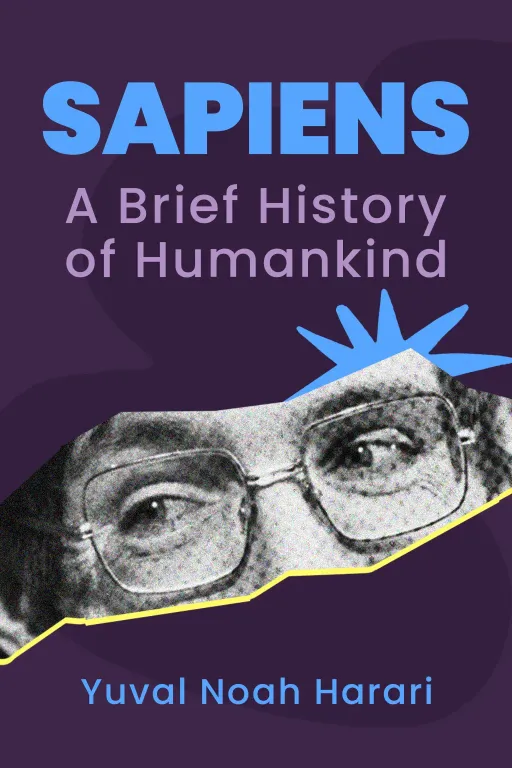
Nova: We're drawing insights from two absolutely pivotal books: "Sapiens: A Brief History of Humankind" by Yuval Noah Harari, and "The Storytelling Animal" by Jonathan Gottschall. Harari, a medieval historian by training, actually zoomed out to give us this incredible macro-history of humanity, and his book exploded onto the scene after being initially rejected by agents. It completely reframed how we look at civilization. And Gottschall then dives into our fundamental human need for stories.
Atlas: So, one's looking at the grand tapestry of human history through the lens of narrative, and the other's exploring why we, as individuals, are so wired for stories. I’m already intrigued. Let’s start with Harari’s big idea then.
The Architects of Reality: How Shared Fictions Shape Civilization
SECTION
Nova: Absolutely. Harari's central, mind-bending argument in "Sapiens" is that our unique ability as humans to believe in shared fictions is precisely what allowed us to dominate the planet. Think about it: a chimpanzee can't convince another chimpanzee to give it a banana today for the promise of ten bananas next week. There’s no shared belief system for that abstract future concept.
Atlas: Right, they operate on what's tangible, what's right in front of them. Survival of the fittest, immediate gratification.
Nova: Exactly. But humans? We invented concepts like money, nations, religions, corporations—things that don't exist in the physical world but are incredibly powerful because millions, even billions, of us they exist. This belief allows for cooperation on a massive scale, far beyond the small tribal groups our ancestors lived in.
Atlas: So you’re saying money isn't real? It's just a story we tell ourselves? That's going to make my tax accountant very confused.
Nova: In a profound sense, yes! A dollar bill is just paper, or now, a digital entry. Its value isn't inherent; it's assigned because we, collectively, agree it has value and can be exchanged for goods and services. That's a shared fiction. Without that shared story, it's just paper. Or pixels.
Atlas: Wow. That’s a bit unsettling, but it makes total sense. We construct these elaborate belief systems, and then they become the very foundation of our daily lives. So the cause is our biological limitation for large-scale cooperation directly, the process is inventing these abstract concepts, and the outcome is complex societies and global trade?
Nova: Precisely. Consider nations, for instance. A nation isn't a natural entity; it's a story of shared identity, history, and destiny. People are willing to fight, even die, for a nation, not because it's a physical thing, but because they deeply believe in its narrative. This allows for immense collective action, from building infrastructure to defending borders.
Atlas: That’s a powerful point. It’s like these stories provide the operating system for human society. And it’s not just nations or money. What about something like human rights? That’s also a shared fiction, isn’t it? A story we collectively agree on that gives individuals inherent worth.
Nova: Absolutely. Human rights don't exist in nature; a lion doesn't respect a gazelle's right to life. But we've constructed this powerful narrative that guides our laws and ethics, allowing us to build more just societies. It’s a testament to the incredible power of shared imagination.
The Storytelling Brain: Our Innate Need for Narrative
SECTION
Nova: And that naturally leads us from the grand societal fictions to the intimate, personal ones. While Harari talks about what stories do for collectively, Jonathan Gottschall, in "The Storytelling Animal," dives into what stories do for individually. He argues that our brains are fundamentally wired for narrative. It's not just entertainment; it's how we make sense of the world.
Atlas: So, it’s not just that we stories, but that we stories? That our brains are constantly constructing narratives, even when we’re not aware of it?
Nova: Exactly. Think about how you process your day. You don't just experience a random sequence of events. You create a narrative: "I woke up, I had coffee, this happened at work, I felt this way." You're constantly imposing a plot, characters, and a cause-and-effect structure onto your life.
Atlas: I guess that makes sense. It’s how we organize chaos, right? Like, if I have a bad meeting, I don't just register it as data points; I create a story around it: "My boss was in a bad mood, he snapped at me, I need to be more careful."
Nova: Yes, and Gottschall suggests this isn't just a habit; it's an evolutionary imperative. Our ancestors who could create compelling narratives—simulating scenarios, understanding cause and effect, learning from others' "stories"—were better equipped to survive. Stories are essentially survival tools, mental flight simulators for life.
Atlas: That makes me wonder about the deeper question from our notes: what foundational story in my life or field might be shaping decisions in ways I haven't fully considered? For someone like me, who's always navigating new information and trying to synthesize it, I could be telling myself a story about "always needing to be ahead" or "information equals power."
Nova: That’s a brilliant example, Atlas. That narrative of "information equals power" or "always needing to be ahead" could drive you to constantly seek more data, perhaps at the expense of deeper reflection or collaboration. It’s a story with a protagonist, a goal, and potential conflicts.
Atlas: And without consciously examining that narrative, I might just keep pushing, thinking it's the only way, without realizing it’s a story I’ve adopted, not necessarily an objective truth. So, understanding that our brains are wired to tell these stories, what can we do with that knowledge? How do we identify these hidden narratives?
Nova: The first step is awareness. Simply acknowledging that your life isn't just a series of facts, but a collection of stories you tell yourself and others. Then, you can start to critically examine them. Is this story serving me? Is it accurate? Or is it a limiting belief dressed up as destiny? You can, in essence, become the editor of your own life's narrative.
Synthesis & Takeaways
SECTION
Nova: So, whether we're talking about the billions of people cooperating under the shared fiction of money, or the individual processing their day through a personal narrative of triumph or struggle, stories are the fundamental operating system of human existence. They're not just entertainment; they're the very architecture of our reality.
Atlas: It’s truly profound to realize how deeply embedded stories are, both in our collective consciousness and in our individual minds. It gives me a new appreciation for the power of belief, and also a sense of responsibility for the stories I choose to live by. It means we're not just passive recipients of reality; we're active participants in its creation.
Nova: Exactly. And that power, once recognized, is incredibly liberating. It suggests we can, to some extent, rewrite the narratives that no longer serve us, both personally and, perhaps, collectively.
Atlas: So, for all our listeners, perhaps the takeaway is a powerful question: What story are you currently living, and is it the one you truly want to tell?
Nova: A perfect ending, Atlas. This is Aibrary. Congratulations on your growth!