The Unseen Architect: How History's Echoes Shape Today's Global Leaders
Golden Hook & Introduction
SECTION
Nova: Most global leaders, when they look at the world, they see current events, market fluctuations, political shifts. They see the immediate, the tangible. But what if I told you that the most profound forces shaping our world, the true architects of our present, are almost entirely invisible?
Atlas: Invisible? Hold on, Nova. Are you suggesting that the intricate dance of international relations, the rise and fall of economies, or even the subtle dynamics within my global teams aren't driven by the headlines we read, but by something we can't even see? That sounds a bit out there.
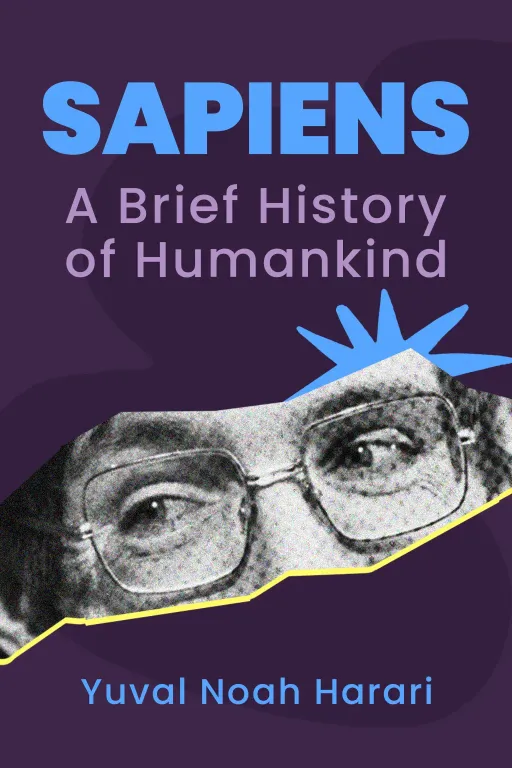
Nova: Exactly! That's the core idea behind "The Unseen Architect: How History's Echoes Shape Today's Global Leaders." We’re talking about the deep, often overlooked currents of history. And today, we're diving into two monumental books that peel back the layers on these invisible forces: "Sapiens: A Brief History of Humankind" by Yuval Noah Harari, and "Guns, Germs, and Steel" by Jared Diamond.
Atlas: Oh, Harari and Diamond! These aren't your typical history textbooks. Harari, a historian from Israel, has this incredible knack for taking the entire sweep of human existence and making grand, often uncomfortable, claims that challenge everything you thought you knew.
Nova: Absolutely. And Diamond, an American geographer and biologist, brings this astonishing interdisciplinary approach, blending biology, anthropology, and history to explain why societies developed so differently. It was genuinely groundbreaking when it came out.
Atlas: So, these authors aren't just recounting facts; they're revealing the fundamental operating system of our world.
Nova: Precisely. And the first invisible architect we need to talk about is the astonishing power of shared fictions.
Shared Fictions & Global Cooperation (Harari's Sapiens)
SECTION
Nova: Harari's central thesis in "Sapiens" is revolutionary: humans dominate the planet not because we're the strongest or fastest, but because we're the only species that can cooperate flexibly in massive numbers. And we do this by believing in shared fictions.
Atlas: Shared fictions? You mean like Santa Claus? Or the Tooth Fairy?
Nova: Well, yes, but on a much grander scale. Think about nations, religions, money, human rights, corporations. None of these exist objectively in the physical world. A dollar bill is just paper, but we collectively agree it has value. A nation is an imagined community, not a biological reality. Harari argues that these "imagined realities" are the glue that allows millions, even billions, of strangers to cooperate towards common goals.
Atlas: So, you're saying our entire global economy, our political systems, even our understanding of justice, are essentially built on a really, really good story that we all collectively tell ourselves?
Nova: In essence, yes. Take a modern corporation like Google. It has employees, buildings, products, but Google itself isn't a physical entity you can touch. It's a legal fiction, a story we've all agreed to believe in, with rules and responsibilities. This shared belief allows countless individuals to invest, work, and trade with it, despite never meeting each other. The cause was the human cognitive revolution, allowing for complex language and abstract thought. The process was the creation and dissemination of these myths, and the outcome was unprecedented cooperation and the building of complex societies.
Atlas: That’s going to resonate with anyone trying to bridge global divides. For a global leader navigating diverse teams, how do you even begin to 'manage' these invisible fictions? Because what's a fundamental truth in one culture might be a complete fiction in another.
Nova: That’s the critical insight. Understanding these deep-seated, often unconscious, collective narratives is paramount. For example, in some cultures, the 'fiction' of strong hierarchical structures and deference to elders might be deeply ingrained, influencing how decisions are made or feedback is given. In others, a 'fiction' of radical individualism and meritocracy might prevail. Ignoring these foundational stories can lead to superficial strategies, miscommunications, and ultimately, ineffective leadership.
Atlas: I can see that. It's not just about language barriers, but about the invisible operating systems of belief that dictate how people interact and make sense of the world. So, when a global team struggles with, say, different approaches to trust or negotiation, it might not be about personalities, but about these deeply embedded, shared fictions.
Nova: Precisely. It's about recognizing that these "fictions" are incredibly powerful motivators, shaping everything from economic behavior to interpersonal dynamics. They are the bedrock of culture. And if shared fictions are one unseen architect, then the very ground beneath our feet is another, perhaps even more fundamental, builder of history.
Geography as Destiny & Global Inequality (Diamond's Guns, Germs, and Steel)
SECTION
Nova: This naturally leads us to the second profound insight, from Jared Diamond’s "Guns, Germs, and Steel." Diamond argues that geographical and environmental factors, not inherent racial or intellectual superiority, were the primary drivers of why some societies developed faster and became more powerful than others.
Atlas: That's a huge claim! So, it wasn't about smarter people, but about better terrain?
Nova: Essentially. Diamond shows how factors like continent orientation, the availability of domesticable plants and animals, and disease environments created massive head starts for certain regions. Take Eurasia, for instance. It’s oriented East-West, allowing for the rapid spread of crops, livestock, and innovations across similar latitudes.
Atlas: Right, like the Fertile Crescent's wheat and barley could easily spread to Europe and Asia.
Nova: Exactly. Contrast that with the Americas, which are North-South oriented. Spreading crops like corn from Mexico to the Andes, or even just ideas, was geographically much harder due to dramatic climate changes over short distances.
Nova: Consider the vivid case of the European conquest of the Americas. The cause was the profound geographical advantages Eurasia had accumulated over millennia. The process involved the diffusion of agriculture, which led to denser populations, the development of specialized labor, and ultimately, writing, complex technologies like steel, and organized armies. Crucially, close proximity to domesticated animals also meant Eurasians developed immunities to a host of diseases, like smallpox.
Atlas: So, when Europeans arrived in the Americas, they didn't just have guns and steel, but unknowingly, they brought biological warfare in the form of germs. The outcome was devastating demographic collapse among indigenous populations who had no prior exposure or immunity.
Nova: Exactly. This wasn't about European genius; it was about the vast, accumulated advantages bestowed by geography and the resulting historical trajectory. That's a powerful and almost unsettling thought – that our present inequalities might be rooted so deeply in ancient geography.
Atlas: For a leader trying to foster true equity in global partnerships, how do you even begin to grapple with such foundational disparities? It's not enough to just say, "let's be fair now," when the playing field was tilted thousands of years ago.
Nova: It’s about informed strategy, not justification. Understanding that these geographical legacies still echo in modern economic disparities and geopolitical power dynamics is crucial. It helps us see that some regions began with inherent advantages that compounded over time. So, when we talk about development aid, or trade agreements, or even cultural exchange, recognizing this deep historical context allows for more nuanced, equitable, and ultimately, more effective approaches. It moves us beyond simplistic explanations of poverty or power, pushing us to address the foundational imbalances that continue to shape our world.
Synthesis & Takeaways
SECTION
Nova: So, what we're left with are these two incredible insights: Harari showing us that our shared beliefs and stories are the invisible social glue, and Diamond revealing that the very land itself is a silent architect, shaping the trajectories of civilizations.
Atlas: It’s a profound realization. The real challenge for a global architect isn't just reacting to the present, but understanding these deep historical currents – the fictions and the geographies – that are constantly pulling us in different directions. It makes you realize how much of what we experience today is a direct echo from millennia ago.
Nova: Absolutely. Effective global leadership demands moving beyond superficial analysis. It requires the humility to acknowledge these "unseen architects" and the wisdom to integrate this deep historical context into every decision. It’s about recognizing that the past isn't just prologue; it's the very foundation upon which our present is built. As leaders, we need to be archeologists of history, not just navigators of today.
Atlas: That's a powerful image: archeologists of history. How might truly integrating these deep historical narratives – the stories we tell ourselves, and the landscapes that shaped us – fundamentally change the way you approach your next global strategy meeting or your next cross-cultural negotiation?
Nova: We hope these insights inspire you to dig deeper.
Nova: This is Aibrary. Congratulations on your growth!