The Ripple Effect: Why Small Changes Drive Big Scientific Breakthroughs
Golden Hook & Introduction
SECTION
Nova: We often think of scientific progress as this steady, relentless climb, each discovery building neatly on the last, like stacking perfect LEGO bricks. But what if that comforting image is completely wrong? What if science actually moves more like a series of intellectual earthquakes, shattering old worlds to build entirely new ones?
Atlas: Oh man, "intellectual earthquakes." That sounds both terrifying and incredibly exciting. Are you saying everything we think we know is just… one tremor away from crumbling?
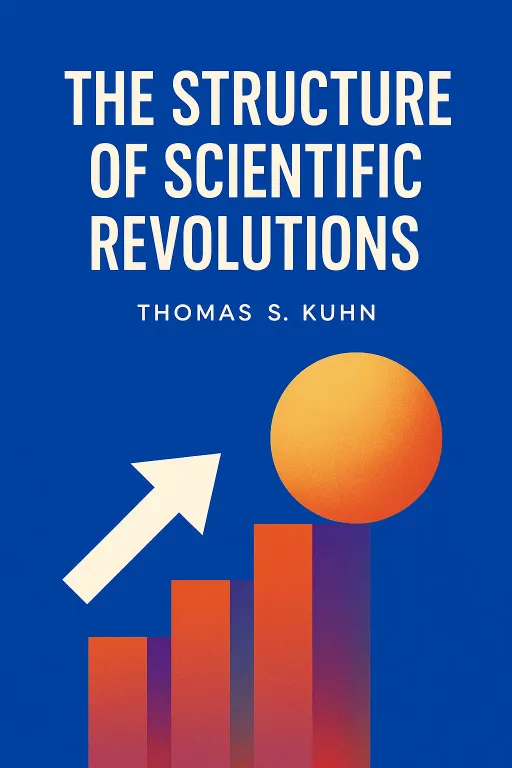
Nova: In a way, yes! Today, we're cracking open two absolute titans that dismantle that very myth of linear progress: "The Structure of Scientific Revolutions" by the brilliant Thomas S. Kuhn, and Yuval Noah Harari's monumental "Sapiens."
Atlas: I'm curious, what connected these two for you, beyond the idea of big changes?
Nova: Well, Kuhn, originally a theoretical physicist, stumbled into the history of science and completely upended our understanding of how knowledge truly advances. His work, which was initially met with both awe and fierce debate, introduced the revolutionary idea that science isn't just about accumulating facts, but about radical 'paradigm shifts.' And then Harari, with "Sapiens," takes that concept to a grand, historical scale, showing how these shifts don't just happen in labs, but fundamentally reshape our entire human story, making it a globally acclaimed phenomenon. It’s a powerful pairing.
Atlas: So basically, we're not just talking about new inventions, but entirely new ways of seeing the world, and then how those new ways completely change everything for us.
Nova: Exactly! Today we'll dive deep into this from two perspectives. First, we'll explore the very nature of these 'paradigm shifts' that redefine science, then we'll discuss how these radical shifts in thinking don't just change our theories, but fundamentally reshape human societies and our entire reality.
The Non-Linear Nature of Scientific Progress: Understanding Paradigm Shifts
SECTION
Nova: So, let's start with Kuhn and his groundbreaking idea of the "paradigm shift." Before Kuhn, the common view was that science was like adding bricks to a wall—each new discovery just built upon the last, making the wall of knowledge taller and stronger.
Atlas: That makes sense, but it also sounds a bit… tidy. Like, too neat for the messy human endeavor that science often is.
Nova: That's where Kuhn comes in. He argued that science operates in periods of what he called "normal science." During these periods, scientists work within an established framework, a "paradigm"—a set of shared assumptions, theories, and methods. Think of it like a puzzle. Everyone agrees on the picture on the box, and they're just trying to fit the pieces together.
Atlas: Okay, so a paradigm is like the operating system for a particular scientific field. Everyone's running the same software.
Nova: That's a perfect analogy! But what happens when you start finding puzzle pieces that just don't fit? Or worse, pieces that suggest the picture on the box is wrong? These are what Kuhn called "anomalies."
Atlas: Ah, the glitches in the matrix. The things the current operating system can't explain.
Nova: Precisely. And for a while, scientists will try to explain these anomalies within the existing paradigm. They'll patch it, tweak it, add epicycles, just like astronomers tried to explain the bizarre "retrograde motion" of planets within the geocentric model—the idea that Earth was the center of the universe.
Atlas: Wait, so astronomers actually saw planets moving backward sometimes? And they just… kept saying Earth was the center? That sounds a bit out there.
Nova: They did! Imagine trying to map the heavens and seeing Mars suddenly loop back on itself. It caused immense headaches for the Ptolemaic, Earth-centered model. They invented incredibly complex systems of "epicycles" – tiny orbits within orbits – to try and make the observations fit their Earth-centric view. It became a monstrously complicated system.
Atlas: That sounds rough. Like trying to fix a leaky faucet by just adding more buckets, instead of replacing the pipe.
Nova: Exactly! And eventually, those anomalies accumulate, and the patches become so convoluted that the old paradigm starts to crack under its own weight. This is when a crisis emerges, and the field becomes ripe for a revolution.
Atlas: And that's when someone comes along and says, "What if the sun is actually at the center?"
Nova: Enter Nicolaus Copernicus. His heliocentric model, placing the sun at the center, suddenly made the retrograde motion of planets beautifully simple to explain. It wasn't just a new fact; it was a completely different way of seeing the cosmos. A new operating system.
Atlas: That's a great example. So, it wasn't about the old scientists being dumb, but about being so deeply ingrained in their current framework that they couldn't see the obvious until someone else came along and literally shifted the entire perspective.
Nova: It's a profound insight into human cognition and scientific communities. Kuhn showed that these shifts aren't purely logical; they involve social, psychological, and even aesthetic factors. The new paradigm isn't just "better" in every single way immediately; it's often simpler, more elegant, and opens up new avenues for research. It’s a complete re-framing of reality.
From Scientific Revolutions to Societal Transformation: Harari's Grand Perspective
SECTION
Atlas: So, if science isn't just a straight line, and these 'paradigm shifts' completely change how we see the universe, what does that mean for? For society? Where does Harari come in?
Nova: That's a brilliant pivot, because Harari essentially takes Kuhn's idea of paradigm shifts and applies it to the entire sweep of human history, showing how radical shifts in thinking don't just change scientific theories, but fundamentally reshape human societies and our entire reality. In "Sapiens," he looks at moments like the Cognitive Revolution.
Atlas: The Cognitive Revolution? That sounds huge. Tell me more.
Nova: Harari argues that around 70,000 years ago, Homo sapiens underwent a "Cognitive Revolution." It wasn't about new tools, but about a new way of thinking and communicating. Specifically, the ability to create and believe in shared fictions, or what he calls "inter-subjective realities."
Atlas: Oh, I love this. So, not just talking about what's real, but talking about things that real in a physical sense, but we they're real, and that makes them powerful?
Nova: Exactly! Things like money, nations, religions, laws, corporations. These don't exist objectively in nature; you can't touch "the economy" or "France" in the same way you can touch a tree. But because millions of people believe in them and act accordingly, they become incredibly powerful forces that shape our lives.
Atlas: That's incredible! So, it's not just about planets, it's about how we literally our reality through shared beliefs? And that sounds like a massive paradigm shift for humanity. How does that echo Kuhn's anomalies?
Nova: It's a perfect echo! Before the Cognitive Revolution, our ancestors could only cooperate in small groups, limited by personal knowledge and direct trust. That was the old paradigm, the old operating system. The anomaly was how to scale cooperation beyond a few dozen individuals. The Cognitive Revolution, with its ability to forge shared myths, provided a new paradigm, a new operating system, that allowed us to cooperate flexibly in massive numbers.
Atlas: That gives me chills. So, the ability to tell stories and believe in them collectively wasn't just a fun new trick; it completely changed the game for our species. It created entirely new realities.
Nova: Precisely. Harari shows how these shifts create new 'operating systems' for humanity. Think about the Scientific Revolution itself, which Harari also details. Moving from a paradigm where knowledge was largely derived from religious texts or ancient authorities, to one based on empirical observation, experimentation, and a willingness to admit ignorance. That was a monumental shift that unleashed unprecedented technological and social upheaval, creating the modern world.
Atlas: So, if we’re looking for a modern equivalent, an ongoing societal paradigm shift, what would that even look like?
Nova: Well, consider the rise of artificial intelligence. For centuries, intelligence was synonymous with human consciousness. That's our current paradigm. But as AI advances, it challenges that core assumption. What if intelligence can exist outside of biological brains? What if it can surpass human intelligence in certain domains? That's an anomaly that could force a massive societal paradigm shift, redefining work, creativity, and even our sense of self.
Synthesis & Takeaways
SECTION
Atlas: Wow, that's a lot to chew on. So, what's the big takeaway from all this? If everything can shift, what widely accepted 'truth' today might be next? What should we, as listeners, be looking out for?
Nova: The big takeaway is that progress isn't a smooth, predictable path. It's full of blind spots, anomalies, and radical shifts. The ripple effect of small changes—those nagging anomalies—can ultimately drive the biggest breakthroughs, both in science and in how we organize our lives. Kuhn teaches us to recognize the deep frameworks we operate within, and Harari shows how those frameworks define our very existence.
Atlas: I guess that makes sense. We get comfortable with our 'operating system,' and it takes something truly disruptive to make us question its fundamental code.
Nova: And that brings us to the profound question our main content poses: What widely accepted scientific 'truth' today might be ripe for a paradigm shift in the coming decades, and why? Is it our understanding of consciousness? The nature of dark matter and dark energy? The very limits of the human lifespan? The way we define "work" or "community"?
Atlas: That's such a hopeful way to look at it, too. Instead of being afraid of things breaking, we can see it as the necessary first step towards something truly revolutionary. It's about staying curious, even when the puzzle pieces don't seem to fit. For me, it's about questioning the 'normal science' of my own daily life and asking where the anomalies are.
Nova: Absolutely. It’s about cultivating an openness to new perspectives, even when they challenge our deepest-held beliefs. Because those are precisely the moments when true breakthroughs occur.
Atlas: Brilliant. So, to our listeners, look for those anomalies, question those truths, and be ready for the next intellectual earthquake.
Nova: This is Aibrary. Congratulations on your growth!