The Origin Story: Unpacking the Evolutionary Roots of Human Behavior
Golden Hook & Introduction
SECTION
Nova: What if I told you that the most powerful force on Earth isn't nuclear weapons, or economic might, or even individual genius, but something entirely invisible, a story we all agree to believe?
Atlas: Whoa, that sounds like something out of a sci-fi novel! What invisible force are we talking about here?
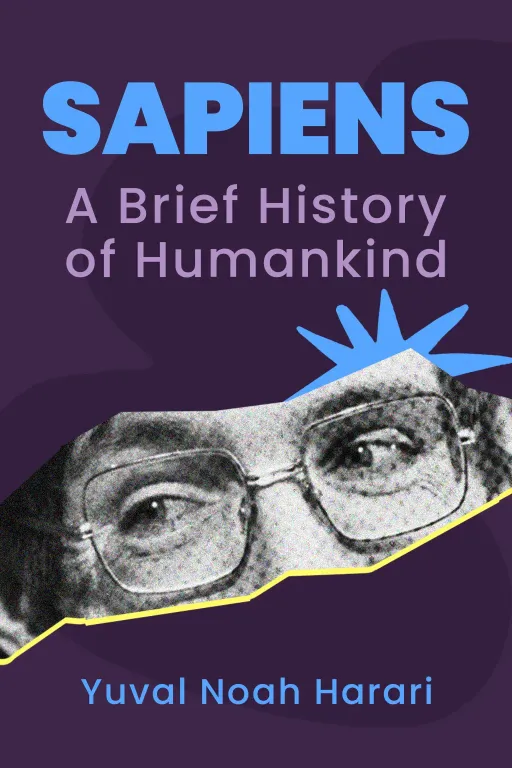
Nova: Not sci-fi, Atlas, but a profound re-evaluation of history laid out in "Sapiens: A Brief History of Humankind" by Yuval Noah Harari. This book became a global phenomenon, really shifting how millions of people understand our past, present, and future, by arguing that our greatest strength lies in what he calls "shared fictions." It's a book that truly forces you to rethink humanity's journey.
Atlas: Shared fictions? That sounds a bit… abstract. Are we talking about myths, or something more fundamental? I mean, how can something fictional be our strength?
Nova: That's the beautiful paradox Harari unveils. We often view human behavior in isolation, as if our actions are purely rational or individual. But Harari argues that our unique ability to create and believe in these shared fictions—these collective myths—is precisely what allowed us to dominate the planet. It's the ultimate blind spot we all have.
The Invisible Glue of Shared Fictions
SECTION
Nova: Think about it: every other animal cooperates, but usually only with a small, familiar group. A pack of wolves, a troop of chimps. They know each other personally. But humans? We can cooperate flexibly with of strangers. And we do it every single day.
Atlas: Right, like… I can buy a coffee from a barista I’ve never met, using a payment app connected to a bank I’ve never physically visited, and we both trust this exchange will work.
Nova: Exactly! And that trust, that entire system, is built on a shared fiction: money. A dollar bill is just a piece of paper, a number in a bank account is just data. It has no inherent value. Yet, billions of us collectively agree it does. We believe the story of money.
Atlas: Okay, so money is a story. But it feels real when I pay my rent or try to buy groceries! How does believing in a story translate into actual power and dominance? What makes that different from, say, a chimp knowing which trees have the best fruit?
Nova: The difference is scale and flexibility. A chimp knows its local environment and its small troop. It can't suddenly decide to cooperate with 10,000 chimps it's never met to build a skyscraper or launch a space mission. Our shared fictions allow us to imagine and agree upon concepts that don't exist in the physical world, like corporations.
Atlas: Corporations? That's a fiction? But they have buildings, employees, products…
Nova: They do, but the corporation itself is a legal fiction. It's an entity created by laws—which are also shared fictions—that allows thousands, sometimes hundreds of thousands, of people to work together towards a common goal. A corporation can own property, sign contracts, even be sued, but it doesn't have a body or a mind. It only exists because we all believe it exists.
Atlas: That’s a great way to put it. So it's like a universal operating system for humans? We all agree on the code, and that lets us run incredibly complex programs together?
Nova: Precisely. And that 'operating system' gave us an incredible evolutionary edge. It's not just money or corporations; think about nations. What is a nation? It's a vast group of people who often don't know each other, but they believe they share a common identity, a common history, often a common destiny. They agree on borders, on laws, on symbols like flags.
Atlas: So, a chimp wouldn't die for a flag, but humans will. Because the flag represents a story we've all bought into, a fiction that binds us together even if we've never met?
Nova: That's the power. This ability to create and believe in these myths allows us to cooperate on a scale that no other species can. That cooperation, whether for war or for building a city, is what ultimately allowed us to spread across the globe and shape it to our will. It's how we went from being just another ape to the dominant species.
Atlas: That makes me wonder, if nations and money are fictions, is there a danger in believing too strongly, or in the wrong fictions?
Nova: That's the crucial insight. Harari isn't saying these fictions are inherently bad, but understanding them as constructs gives us a powerful lens to examine their impact. They provide order and enable progress, but they can also lead to conflict, inequality, and even self-destructive behaviors when the stories we tell ourselves become rigid or exclusionary.
Synthesis & Takeaways
SECTION
Nova: So, this understanding of shared fictions fundamentally shifts our view of human behavior. Our conflicts, our aspirations, our entire social structure are built on these agreed-upon stories. It's a constant interplay between the objective reality of our biology and the subjective reality of our collective imagination.
Atlas: That's incredible. Considering our shared evolutionary history and these powerful fictions, one behavior that makes more sense to me now is… our unwavering loyalty to abstract groups, even when it seems irrational. Like sports teams, or political parties, or even brands. It’s all part of that same fictional glue, isn’t it? The belief in "us" versus "them" is just another story.
Nova: Absolutely. And recognizing this isn't to say these fictions are 'bad,' but to understand their immense power and how they shape our collective destiny. It's about seeing the matrix we operate within, and perhaps, even having the agency to question or reshape some of those stories for a better future. It’s about going beyond the surface and understanding the deep evolutionary roots of why we do what we do.
Atlas: That really makes you look at the world differently. We'd love to hear from our listeners: what human behavior makes more sense to now, after thinking about shared fictions and our evolutionary history? Share your thoughts with us online!
Nova: This is Aibrary. Congratulations on your growth!