The Invisible Hand of History: Understanding Today's World Through Yesterday's Lens.
Golden Hook & Introduction
SECTION
Nova: What if I told you the most powerful forces shaping your industry, your society, and even your daily life aren't tangible resources or political decisions, but invisible stories we all implicitly agree to believe?
Atlas: Whoa, that sounds a bit out there, Nova. Invisible stories? I'm used to dealing with balance sheets and market trends. But honestly, I'm always looking for those deeper patterns, the hidden levers that move everything. Tell me more.
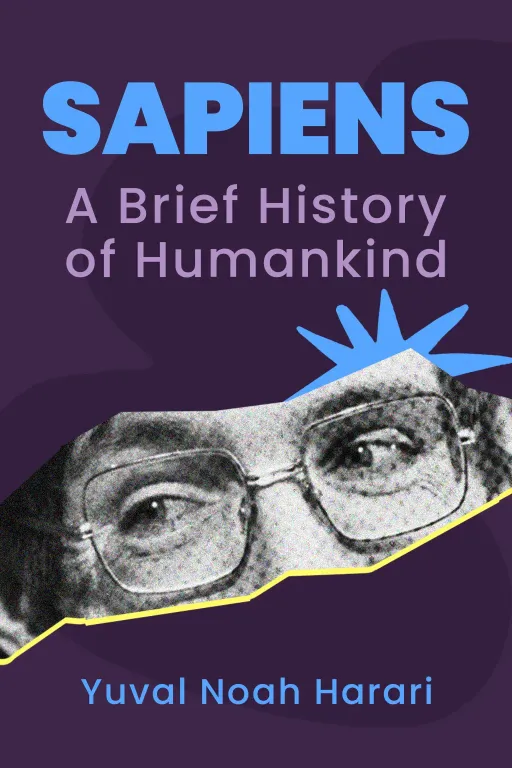
Nova: Absolutely, Atlas. Today, we're pulling back the curtain on those very forces, diving into two monumental works that completely reframe how we understand human history and our present. First, Yuval Noah Harari's groundbreaking. It's fascinating because that book, which has sold millions, actually started as a series of lectures for a general audience, not some dry academic treatise.
Atlas: I love that origin story. It speaks to making complex ideas accessible.
Nova: Exactly. And then we have Jared Diamond's Pulitzer Prize-winning. Can you believe that book was famously rejected by over two dozen publishers before becoming a global phenomenon? It just shows how revolutionary its ideas were.
Atlas: That's incredible. So, we're talking about books that really challenged the status quo. I'm curious, how do these two very different lenses help us understand those "invisible stories" you mentioned?
The Architects of Reality: How Shared Fictions Shape Our World
SECTION
Nova: Well, let's start with Harari and. He introduces this radical idea that what truly sets humans apart, what allowed us to dominate the planet and build complex societies, isn't just our intelligence or tools. It's our unique capacity to believe in shared fictions.
Atlas: Shared fictions. So you’re saying things like... Santa Claus?
Nova: A bit more profound than Santa, though the mechanism is similar! Think about it this way: a chimpanzee won't trade bananas for a promise of more bananas tomorrow, because that promise is just noise. But humans? We create intricate economic systems based on pieces of paper or digital numbers—money—that only have value because billions of people they do. That belief is the fiction.
Atlas: I totally know that feeling. It's like, you look at a $20 bill, and it's just paper, but it unlocks so much. It's not the paper itself, it's the shared agreement.
Nova: Precisely. This shared fiction of money allows strangers who have never met to cooperate on a massive scale. It enables global trade, complex supply chains, and the very existence of corporations. A company, legally speaking, is a 'legal fiction,' a story we tell that allows a collective of individuals to act as one entity with rights and responsibilities.
Atlas: Wow. That's actually really inspiring, because if we're building systems on these shared stories, then understanding them, and perhaps even consciously shaping them, could be incredibly powerful for building better organizations or even economies. What's another big one?
Nova: Nations. Consider the concept of a country. The borders on a map, the national identity, the idea of 'my people' or 'my flag'—these are all incredibly powerful shared fictions. They dictate who we go to war with, who we trade with, who we feel loyalty towards. They exist purely in our collective imagination, yet they have produced empires, revolutions, and global conflicts.
Atlas: That gives me chills, thinking about how something so intangible can lead to such profound, tangible consequences. For someone trying to build unshakeable team trust, this concept of shared fictions probably plays a huge role in developing a strong organizational culture. It's about buying into a common narrative, isn't it?
Nova: Exactly. The success of any large group, whether a nation or a company, often hinges on the strength and coherence of its shared fictions – its values, its mission, its vision. These aren't just words; they're the stories that bind people together and give meaning to their collective effort. When those fictions erode, so does the collective's ability to function.
Geography's Echo: Unpacking the Environmental Blueprint of Civilization
SECTION
Nova: From the invisible stories in our minds, let's shift to the very tangible, yet often overlooked, stage upon which these stories played out: our planet itself. This is where Jared Diamond's comes in. He argues that broad patterns of history, like why certain civilizations developed 'guns, germs, and steel' before others, weren't due to inherent superiority, but largely due to geographical and environmental luck.
Atlas: Hold on, so you're saying it's not about human ingenuity or drive, but where you happened to be born? That sounds rough.
Nova: It's a powerful argument that challenges many conventional assumptions. Diamond's core idea is that the availability of domesticable plants and animals, and the ease with which they could spread, was a massive head start. Eurasia, for instance, had a disproportionately high number of suitable wild species for domestication—like wheat, barley, and various large mammals.
Atlas: I guess that makes sense. If you have stable food sources and animals for labor, you can feed more people, build cities, and specialize.
Nova: Precisely. And here's the crucial part: Eurasia's landmass is primarily oriented along an east-west axis. This meant that crops and animals, and the innovations that came with them, could spread relatively easily across similar latitudes and climates. Think about how much easier it is to move wheat from France to China than it is to move corn from Mexico to Canada, because of the drastic climate changes along a north-south axis.
Atlas: That’s a great way to put it. So, the geographical alignment literally facilitated the sharing of knowledge and resources, accelerating development in those regions. I’ve been thinking about how this historical understanding of environmental determinism could inform our approach to global development or resource allocation today. Does it challenge our assumptions about 'merit' or 'failure' in different regions of the world?
Nova: It absolutely does. Diamond's work suggests that many of the disparities we see today have deep geographical roots, not just recent political or cultural ones. It's not about blaming geography, but understanding its profound historical influence. For example, the lack of domesticable animals in the Americas meant no beasts of burden, no animal-borne diseases to build immunity against, and slower agricultural diffusion. This put them at a severe disadvantage when they encountered Eurasian societies who had developed advanced weaponry, steel tools, and devastating diseases over millennia.
Atlas: That’s kind of heartbreaking. It puts so much of what we consider 'progress' into a completely different light. It makes me wonder about the unexamined impacts of these historical legacies on modern industries and societies, especially around access to resources or even global market dynamics.
Synthesis & Takeaways
SECTION
Nova: And that's where the two books start to intertwine. Harari shows us how our shared fictions allow us to organize and cooperate, giving us agency. Diamond reveals the geographical stage and the environmental constraints that shaped and those fictions could spread and flourish. Together, they illustrate the invisible hands—both conceptual and environmental—that have sculpted human history.
Atlas: So, it's not just about what we we're building, but the very ground we're building it on, and the collective stories that allow us to build anything at all. Understanding these deep historical currents helps us move beyond superficial explanations for current events. It offers a much more holistic view, which is exactly what I'm always looking for.
Nova: Exactly. It's about seeing the whole picture, recognizing that today's challenges aren't isolated incidents, but rather the culmination of millennia of both collective human imagination and environmental realities. It gives us a clearer lens to contextualize the present and envision more sustainable futures.
Atlas: That's actually really inspiring. It makes me think about the "Deep Question" we often pose. So, considering this long view of history—the power of shared fictions and the enduring echo of geography—what current 'shared fiction' or 'environmental legacy' do you believe has the most profound, yet often unexamined, impact on industry or society right now?
Nova: Something worth reflecting on, for sure.
Atlas: Absolutely.
Nova: This is Aibrary. Congratulations on your growth!