The Echo of Empires: Understanding History's Hidden Patterns
Golden Hook & Introduction
SECTION
Nova: What if the history books you read, the grand narratives you absorbed, were actually missing the plot? What if the real drivers of civilization weren't kings or battles, but something far more subtle, even invisible?
Atlas: Whoa, invisible? You’re telling me all those dates and names I memorized for history class were just… window dressing?
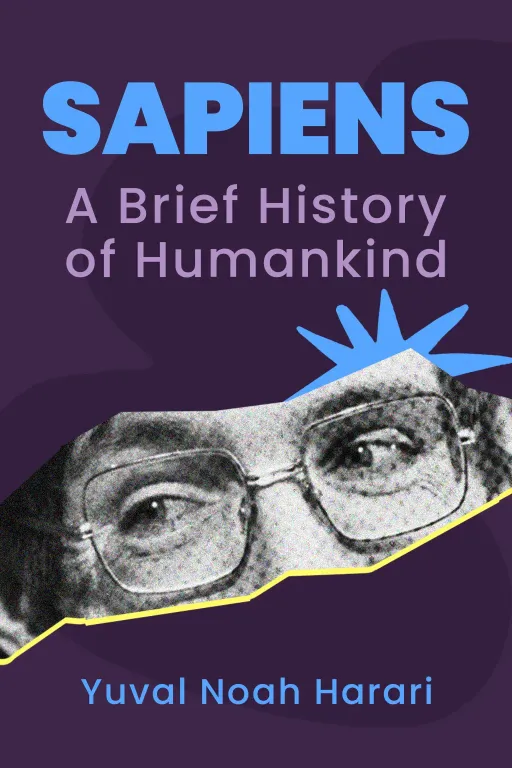
Nova: Exactly! Today, we're peeling back those layers to reveal the profound, often hidden, patterns that truly weave the tapestry of human history. We're diving into the groundbreaking insights from two intellectual titans: Yuval Noah Harari's "Sapiens: A Brief History of Humankind" and Jared Diamond's "Guns, Germs, and Steel."
Atlas: Oh, I love those authors! Both Harari and Diamond have this incredible knack for making incredibly complex, sprawling historical and anthropological concepts not just digestible, but genuinely captivating for a global audience. They really shifted how a lot of us think about the past.
Nova: They absolutely did. And what they both show us, from very different angles, is that history is far from a linear march of isolated events. It's a complex, repeating dance of culture, geography, and power.
The Power of Shared Fictions: How Ideas Shape Humanity (from "Sapiens")
SECTION
Nova: And that brings us to our first deep dive: the astonishing power of shared fictions. Harari, in "Sapiens," argues something truly revolutionary: that our ability to cooperate on a massive scale isn't down to biology or some inherent goodness. It's because we can all believe in the same made-up stories.
Atlas: Hold on, "fictions"? Are you genuinely saying that things like, say, our entire financial system, or even the concept of a nation, are just... elaborate stories we tell ourselves? That sounds a bit out there.
Nova: It sounds radical, but think about it. A dollar bill has intrinsic value only because billions of people collectively agree it does. The borders of a country, the laws that govern us, the very idea of human rights – these aren't physical realities. They are powerful, shared myths that allow us to organize ourselves into communities far larger than any primate troop could ever manage.
Atlas: So, it's like a collective hallucination that just... works? Because everyone buys into it? That’s actually really inspiring, but also kind of unsettling. It makes me wonder what other 'fictions' I'm living by without even realizing it.
Nova: Precisely. Before the Cognitive Revolution, our ancestors lived in small, intimate bands. Everyone knew everyone. But once we started telling these grand narratives – about gods, about tribes, about empires, and eventually about corporations and currency – we could suddenly coordinate millions, even billions, of strangers. It's the ultimate social technology.
Atlas: That’s a great way to put it. It explains how we jumped from a few dozen hunter-gatherers to sprawling cities and global trade networks. It wasn't just bigger brains, it was bigger imaginations.
Geography's Unseen Hand: How Environment Predetermines Destiny (from "Guns, Germs, and Steel")
SECTION
Nova: And that idea of fundamental, often invisible, drivers of history leads us directly to another profound perspective from Jared Diamond. If Harari talks about the invisible threads of our collective imagination, Diamond talks about the invisible hand of geography itself.
Atlas: So, if Harari talks about our minds, Diamond talks about the dirt beneath our feet? How does dirt dictate destiny?
Nova: It’s more than just dirt, Atlas, it’s the entire environmental lottery. Diamond’s groundbreaking work in "Guns, Germs, and Steel" argues that it wasn't racial superiority or inherent intelligence that gave some societies an early advantage. It was the sheer luck of their geographical hand.
Atlas: Okay, so… a society with good crops and animals just inherently had an advantage over one that didn't have them, almost like a geographical lottery? That makes me wonder what kind of luck my ancestors had with their local flora and fauna.
Nova: Exactly! Imagine living in the Fertile Crescent, where you have access to a dozen highly productive, easily domesticable plants like wheat and barley, and a host of large, docile animals like sheep, goats, and cows. Compare that to societies in the Americas, where the available domesticates were far fewer and harder to cultivate.
Atlas: That’s a perfect example. I can see how that would give you a massive head start. More food means more people, which means more specialization, more innovation, more complex societies.
Nova: And it compounded. These advantages spread more easily along the East-West axis of Eurasia, where climates and day lengths are similar, allowing crops and animals to thrive in new areas. The North-South axis of the Americas and Africa, with drastic climatic changes over shorter distances, made that spread much slower. This led to differential development, technological advancement, and even immunity to diseases that would later devastate populations encountering them for the first time.
Atlas: But wait, doesn't that sound a bit... deterministic? Like, it takes away human agency and makes it all about where you happened to be born?
Nova: Diamond is careful to point out it’s not about inherent superiority or inferiority. It’s about the initial conditions. Those early environmental advantages created a cascade of effects that snowballed over millennia, leading to the disparities we see today. It’s a powerful, and sometimes uncomfortable, lens through which to view global inequality. It forces us to look beyond immediate causes and consider the deep, ancient roots.
Synthesis & Takeaways
SECTION
Nova: So, what we've uncovered today, through the brilliance of Harari and Diamond, is that both our shared internal fictions and our external geographical realities are the silent architects of history. They explain why some civilizations flourished while others struggled, why some ideas took hold and others faded.
Atlas: That gives me chills, actually. When we look at, say, global disparities today, or even the challenges of international cooperation, we're really seeing the echoes of these ancient patterns, not just recent events. It makes you think about how much of our present is truly dictated by our past.
Nova: Absolutely. Understanding these hidden patterns – whether it’s the power of a shared belief system or the subtle influence of ancient geography – empowers us. It helps us move beyond superficial explanations for current global challenges and offers a much deeper, more nuanced understanding of our world. It's about recognizing the long game of history.
Atlas: It’s a powerful reminder that if we want to truly understand where we are, we have to grasp the invisible forces that got us here. What a journey through time and perspective!
Nova: Indeed. This is Aibrary. Congratulations on your growth!