Beyond the Map: Tracing Humanity's Journey with Empathy and Evidence
Golden Hook & Introduction
SECTION
Nova: Most of us think we know history. Dates, names, battles, kings, queens. A long, often dry, list of things that happened. But what if that familiar narrative is just the surface, and beneath it lies an intricate, invisible architecture that truly explains why our world is the way it is?
Atlas: Oh, I like that, Nova. That's going to resonate with anyone who ever struggled to stay awake in a history class. You’re hinting that the real story is much deeper, much more alive than the textbooks let on.
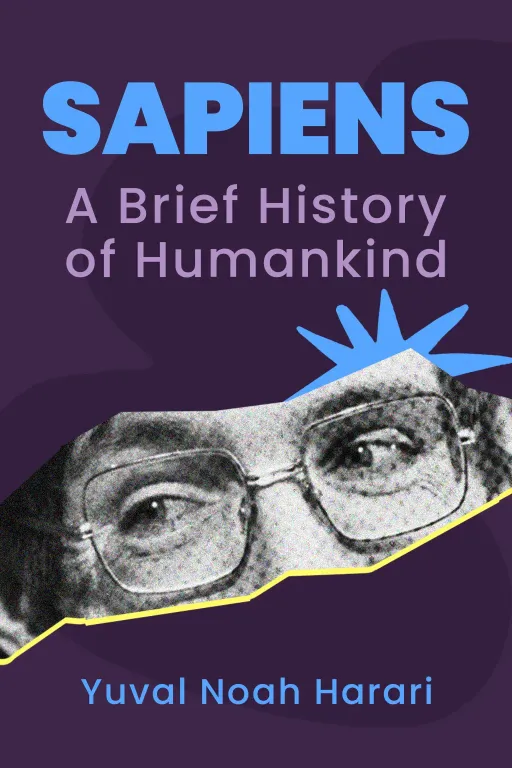
Nova: Exactly! Today, we’re venturing far beyond the dusty archives to explore the profound, often hidden, forces that have shaped humanity’s journey. And we’re doing it with the help of two absolute titans of modern historical thought. First up, we have Yuval Noah Harari’s groundbreaking book, Sapiens: A Brief History of Humankind. Harari, a historian by training, audaciously weaves together biology, anthropology, and economics, giving us this sweeping, interdisciplinary narrative that utterly reframes our understanding of human evolution. It’s a book that quickly became an international bestseller, translated into dozens of languages, and lauded for its ability to challenge conventional historical perspectives, even if some critics found its generalizations a bit too broad.
Atlas: Right, and then there’s the equally monumental Guns, Germs, and Steel by Jared Diamond. What's fascinating about Diamond is his background as a geographer and ornithologist, bringing this truly unique ecological and environmental lens to human history. That perspective earned him a Pulitzer Prize and sparked a massive academic discussion about the interplay between human agency and environmental factors.
Nova: Together, these two books don't just recount history; they provide a new set of glasses through which to see the entire human story. They ask us to look for the 'why' behind our shared experience across millennia.
The Unseen Architect: Shared Fictions and Human Cooperation
SECTION
Atlas: So, let's start with Harari’s Sapiens, because it introduces a concept that, honestly, sounds a bit… abstract. He talks about 'shared fictions.' What exactly do you mean by that, and how can something fictional be so powerful in shaping our very real world?
Nova: It's one of the most profound insights of the book. Harari argues that what truly sets Homo sapiens apart, what allowed us to dominate the planet and build complex societies, isn't just our intelligence or tools. It’s our unique ability to believe in shared fictions. These are collective myths, stories, and beliefs that exist only in our collective imagination, yet they allow millions of strangers to cooperate effectively. Think about it: a nation, a corporation, human rights, money… none of these exist physically. You can’t touch 'France' or 'Google' in the same way you can touch a tree.
Atlas: Hold on, so you’re saying that the very foundations of our global society – things we take as absolutely real and fundamental – are essentially made-up stories? That sounds almost… subversive.
Nova: It does, doesn't it? But consider money. A dollar bill, or a digital bank balance, has no intrinsic value. It's just a piece of paper or a number on a screen. Its value comes entirely from our collective belief, our shared fiction, that it have value. Because we all believe it, it enables billions of people who’ve never met to exchange goods and services, to build complex economies. Without that shared fiction, societal cooperation beyond a small tribe simply wouldn't be possible.
Atlas: That’s a great way to put it. I can definitely relate to the power of shared beliefs. It makes me wonder, how do these shared fictions continue to shape our daily lives or global interactions right now? Like, beyond just money.
Nova: Well, think about our legal systems or political ideologies. Democracy, capitalism, communism – these are all incredibly powerful shared fictions. We organize our entire societies around these abstract principles, and people are willing to live and die for them. They create our sense of identity, our purpose, and the rules of engagement for almost every interaction we have. Understanding this helps us see that these aren't immutable laws of nature; they are constructs we’ve created. And if we created them, we can potentially change them. It's a truly empowering, if also slightly unsettling, idea.
Geography's Iron Hand: How Environment Forged Civilizations
SECTION
Atlas: That's a mind-bending thought, Nova. The idea that so much of our reality is built on collective stories. But what if it's not all about these abstract concepts? What about the tangible, physical world around us? Surely the environment played a massive role in shaping human history too?
Nova: Absolutely! And that naturally leads us to Jared Diamond’s monumental work, Guns, Germs, and Steel. Diamond offers a powerful counterpoint, or perhaps a complementary lens, arguing that geographical and environmental factors have wielded an 'iron hand' in shaping the trajectories of different human societies. He asks, why did some continents develop advanced civilizations and technologies far earlier than others? Why did some peoples conquer, and others get conquered?
Atlas: Okay, so you’re saying it's not about inherent superiority or intelligence, but something more fundamental about the land itself? Can you give an example of how something as simple as geography could have such profound impacts?
Nova: He makes a compelling case. Consider the availability of domesticable plants and animals. Eurasia, for instance, had a massive advantage. It had a far greater diversity of large mammals suitable for domestication – cattle, sheep, goats, pigs, horses – and a wider array of high-yield cereal crops like wheat and barley. The Americas, by contrast, had very few. This meant Eurasian societies could develop agriculture much faster, leading to food surpluses, which then supported denser populations, specialized labor, and eventually, the rise of complex states, writing, and advanced technology.
Atlas: Wow. So, it's not just was available, but it was available too? As in, the spread of these innovations?
Nova: Precisely. Eurasia also benefits from its east-west axis. This meant that domesticated plants and animals, and the innovations that came with them, could spread much more easily across similar latitudes, maintaining similar climates and day lengths. In the Americas, the north-south axis meant major climate zones changed rapidly, making the spread of crops and technologies much slower and more challenging. This seemingly simple geographical fact compounded over millennia, leading to vastly different rates of development and ultimately, profound inequalities.
Atlas: That makes me wonder about agency, though. Are we just puppets of our environment, or do humans still have a say? It sounds almost like a deterministic view of history.
Nova: It's a crucial question, and Diamond is careful to emphasize that it's not about inherent superiority, nor does it remove human agency entirely. Instead, he highlights that these initial environmental advantages created a. Once one society developed agriculture, larger populations, and then technologies like steel and writing, those advantages became self-reinforcing. It's about understanding the deep, systemic, and often unconscious forces that set the stage, not about denying the millions of choices individuals and groups made within those constraints.
Synthesis & Takeaways
SECTION
Nova: So, when we look at history through the lenses of Harari's 'shared fictions' and Diamond's 'geography's iron hand,' we get a much richer, more nuanced picture. It’s not just about what happened, but it happened.
Atlas: Right. History isn't just a sequence of events. It’s this incredibly complex interplay between the stories we collectively invent to cooperate and the very real, physical constraints and opportunities presented by our environment. It's like seeing the hidden currents beneath the surface of the ocean, guiding the ships of human civilization.
Nova: Absolutely. And understanding these forces is so critical for making sense of our present world. It helps us challenge assumptions about why certain societies thrive or struggle, pushing us to look beyond simplistic explanations. It shows us that our global societies are shaped by both the invisible threads of our imagination and the immovable realities of our planet.
Atlas: That’s actually really inspiring, Nova. It makes you realize that the 'shared fictions' we continue to believe, and the environmental changes we face today, are still profoundly shaping our future. For our listeners who are always seeking to connect the dots, who want to trace the human story across time and cultures, this perspective offers a profound way to do that. Think about the 'shared fictions' or environmental influences from the past that continue to shape your current understanding of global societies. How might seeing these unseen architects change your perspective?
Nova: It’s an ongoing journey of discovery, and these books are brilliant guides.
Atlas: This is Aibrary. Congratulations on your growth!