

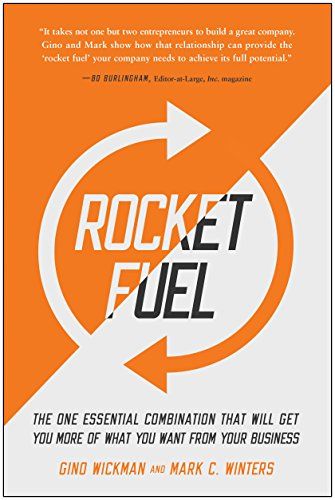
Rocket fuel
The One Essential Combination That Will Get You More of What You Want from Your Business
Introduction
Nova: Have you ever noticed how some small businesses seem to hit a wall after a few years of incredible growth? They have this brilliant founder who is essentially a force of nature, but suddenly, the gears start grinding. The founder is exhausted, the staff is confused, and that early magic just turns into daily chaos. It is a phenomenon known as the entrepreneur's ceiling, and today we are talking about the book that claims to have the secret ingredient to break through it. We are diving into Rocket Fuel by Gino Wickman and Mark Winters.
Nova: Exactly. And the core argument of Rocket Fuel is that most of these founders are trying to do two jobs that are fundamentally incompatible. Gino Wickman, who is also the mind behind the Traction system, argues that for a company to really take off, you need two distinct types of people at the top: the Visionary and the Integrator. Most people try to be both, and that is where the trouble begins.
Nova: Pretty much. Think of it like a rocket. You need the fuel, which is the big ideas and the passion, but without the rocket structure to contain and direct that energy, you just have a giant explosion on the launchpad. Rocket Fuel is about finding your other half to ensure you actually reach orbit.
Key Insight 1
The Visionary
Nova: Let us start with the Visionary. If you are an entrepreneur, there is a very high chance this is you. The Visionary is the person with ten miles of vision but often zero feet of ground-level execution. They are the ones who wake up at three in the morning with a world-changing idea, and by nine in the morning, they have five more. They are high-energy, they are great with big-picture strategy, and they are usually the ones who founded the company because they saw a gap in the market that no one else did.
Nova: Spot on. Wickman points out that Visionaries often have about twenty ideas a day. Now, the problem is that nineteen of those ideas might be total duds or even dangerous for the business. But that one twentieth idea? That is the one that generates millions of dollars. The challenge is that the Visionary usually treats all twenty ideas with the same level of manic intensity, which drives their employees absolutely crazy because they do not know what to focus on.
Nova: That is the Visionary's curse. They are creators, not finishers. They thrive on the hunt, the big deals, and the R and D. In the book, they list the five core functions of a Visionary. First is big ideas and R and D. Second is big-picture strategy. Third is the big relationships, like your key clients or partners. Fourth is the company culture and the vision. And fifth is the big, messy problem-solving that requires creative thinking.
Nova: That is why they are often miserable when the company grows. They get bogged down in the day-to-day management, which they are usually terrible at. They hate details. They hate repetitive tasks. They hate holding people accountable. When a Visionary is forced to manage people, they feel like they are in a cage. They lose their spark, and the company loses its edge.
Nova: Exactly. But it is more than just taking the boring stuff. They need someone who can actually tell them no. That is a hard pill for most Visionaries to swallow, but it is the only way they can actually scale.
Key Insight 2
The Integrator
Nova: This is where the Integrator comes in. If the Visionary is the engine, the Integrator is the transmission. They are the person who takes all those big, messy ideas and filters them through the lens of reality. An Integrator is naturally organized, detail-oriented, and focused on execution. They are the glue that holds the company together.
Nova: Usually, yes. In the EOS world, they are called the Integrator because their job is to integrate all the major functions of the business: sales, marketing, operations, finance. They are the ones who manage the day-to-day and ensure that the team is actually following the plan. While the Visionary is looking at the horizon three years out, the Integrator is looking at the next ninety days.
Nova: There is massive friction, and Wickman says that is actually a good thing as long as it is managed correctly. He calls it the two-piece puzzle. The Integrator's five functions are very different from the Visionary's. They handle leading, managing, and accountability, which we call LMA. they manage the profit and loss of the company. They execute the strategic plan. They act as the harmonizer for the leadership team. And finally, they are the ones who remove the obstacles.
Nova: That is a great analogy. The Integrator makes sure the woodwinds aren't playing a different song than the brass section. One of the biggest roles of an Integrator is to be the filter for the Visionary. When the Visionary comes in with twenty ideas, the Integrator says, Let us pick the one that actually fits our current goals and put the other nineteen in a folder for later. It saves the company from the whiplash we talked about earlier.
Nova: Oh, they definitely do. The book describes the Integrator as the person who has to say no more than anyone else in the company. But without that no, the company never gets anything done. A key point in the book is that the Integrator must have the authority to run the business. If the Visionary keeps stepping over the Integrator to give orders to the staff, the whole system breaks down.
Nova: It can be. A great Integrator doesn't need the spotlight. They get their satisfaction from seeing the machine run perfectly. They love systems and processes. While the Visionary is the one giving the keynote speech at the conference, the Integrator is the one back at the office making sure the orders are actually being shipped and the customers are happy.
Key Insight 3
The Five Rules of the Relationship
Nova: Now, putting these two together is like mixing chemical components. If you do it right, you get rocket fuel. If you do it wrong, the lab explodes. To prevent the explosion, Wickman and Winters outline five specific rules for the Visionary-Integrator relationship. The first rule is that they must be on the same page. They suggest a Same Page Meeting at least once a month where they can hammer out their differences in private.
Nova: Exactly. Rule number two is that the Integrator is the tie-breaker. This is the hardest one for founders. If they can't agree on a day-to-day operational issue, the Integrator has the final word. The Visionary has to trust them enough to let go of the steering wheel.
Nova: It is. But remember, the Visionary still owns the vision. They decide the destination. The Integrator just decides the best route to get there. Rule number three is about the Accountability Chart. You have to clearly define who is responsible for what. No overlapping duties. If both people are responsible for marketing, then no one is truly responsible.
Nova: Which leads perfectly into Rule number four: No end-runs. This is a big one. An end-run is when an employee goes to the Visionary because they didn't like the answer the Integrator gave them. Or, even worse, the Visionary goes straight to an employee to start a new project without telling the Integrator. Both of these are strictly forbidden. If an employee comes to the Visionary with a problem, the Visionary has to say, Have you talked to the Integrator about this?
Nova: Precisely. And the final rule, number five, is that the relationship must be based on mutual respect. The Visionary has to appreciate that the Integrator makes their life possible, and the Integrator has to appreciate that the Visionary is the reason they have a company to run in the first place. When that respect is there, the friction becomes productive instead of destructive.
Nova: It is frequently compared to a marriage in the book. And just like a marriage, you have to work on it. It doesn't just happen by accident. You have to be intentional about maintaining the chemistry.
Key Insight 4
Finding Your Type and Your Partner
Nova: So, after hearing this, a lot of people wonder, how do I know for sure which one I am? The book provides an assessment called the V-I Scorecard. There are some key indicators. For example, are you more focused on the future or the present? Do you prefer creating new things or making existing things better? Do you find yourself bored by details or energized by them?
Nova: Then you're definitely a rare breed! There are actually far fewer Integrators in the world than there are Visionaries. That is why they are so valuable. The book notes that many companies struggle because they have two Visionaries at the top. They have great ideas, but they are just spinning in circles because no one is grounding them. Or you have two Integrators, and the company is very efficient but it's not going anywhere because there's no innovation.
Nova: It is a process. Wickman suggest looking for people who are already in your life who seem to naturally fill that role. Often, it is someone already in the company who is frustrated because they see the chaos and want to fix it. But he also warns against just hiring a mini-me. A Visionary shouldn't hire another Visionary. You need someone who is your opposite in almost every way.
Nova: Right, but comfort doesn't build a rocket. You need the tension. The book suggests looking for someone who has the GWC factor. They have to Get it, they have to Want it, and they have to have the Capacity to do it. You need someone who has the emotional intelligence to handle the Visionary's personality but the steel in their spine to hold them accountable.
Nova: That is the Rocket Fuel effect. It is about moving from a state of being a job-owner to being a true business-owner. You are building a system that can thrive without you having to be involved in every single tiny decision.
Conclusion
Nova: To wrap things up, Rocket Fuel is really a call to self-awareness for any leader. It is about admitting that you can't be everything to everyone. If you are a Visionary, your job is to stay in the clouds and dream big, but you need an Integrator to build the ladder so you can actually reach those dreams. If you are an Integrator, you are the unsung hero who turns chaos into order and creates the foundation for lasting success.
Nova: Exactly. If you're feeling stuck or overwhelmed in your business, the answer might not be to work harder. It might be to find your other half. Stop trying to be the whole puzzle and start looking for the piece that fits yours. When you find that combination, you'll have all the fuel you need to go as far as your vision can take you.
Nova: This is Aibrary. Congratulations on your growth!