The Anxious Brain, Unlocked: A Blueprint for Resilience
Golden Hook & Introduction
SECTION
Socrates: Picture this: you're driving, and the car in front of you slams on its brakes. Before you can even form the thought 'danger,' your foot is already on the brake, your heart is pounding, your hands are gripping the wheel. That lightning-fast reaction is your amygdala. But then, five minutes later, you start worrying—'Did I leave the stove on?'—and a slow, creeping anxiety builds. That's your cortex. Two different feelings of anxiety, two completely different parts of the brain. So, who is really in charge, and why does one part seem to hijack the other?
Aliu Aliu Olawale: That's a question I think everyone can relate to, that feeling of being a passenger to your own emotions. It's a powerful way to frame the internal conflict we all feel.
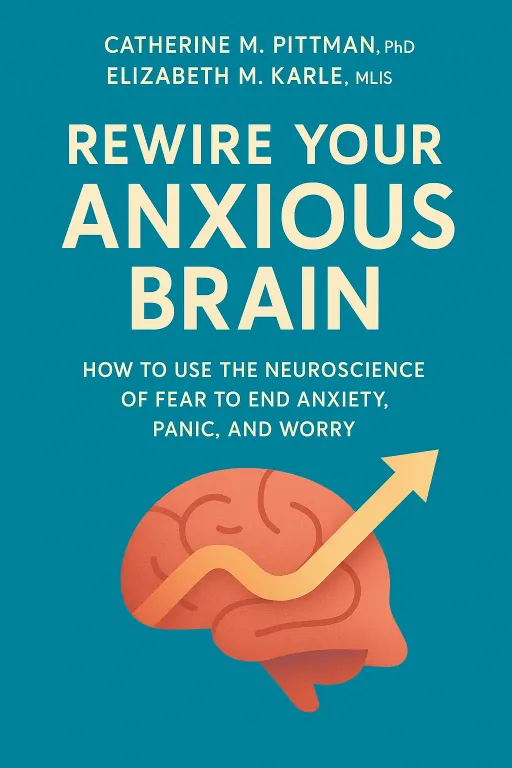
Socrates: It really is. And today, we're exploring the groundbreaking book 'Rewire Your Anxious Brain' by Catherine Pittman and Elizabeth Karle to answer that very question. We'll dive deep into this from two perspectives. First, we'll uncover these two separate 'engines' in your brain that produce anxiety. Then, we'll decode the strange and powerful language of the brain's fear center, revealing why it learns from experience, not arguments, and how you can finally start speaking its language. I'm so glad to have you here, Aliu. As a curious, analytical mind and a future healthcare professional, you're the perfect person to help dissect what is essentially a user manual for the anxious brain.
Aliu Aliu Olawale: Thanks, Socrates. I'm excited. Understanding the 'why' behind our feelings is the first step toward changing them, and this feels like a crucial piece of that puzzle, especially for anyone interested in personal growth or mental well-being.
Deep Dive into Core Topic 1: The Brain's Two Anxiety Engines
SECTION
Socrates: Fantastic. So Aliu, let's start with that first idea, the two engines. The book calls them the cortex pathway and the amygdala pathway. To make this real for everyone listening, let's look at a simple story from the book. Imagine a ten-year-old girl named Melinda. Her mom asks her to go down to the basement to find some camping gear. It's a little dim, a little cluttered. As she walks through a doorway, she suddenly sees a figure and jumps back, her heart racing. She feels a jolt of pure, physical fear.
Aliu Aliu Olawale: An instant reaction.
Socrates: Instant. But a second later, her eyes adjust, and she realizes... it's just a coat hanging on a coatrack. She lets out a breath and thinks, "Oh, it's just a coat." In that tiny moment, we see both pathways at work. The amygdala, the brain's smoke detector, saw a shape and screamed "Intruder!" triggering a physical, fight-or-flight response before her conscious brain even had a chance to process the details. That was the jump, the pounding heart.
Aliu Aliu Olawale: That's a perfect illustration. It's like the amygdala is the first responder on the scene—it doesn't wait for all the information, it just acts to prevent the worst-case scenario. The cortex, the thinking part of the brain, is the detective that arrives a moment later to calmly assess the situation and figure out what actually happened.
Socrates: Exactly! The first responder. And the book makes it clear this is an ancient survival mechanism. It's better to jump back from a stick that looks like a snake than to take time to analyze a snake that looks like a stick. But, what happens when that first responder is, let's say, over-caffeinated and starts seeing threats everywhere?
Aliu Aliu Olawale: Then you get chronic anxiety. It makes me think about patients who experience panic attacks. They often describe the feeling as coming 'out of the blue.' This model suggests it's not out of the blue at all; it's the amygdala pathway firing so fast and so powerfully that the cortex is left behind, scrambling to make sense of a massive physical reaction that's already in full swing. They feel the terror first, and only then does their mind try to find a reason for it.
Socrates: And that is the absolute key. You can't use the detective's logic to calm the first responder's adrenaline. They are fundamentally speaking different languages. Your cortex can say "it's just a coat" or "I'm not in danger," but the amygdala has already flooded your body with stress hormones.
Aliu Aliu Olawale: Which is why telling someone in a panic to "just calm down" is so ineffective. You're speaking cortex-language to an amygdala-problem. It's like trying to stop a fire with a history book.
Socrates: A history book! I love that. It's completely the wrong tool. And this brings us to the second, and perhaps more profound, idea in the book...
Deep Dive into Core Topic 2: Decoding the Amygdala's Language
SECTION
Socrates: ... so if the amygdala doesn't listen to logic, what language it speak? The book argues it speaks the language of association and raw experience. And there's a story in here that is just unforgettable. It's about a Vietnam veteran named Don.
Aliu Aliu Olawale: I'm listening.
Socrates: Don has PTSD. For years after the war, he's mostly stable. But then, suddenly, he starts having severe panic attacks every single morning. He wakes up, goes to take a shower, and is hit with overwhelming terror. There's no logical reason. He and his wife are completely baffled. He's not thinking about the war, nothing specific is happening. It's just this wave of panic, every day.
Aliu Aliu Olawale: That sounds incredibly distressing. The not-knowing must be part of the terror.
Socrates: Exactly. So Don, being methodical, starts paying close attention. He realizes the panic builds as he's in the shower. And then, one day, it hits him. He picks up the bar of soap and smells it. He realizes his wife, just by chance, had recently bought the same brand of soap that he had been issued and used every day during his tour in Vietnam.
Aliu Aliu Olawale: Wow. So the smell...
Socrates: The smell. A completely neutral sensory input. But his amygdala had created a powerful, unconscious association. During a time of intense fear and mortal danger, that smell was a constant presence. So his brain wired them together: "Smell of this specific soap equals danger." It wasn't logical. It was associative.
Aliu Aliu Olawale: That's... profound. It's not cause-and-effect, it's just... a pairing. The soap didn't the danger, but it was for the danger. The amygdala just wires them together. This is so important for de-stigmatizing anxiety and PTSD. It's not a character flaw or a weakness of mind; it's a memory circuit that's been wired by trauma, sometimes in ways we can't consciously access.
Socrates: Precisely. The book quotes the neuroscientist Joseph LeDoux, who says, "People don’t come preassembled, but are glued together by life." Your amygdala is glued together by these experiences. And this is why, as the book points out, you can't just Don, 'The soap is safe.' His cortex, his thinking brain, knows that perfectly well. But his amygdala doesn't. It's operating from an old, powerful memory.
Aliu Aliu Olawale: So to 'unglue' it, or maybe re-glue it differently, you have to give the amygdala a new experience. You have to create a new, competing association. This is the foundation of exposure therapy, isn't it? You have to, as the book says, 'activate to generate' a new connection. You have to experience the trigger—the smell of the soap—in a context that is repeatedly and demonstrably safe.
Socrates: You've hit the nail on the head. You have to show, not tell. The amygdala learns from doing, not from listening to a lecture. And that's the bridge between understanding our anxiety and actually beginning to heal it. It's about learning to speak the right language to the right part of the brain.
Synthesis & Takeaways
SECTION
Socrates: So, let's pull these two threads together. We have these two systems running in parallel: the thinking cortex and the feeling amygdala. The cortex creates worry with its 'what if' stories and future projections. The amygdala, on the other hand, creates instant, physical fear based on past associations it has learned.
Aliu Aliu Olawale: And the key insight, the real takeaway for me, is that they require completely different approaches. You can't reason with an amygdala trigger, and you can't just 'feel' your way out of a cortex-driven worry loop. You need a two-pronged strategy.
Socrates: Exactly. So, as we wrap up, let's leave our listeners with one simple, practical strategy for each. For that fast-acting amygdala, the one that hijacks your body, the book suggests something you can do right now: deep, slow breathing. It's a physical action that directly activates your body's parasympathetic nervous system—the 'rest and digest' system. It's a way of speaking the amygdala's native language of physical sensation to say, "We are safe. Stand down."
Aliu Aliu Olawale: I love that. It's a direct, physiological intervention. And for the cortex, for those looping worries about the future or ruminations about the past? The book's advice is brilliant: 'Don’t erase—replace.' Trying to force a thought out of your head is like trying not to think of a pink elephant; it just makes it stronger. Instead, you acknowledge the thought, and then consciously replace it with a concrete plan or a pre-prepared coping thought, like 'I am capable of handling this.' It's an act of mental redirection.
Socrates: Beautifully put. It's about actively choosing where to put your focus.
Aliu Aliu Olawale: So the question for everyone listening is: which engine is driving your anxiety right now? Is it the fast, physical amygdala, or the slow, worrying cortex? And, more importantly, are you using the right language to speak back to it?
Socrates: A perfect question to end on. Aliu, thank you for bringing your insight to this. It's been a fascinating discussion.
Aliu Aliu Olawale: The pleasure was all mine, Socrates. Thank you.