

The Scientist's Guide to Dreaming: A Blueprint for Real-World Change
Golden Hook & Introduction
SECTION
Nova: Deborah, as a scientist working on huge environmental challenges, you're driven by a vision of a better future. But what if I told you that the very act of fantasizing about that cleaner, healthier world could be the one thing sapping your energy to create it? That the dream itself could be a trap?
Deborah Ntaidu: That's a provocative question, Nova. My entire field is built on the pursuit of a better future. The idea that dreaming about it could be counterproductive… well, as a scientist, I'd say show me the data.
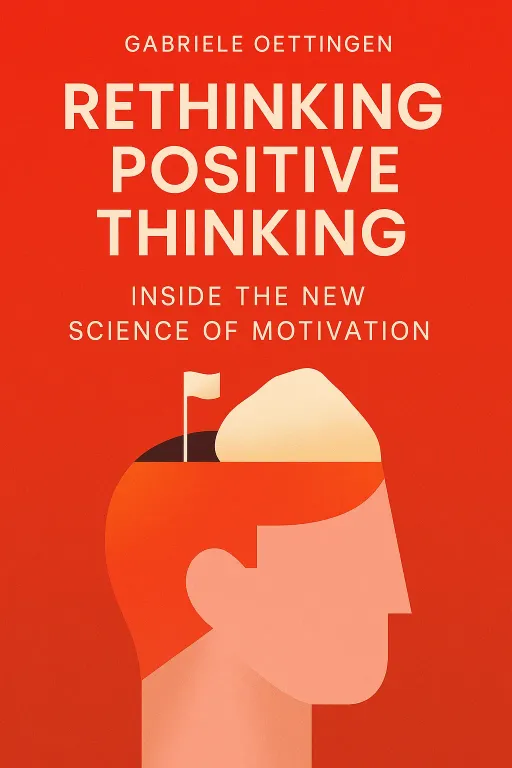
Nova: I am so glad you said that! Because that is exactly what we're doing today. We're diving into Gabriele Oettingen's book, "Rethinking Positive Thinking," which does just that. It dismantles one of the most cherished ideas of our time with cold, hard evidence. This is the radical idea at the heart of the book. Today we'll dive deep into this from two perspectives. First, we'll explore the surprising science showing why pure positive thinking can actually hold you back. Then, we'll equip you with a powerful, four-step tool called WOOP that turns this science into a practical strategy for achieving your most ambitious goals.
Deborah Ntaidu: I'm intrigued. A practical strategy based on evidence sounds right up my alley. Let's get into it.
Deep Dive into Core Topic 1: The Energy-Draining Power of Positive Fantasies
SECTION
Nova: So let's get right into the evidence, because I know that's where you live, Deborah. Oettingen didn't just guess about this; she ran experiments. Let's talk about one of the first ones from 1991: the Weight-Loss Study.
Deborah Ntaidu: Okay, a classic public health challenge.
Nova: Exactly. She took a group of 25 obese women who were enrolling in a comprehensive weight-loss program. She asked them two kinds of questions. First, she asked about their expectations: "Based on your past experiences, how likely do you think you are to succeed?" But then, she asked them to fantasize. She gave them open-ended scenarios, like seeing a tempting piece of cake, and asked them to write down their thoughts and daydreams.
Deborah Ntaidu: So she was separating logical expectation from free-form fantasy. That's a clever research design.
Nova: It's the key to the whole thing! A year later, she checked the results. The women who had high —the ones who said, "Yeah, I've succeeded at things like this before, I think I can do it"—they lost more weight. That makes sense. But here's the twist. The women who indulged in the most positive —the ones who wrote about how amazing it would feel to be thin, how everyone would admire them, how easy it would be—they lost, on average, 24 pounds than the other women.
Deborah Ntaidu: Twenty-four pounds less? That's a huge effect size. It's fascinating because it's so counterintuitive. As a researcher, my first question is about the mechanism. The book suggests this isn't just psychological, but physiological, right? The fantasy tricks the brain into feeling like the goal is already accomplished, so it lowers blood pressure, it calms you down... it basically puts your body on the couch when it needs to be on the treadmill.
Nova: You've nailed it! It's a state she calls "mental attainment." Your mind simulates the victory so well that your body relaxes. It's been measured. Systolic blood pressure drops. You feel calm, happy, and completely un-energized to do the hard work. And she found this same pattern everywhere. Take the study on graduate students looking for jobs.
Deborah Ntaidu: Oh, I can relate to that one.
Nova: Right? She had 83 grad students rate how often they fantasized about landing a great job with a high salary. Two years later, she followed up. The result was crystal clear: the more frequently students had experienced those positive fantasies, the fewer job applications they had sent out, the fewer offers they had received, and the less money they were earning.
Deborah Ntaidu: I see that. It's like fantasizing about a successful grant proposal defense. If you spend all your energy imagining the applause and the breakthrough discovery, you might not have the grit to stay up late re-analyzing the data for the tenth time. The fantasy becomes a substitute for the work. It's a form of mental procrastination, and it's particularly dangerous for long-term, difficult goals like the ones in environmental science.
Nova: That's the perfect term for it: mental procrastination. You feel like you're doing something productive by "visualizing success," but the data shows you're actually doing the opposite. You're taking a mental vacation.
Deborah Ntaidu: And that's a sobering thought. It implies that a lot of well-intentioned motivational advice could be actively harming people's progress.
Deep Dive into Core Topic 2: WOOP: The Scientist's Toolkit for Turning Dreams into Reality
SECTION
Nova: You've hit on the exact problem, Deborah. The fantasy becomes a substitute. So if dreaming is the trap, how do we get out of it? This is where Oettingen's work gets really powerful. She doesn't say 'stop dreaming.' She says, 'dream smarter.' And she created a tool for it, a simple acronym: WOOP.
Deborah Ntaidu: WOOP. Okay, what does it stand for?
Nova: It stands for Wish, Outcome, Obstacle, Plan. It's a simple, four-step mental exercise you can do in about five minutes. You start with your —a goal that's important to you. Then, you vividly imagine the best. You let yourself feel how great it would be. This is the positive fantasy part. But then—and this is the crucial pivot—you switch gears. You identify your main internal. What is it inside that holds you back? And finally, you make a simple 'if-then' to overcome that obstacle.
Deborah Ntaidu: So you're deliberately contrasting the dream with the reality of what's stopping you.
Nova: Precisely. It's called "mental contrasting." Let me give you a real-world example from the book, the story of Tammy. Tammy was a middle-aged school counselor who felt completely overwhelmed every evening. She'd come home from work and immediately feel this mountain of pressure: make dinner, do laundry, pay bills. She was stressed, and her family life was suffering.
Deborah Ntaidu: A very common problem.
Nova: A very common problem. So she did a WOOP. Her was: "to enjoy my evening without feeling overwhelmed." The best she imagined was a feeling of family harmony, laughing with her kids, connecting with her husband. Then came the hard part. The. It wasn't the chores themselves. She identified the obstacle as, and I'm quoting here, "the pressure I put on myself to get everything done right away." It was internal.
Deborah Ntaidu: That's a critical insight. The obstacle wasn't external, it was her own mindset.
Nova: Exactly. And that insight allowed her to make a. Her plan was: " I feel that pressure to do everything when I get home, I will stop and prioritize family closeness first." That very night, she came home, felt the usual stress, but her 'if-then' plan kicked in. She let the laundry go for a bit, baked cookies with her kids, and went for a long walk with her husband. She achieved her wish of a harmonious evening, not by getting more done, but by confronting the internal obstacle that was driving her.
Deborah Ntaidu: Okay, I love this. It's essentially a personal scientific method. The 'Wish' is your hypothesis. The 'Outcome' is the desired result. The 'Obstacle' is the critical variable you need to control for. And the 'Plan' is your experimental procedure. It's about designing a system for your own behavior, not just hoping for the best.
Nova: That's the perfect way to put it! It's designing a system for your own mind. And it's that 'Obstacle' step that's so key. It forces you to confront reality, and in doing so, it actually energizes you. The research shows that when you mentally contrast a feasible wish with an obstacle, your blood pressure actually goes. Your body gets ready for action.
Deborah Ntaidu: And it has to be an obstacle, right? That's what's so powerful. It's not 'my boss is the obstacle.' It's 'my fear of speaking up to my boss is the obstacle.' In my world, it's not 'there's no funding for this water quality project.' It's 'my own hesitation to write a bold, ambitious grant is the obstacle.' It puts the agency back in your hands. It moves you from being a victim of circumstance to being the scientist of your own life.
Synthesis & Takeaways
SECTION
Nova: The scientist of your own life. I love that. So we've gone from a surprising, almost depressing truth—that our dreams can demotivate us—to a practical, four-step tool that turns those dreams into fuel. It’s not about abandoning positive thinking, but about grounding it in reality. It's about confronting what holds us back, not just wishing it away.
Deborah Ntaidu: Exactly. It's about being a realist in order to be an effective dreamer. The fantasy gives you the 'why,' but confronting the obstacle gives you the 'how.' Without both, you're just stuck. The WOOP framework provides the structure to connect them.
Nova: So, as we wrap up, what's the one thing you'd want our listeners to take away from this, especially from your perspective as a scientist and a caregiver for the environment?
Deborah Ntaidu: I'd say, treat your own motivation like a research project. Be curious about what really works. And for anyone listening, especially if you're in a field like science, education, or activism where the goals are huge and the obstacles are many, I'd say just try it as an experiment. Pick one thing this week. Maybe it's a paper you're avoiding, or a difficult conversation you need to have. Ask yourself: What is my wish? What is the outcome? What is the real, internal obstacle? And what is my 'if-then' plan? Don't just think it, WOOP it. See what the data tells you.
Nova: A perfect call to action. Don't just hope for a better future, run the experiment to create it. Deborah, thank you so much for bringing your brilliant perspective to this.
Deborah Ntaidu: It was my pleasure, Nova. This was fascinating.









