The Hidden Cost of 'Always On': Reclaiming Your Time and Energy in a Demanding World.
Golden Hook & Introduction
SECTION
Nova: What if I told you that the very thing you've been taught to optimize—your time—is actually a red herring when it comes to sustainable high performance? That focusing solely on time management might be making you more exhausted, not less?
Atlas: Oh man, that just hit me right in the feels! I imagine a lot of our listeners, especially those who are always trying to cram more into their day, are feeling that exact exhaustion. It's like we're constantly chasing the clock, and the clock keeps winning.
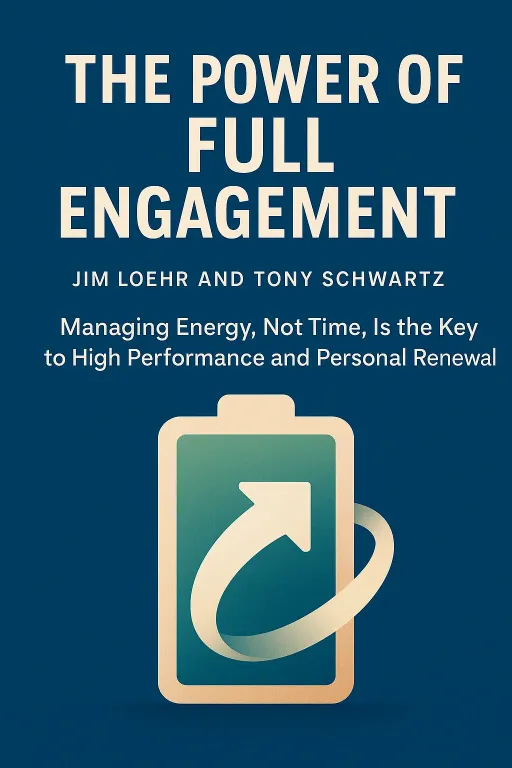
Nova: Exactly! It's a common trap. And today, we're going to dive into why that might be, drawing on some truly transformative insights. We're talking about the brilliant work of Jim Loehr and Tony Schwartz in their book, "The Power of Full Engagement." These two, with their background in sports psychology and performance coaching, bring a unique perspective to human capacity, showing us that the game isn't just about corporate efficiency.
Atlas: Right, and that immediately makes me think of the other side of that coin. Because if we're not managing time, what we managing? That's where Alex Soojung-Kim Pang steps in with his book, "Rest." Pang, coming from a background in Silicon Valley tech and foresight, saw firsthand the burnout culture he then sought to counteract. He makes a compelling case for rest not as a luxury, but as a critical, strategic tool.
Nova: Absolutely. And that's the core of our discussion today. The feeling of being perpetually exhausted, of being 'always on,' isn't a weakness. It's a signal. And understanding that signal, and how to respond to it, is what we'll explore. First, we'll challenge the very notion of time management as the ultimate key to productivity, and then we'll uncover the often-overlooked, strategic power of deliberate rest as a fuel for our most creative and effective selves.
Energy Management vs. Time Management: The True Path to Performance
SECTION
Nova: So, let's start by flipping the script. Loehr and Schwartz argue that sustainable high performance isn't about time management; it's about. They propose that we have four dimensions of energy: physical, emotional, mental, and spiritual. And our ability to perform at our best hinges on effectively renewing all of them.
Atlas: Okay, but for someone who's already juggling a million things, isn't 'managing energy' just another thing to manage? It sounds a bit abstract. How is this different from time management, which feels more tangible – like putting things on a calendar?
Nova: That's a great distinction, Atlas. Think of it like this: time is finite. We all get 24 hours. No amount of time management can give you more minutes. But energy is renewable. Imagine a high-performance athlete. They don't just train for 10 hours straight; they have cycles of intense effort followed by strategic recovery. They manage their physical energy with nutrition, sleep, and rest days. They manage their emotional energy by building positive relationships and celebrating wins.
Atlas: I see. So, it's not about just scheduling tasks, it's about scheduling your for those tasks. It's like having a phone with a great calendar app, but if the battery's dead, the app doesn't matter.
Nova: Exactly! The executive who prioritizes only back-to-back meetings, skipping meals, ignoring personal passions, and constantly reacting to emails, might be a master of their calendar. But they're likely depleting their physical, emotional, and mental batteries. The outcome? Burnout, poor decision-making, and eventually, ineffective performance. They're trying to operate on an empty tank, no matter how perfectly scheduled that empty tank is.
Atlas: That makes me wonder, then, what does managing emotional or spiritual energy look like in a practical sense? Because physical energy, like sleep and food, feels more straightforward. But emotional and spiritual? That sounds a bit out there for a busy professional.
Nova: Not at all. Emotional energy, for instance, comes from feeling appreciation, connection, and a sense of progress. If your work environment is toxic, or you're constantly feeling unappreciated, your emotional energy tanks. Managing it might mean setting boundaries, cultivating positive relationships, or engaging in activities that bring you joy and a sense of accomplishment. Spiritual energy is about purpose and values. Are you living in alignment with what truly matters to you? Regularly reflecting on your values, or engaging in activities that give you a sense of meaning, can recharge that spiritual battery. It's about proactive self-care across all these dimensions, not just squeezing more into time.
The Strategic Power of Deliberate Rest: Fueling Creativity and Productivity
SECTION
Nova: And speaking of renewal, that leads us perfectly to the often-misunderstood power of rest. Alex Soojung-Kim Pang, in "Rest," makes a powerful argument that rest isn't the opposite of work; it's of work. It’s what allows us to truly excel.
Atlas: I imagine a lot of our listeners hear 'rest' and think 'laziness' or 'time I'm not being productive.' Isn't that the default mindset, especially in demanding fields where busyness is often equated with importance?
Nova: Absolutely, that's the deeply ingrained cultural narrative we need to challenge. But here's the fascinating part: if you look at history's most productive and creative minds, they didn't just work all the time. Charles Darwin, for example, would work intensely for a few hours in the morning, then spend the rest of his day walking, reading non-scientific books, or just thinking. He called it his "daily constitutional." Albert Einstein famously took naps throughout the day. These weren't breaks from work; they were integral to their work.
Atlas: Wow, that's incredible. So, it's not just about stopping work, it's about a of rest? What does 'deliberate rest' look like for someone who feels they have no time for it? Like how do you even schedule "deep play" when your calendar is already packed?
Nova: The key is "deliberate." It's not passive consumption, like endlessly scrolling on your phone, which can actually be mentally draining. Deliberate rest involves activities that engage different parts of your brain or body in a restorative way. For Darwin, it was those long, thoughtful walks. For others, it might be playing a musical instrument, gardening, pursuing a hobby that requires focus but isn't work-related, or even just staring out the window for 15 minutes without distraction. The process is that these periods allow your unconscious mind to process information, consolidate memories, and make connections that conscious effort often misses. The outcome is enhanced creativity, sharper problem-solving, and a renewed sense of focus when you return to your tasks.
Atlas: That makes sense. It's like letting your brain defrag in the background. I guess that means those little "healing moments" the main content talks about—like a 15-minute walk without your phone—are actually incredibly powerful.
Nova: Precisely. They're not just about relaxation; they're about active mental and emotional renewal. It's a strategic investment in your capacity. By integrating these periods of deliberate rest, you're not just avoiding burnout; you're actively fueling your creativity and sustained productivity. You're giving your brain the space it needs to do its best work.
Synthesis & Takeaways
SECTION
Atlas: So, we're moving from a mindset of 'grind harder and manage every second' to 'optimize your internal resources and rest smarter.' It’s a complete paradigm shift.
Nova: It truly is. The hidden cost of 'always on' isn't just feeling tired; it's diminishing our capacity for creativity, deep thought, and ultimately, sustainable high performance. Loehr and Schwartz show us that managing our energy across all four dimensions – physical, emotional, mental, and spiritual – is the foundation. And Pang reinforces that deliberate rest isn't a luxury, but a non-negotiable component of that energy management.
Atlas: That's actually really inspiring, because it means we have more control than we think. It's not about finding more hours in the day, but about finding more and more in our hours. It’s about making that choice, isn't it? To honor your energy.
Nova: Exactly. Your exhaustion is a signal, not a weakness. And the answer isn't to push through it, but to strategically renew. So, for our listeners, what's one small, intentional period of complete disengagement you can plan today? Even just fifteen minutes. It's a powerful first step towards reclaiming your time and energy in this demanding world.