Beyond the To-Do List: How to Master Your Energy, Not Just Your Time.
Golden Hook & Introduction
SECTION
Nova: What if the biggest lie you've been told about productivity isn't about to manage your time, but that time is even the problem at all?
Atlas: Whoa, that's a bold claim right out of the gate, Nova. Because if there's one thing I hear constantly, it's "I don't have enough time." We're all chasing the clock, aren't we?
Nova: Absolutely, Atlas. We're conditioned to believe that if we just optimize our calendars, stack our to-do lists, and work longer hours, we'll finally conquer the beast of busyness. But what if that entire premise is fundamentally flawed? What if the real bottleneck isn't the minutes in your day, but the fuel in your tank?
Atlas: Okay, so you’re saying it’s not about time management, it’s about… something else? Because my calendar looks like a war zone, and I promise you, it feels like a time problem.
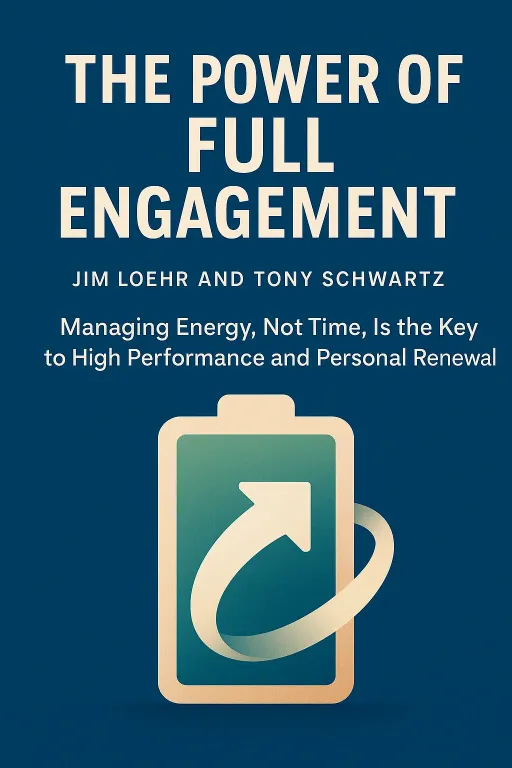
Nova: It feels that way because that's where we look. But today, we're diving into a paradigm shift articulated brilliantly by Jim Loehr and Tony Schwartz in "The Power of Full Engagement," and further illuminated by Alex Soojung-Kim Pang in his book "Rest." Loehr and Schwartz, in particular, came from a fascinating background – they were working with elite athletes, applying the rigorous principles of sports psychology to help them achieve peak performance, and then they realized these same principles were profoundly applicable to corporate executives, to trying to sustain high performance.
Atlas: So, they took what makes a champion athlete tick, and applied it to… well, people like us, juggling multiple ventures and trying to build a life beyond just a business? That's really interesting. It makes me wonder what they saw that the rest of us are missing.
Nova: Precisely. They saw that the problem wasn't a lack of hours; it was a lack of. And that, Atlas, is our first big idea: the radical reframing of productivity from time management to energy management.
The Energy-Time Paradigm Shift: Beyond the To-Do List
SECTION
Nova: So, let's unpack this. The cold, hard truth, as Loehr and Schwartz put it, is that you're not running out of time; you're running out of energy. Think of it like this: you can have an entire day stretched out before you, perfectly blocked out in your calendar, but if you're physically exhausted, emotionally drained, mentally scattered, and spiritually disengaged, that time is essentially useless.
Atlas: Right, like having a super-fast car but no gas in the tank. Or maybe, a car with gas, but the engine is sputtering, the tires are flat, and the driver is completely lost.
Nova: Exactly! They identify four interconnected sources of energy: physical, emotional, mental, and spiritual. And here’s the crucial part: true productivity comes from strategically and these energies, not just relentlessly spending them.
Atlas: Okay, I get physical energy – sleep, nutrition, exercise. That makes sense. But emotional, mental, and spiritual energy? Can you give us some concrete examples of what those actually mean, and how they get drained? Because for a lot of us who are trying to integrate our business, family, and faith, 'spiritual energy' sounds a bit… abstract.
Nova: Let’s break it down. Physical energy is indeed about the body – sleep, nutrition, movement. When you're physically depleted, you feel sluggish, you can't focus. Emotional energy is about the quality of your feelings. Are you feeling joy, gratitude, patience? Or are you constantly battling frustration, anger, anxiety? Being in a state of chronic negative emotions is incredibly draining. Think about a tough conversation or a conflict – you feel it in your gut, right?
Atlas: Oh, I know that feeling. A day full of back-to-back challenging conversations can absolutely wipe me out, even if I haven't physically moved much. It's like an emotional workout.
Nova: Precisely. Then there’s mental energy. This is about focus, concentration, analytical thinking. Constantly juggling tasks, switching contexts, or being bombarded by information drains your mental reserves. That feeling of brain fog or decision fatigue? That’s mental energy depletion.
Atlas: So, for someone like our listener, who's a natural integrator, constantly switching between different ventures and roles, that mental energy drain must be constant. It’s not just about getting through the to-do list, it’s about the of that list.
Nova: Absolutely. And finally, spiritual energy. This isn't necessarily about religion, though it can be. It's about your sense of purpose, meaning, and connection to your deepest values. When you're doing work that aligns with your values, you feel energized. When you're constantly compromising your beliefs or feeling like your work is meaningless, that’s a profound spiritual drain.
Atlas: That resonates deeply with someone who's building a life, not just a business, someone who values connection and purpose. If I'm doing things that don't feel right, even if they're "productive" on paper, it just… Hollows you out.
Nova: It does. And the critical insight here is that these four dimensions are interconnected. Neglecting one will inevitably impact the others. You can't just power through on mental energy if your emotional and physical tanks are empty. It's a recipe for burnout, not sustained success.
Strategic Recovery: Rest as a Partner to Work
SECTION
Nova: Now, understanding these energy sources is one thing, but the truly transformative insight comes from how we them. This is where Alex Soojung-Kim Pang's "Rest" comes into play, perfectly complementing Loehr and Schwartz. Pang makes a radical claim: rest is not the opposite of work; it's work's partner.
Atlas: But wait, Nova, that sounds almost heretical in our current hustle culture. We're told to grind, to push through, to always be "on." How do you convince someone that is actually productive? It sounds a bit out there.
Nova: It's completely counter-intuitive, isn't it? Pang reveals that highly creative and productive people throughout history weren't just working harder; they were. He talks about deliberate rest, which includes things like deep play, napping, long walks, and even structured hobbies. Think about Charles Darwin, who would walk for hours every day, often making his scientific breakthroughs during those seemingly unproductive strolls. Or Winston Churchill, famed for his afternoon naps, which he considered essential for sustained mental acuity during wartime.
Atlas: So, it's not permission to be lazy, but rather a strategic deployment of different kinds of activities that like rest but are actually fueling different energy dimensions. For someone who feels guilty taking a break, this is a total mindset flip.
Nova: Exactly. It's about strategic recovery. Just as an athlete trains intensely and then recovers intensely, we need to apply that same principle to our intellectual and creative lives. A 15-minute 'micro-recovery' isn't just about stepping away; it's about actively engaging in something that replenishes a specific energy source. Maybe it's a quick walk outside to recharge physical and mental energy, or a few minutes of meditation for spiritual and emotional.
Atlas: I can see how that would be powerful. For our listeners, who are often juggling multiple demands and striving for holistic growth, the idea of integrating these 'micro-recoveries' could be a game-changer. It’s not about finding an extra hour; it’s about making smarter choices within the time you already have.
Nova: It absolutely is. Pang's work shows that these periods of deliberate rest are crucial for creativity, problem-solving, and sustaining high-quality output over the long term. It's during these 'off' periods that our subconscious mind can connect disparate ideas, leading to those 'aha!' moments we crave.
Atlas: So you’re saying, to generate brilliant ideas, we actually need to spend time forcing them, and time allowing our minds to wander productively? That's actually really inspiring.
Nova: It's the ultimate paradox of productivity. The belief that more hours automatically equals more output is a fallacy. What truly matters is the quality of your energy, and the intentionality of your recovery.
Synthesis & Takeaways
SECTION
Nova: So, what we've really explored today is a profound shift: moving beyond the tyranny of the to-do list and embracing a more holistic, sustainable approach to life and work. It's about recognizing that our capacity isn't infinite, and that strategic recovery is not a luxury, but the very engine of sustained high performance and well-being.
Atlas: That gives me chills, Nova. It’s such a hopeful way to look at it, especially for those of us who feel like we’re constantly battling the clock and running on fumes. It’s not about doing more; it’s about being more intentional about how we live and work. How might focusing on energy, not just time, fundamentally change how you approach all the dimensions of your life – your business, your family, your faith, your self?
Nova: That’s the question, isn't it? And the tiny step we want to leave our listeners with today is this: Identify just one energy drain you experience daily. Perhaps it's endless scrolling, or back-to-back meetings, or even just sitting too long. Then, schedule a 15-minute 'micro-recovery' activity to counter it today. It could be a walk, a few deep breaths, listening to a favorite song, or even just staring out the window.
Atlas: It’s a simple act of self-awareness and self-care, acknowledging that you're not a machine, but a complex system that needs deliberate refueling. What a powerful idea.
Nova: Indeed. And it's one that can profoundly change the trajectory of your productivity and your peace of mind.
Atlas: Absolutely. Thank you, Nova, for shedding light on such a critical topic.
Nova: And thank you, Atlas, for those excellent insights.
Nova: This is Aibrary. Congratulations on your growth!