The Mindset Edit: Rewriting Your Brain for Confidence and Connection
Golden Hook & Introduction
SECTION
Nova: Have you ever felt like you have, and I'm quoting here, "three radio stations playing in your head at the same time"?
Jasmin: Oh, wow. Yes. All the time.
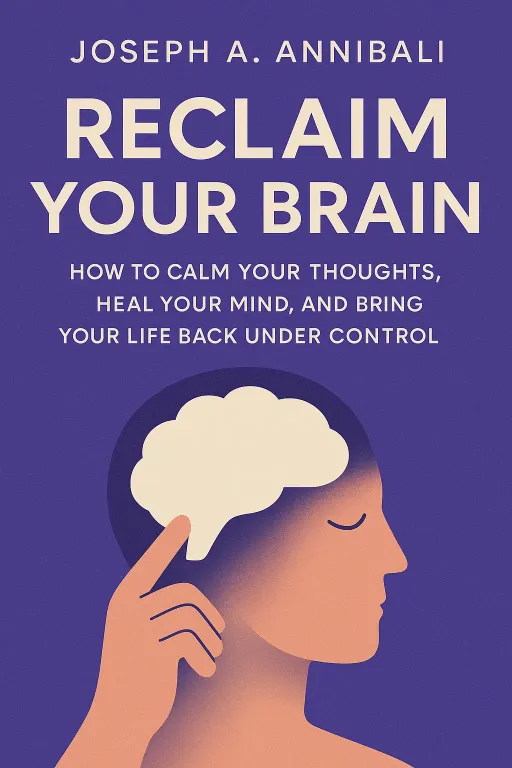
Nova: Right? That's how one woman in Dr. Joseph Annibali's book, "Reclaim Your Brain," described her mind. It's this constant, buzzing, overwhelming feeling that so many of us, especially in our hyper-connected world, know all too well. It's that "busy brain" that can hijack our focus, our confidence, and even our relationships.
Jasmin: It's such a perfect description. That feeling of being pulled in a million directions at once, where you can't find the 'off' switch. It’s like having too many browser tabs open in your mind, and they’re all auto-playing videos.
Nova: Exactly. And today, we're going to use this incredible book as our guide to find that switch. We're so glad to have you here, Jasmin, because your interest in mindset, emotions, and relationships is the perfect lens for this. Today we'll dive deep into this from two perspectives. First, we'll explore the science behind why our brains feel so 'busy' and out of control.
Jasmin: The 'why' behind the chaos. I love that.
Nova: And then, we'll discuss a powerful, actionable technique for rewriting the negative stories that hold us back, especially in our relationships. It's about moving from being a passenger in our own minds to becoming the active author of our mental and emotional lives.
Jasmin: I'm ready. Let's get into it.
Deep Dive into Core Topic 1: The Brain's Tug-of-War
SECTION
Nova: So let's start with the hardware. Dr. Annibali explains that this 'busy brain' feeling isn't just a metaphor. It's a real biological event. He describes it as a tug-of-war between two key parts of our brain: the prefrontal cortex, or PFC, and the limbic system.
Jasmin: Okay, break that down for us.
Nova: Think of your prefrontal cortex as the calm, experienced CEO of your brain. It's the part right behind your forehead that handles logic, planning, impulse control, and concentration. It's the adult in the room.
Jasmin: The one that says, "Maybe we shouldn't send that angry email at 2 a. m."
Nova: Precisely! Then you have the limbic system, deep in the center of the brain. Dr. Annibali calls it the "wild horses." It's the seat of our emotions, our fight-or-flight response, our anxiety. It's powerful, fast, and essential for survival, but it's not always rational. A healthy mind is one where the CEO—the PFC—is holding the reins and guiding the wild horses.
Jasmin: But when we're stressed, it feels like the horses are running wild and the CEO has been thrown from the carriage.
Nova: That's the perfect image. The book gives a great example with a woman named Sierra. She's a caregiver for her mother, who has worsening dementia. She's also juggling her job and her own household. Her stress level is already incredibly high, meaning her limbic system is constantly on high alert.
Jasmin: That sounds exhausting.
Nova: It is. And then, a seemingly normal stressor hits: the April 15th tax deadline is approaching. For most people, it's an annoyance. For Sierra, whose PFC is already exhausted from trying to manage everything, it's the final straw. The book says her limbic system goes into overdrive, the wild horses break free, and she starts having full-blown panic attacks. Her brain's balance is completely overthrown.
Jasmin: Wow. That story is so powerful because it's not some huge, dramatic, life-altering event that causes the break. It's the drip, drip, drip of everyday stress that finally overflows the container. It makes me think about the media world, where we're constantly in that high-alert state, reacting to breaking news or social media trends. It feels like our limbic system is the one running the show, and the PFC has left the building!
Nova: It's a state of chronic activation. Your brain doesn't get a chance to reset.
Jasmin: So, if our inner CEO is constantly getting overwhelmed by these wild, emotional horses, how do we start to support it? How do we give the CEO a fighting chance?
Deep Dive into Core Topic 2: The Mindset Edit
SECTION
Nova: That's the perfect question, and it leads us right to our second point. Because it's not just about the brain's hardware, but the 'software' we run on it—the stories we tell ourselves. And sometimes, these stories are the very things keeping our limbic system on high alert, constantly feeding those wild horses.
Jasmin: So the stories we believe about ourselves can physically impact our brain's balance.
Nova: Absolutely. This is where the book gets really transformative. Dr. Annibali shares the story of a patient named Gwen, and it's one that really stuck with me. Gwen was 29, a successful professional, attractive, outgoing... but she was completely unable to form a lasting romantic relationship.
Jasmin: What was holding her back?
Nova: For months in therapy, she couldn't put her finger on it. But finally, she revealed her secret. Years earlier, she had contracted herpes from a boyfriend. And the story she built around this fact was devastating. The story was: "I am damaged. I am dirty. I am unlovable."
Jasmin: Oh, that's heartbreaking.
Nova: It was. And this story was so powerful that it became her reality. She would date men, but as soon as a relationship started to get serious or move toward intimacy, she would unconsciously sabotage it. She'd pick a fight, find a flaw, or just pull away. Her story was a self-fulfilling prophecy, protecting her from the rejection she was certain would come if anyone ever found out her secret.
Jasmin: That's incredibly vulnerable and so brave of her to finally share. It really speaks to the 'self-confidence' and 'love relationships' piece that I'm so interested in. In our 20s, there's so much pressure to present this perfect, curated version of ourselves, online and offline. A story like Gwen's, born from something so personal and stigmatized, can feel like your entire identity.
Nova: It really can. And the healing process for her wasn't about changing the fact of her condition. It was about changing the story. Her therapist helped her do a few key things. First, to herself from the thought. To see it not as a fundamental truth, but as a thought her brain was producing. Second, she started a gratitude practice, focusing on all her other amazing qualities—her intelligence, her humor, her loyalty.
Jasmin: She was rewriting the script, focusing on the other characters and plotlines, not just this one difficult scene.
Nova: Beautifully put. And she learned to challenge the story. She realized that about one in five Americans has the same condition. She wasn't some unique, unlovable outcast. She was a normal person dealing with a common medical issue.
Jasmin: It's one thing to logically know a story is harmful, but how do you begin to detach from it when it feels so real, so defining?
Nova: That's the core of the work. It's about creating that initial sliver of space between you and the thought. Dr. Annibali emphasizes that you are not your thoughts. You are the observer of your thoughts. For Gwen, this process took time, but eventually, she met someone she really liked. And with her therapist, she practiced how she would tell him. She finally did, and you know what? He accepted her completely. They went on to get married. She changed her story, and in doing so, she changed her life.
Jasmin: That gives me chills. She didn't let the story be the editor of her life anymore. She became the editor.
Synthesis & Takeaways
SECTION
Nova: And that's the beautiful synthesis of Dr. Annibali's work. We have this biological tendency for our 'wild horses' to run amok, especially in our stressful modern world. But we also have this incredible power of consciousness—the ability to become the editor of our own minds.
Jasmin: It's about understanding the brain's default settings, but not being a slave to them. We can install new software.
Nova: Exactly. And for anyone listening who feels overwhelmed by this, the book offers a simple but profound first step. It's a technique for creating that distance we talked about. Dr. Annibali calls it the 'Ronald Reagan Approach.'
Jasmin: Okay, I'm intrigued. What is it?
Nova: When you catch yourself in a spiral of negative thinking, you simply say to yourself, with a bit of humor and detachment, "There's my brain being negative again."
Jasmin: "There you go again..."
Nova: Exactly! You're not fighting the thought, you're not judging yourself for having it. You're just observing it, labeling it as a product of your brain's hardwiring. It's a pattern, not a prophecy.
Jasmin: I love that. It's not about self-criticism, it's about self-awareness. It's like you're a journalist observing a source, not becoming the story itself. It creates that tiny bit of space you need to choose a different thought, a different action.
Nova: It's the first step in the edit. It's how you take the pen back. So for everyone listening, as we wrap up, we want to leave you with a question to ponder, a little piece of homework for your own self-care.
Jasmin: What's one story you've been telling yourself that might be due for an edit?
Nova: It could be about your career, your abilities, or your relationships. Just notice it. That's where the power begins. Jasmin, thank you so much for these incredible insights.
Jasmin: This was amazing. Thank you, Nova.