The Entrepreneur's Busy Brain: From Overwhelm to Executive Control
Golden Hook & Introduction
SECTION
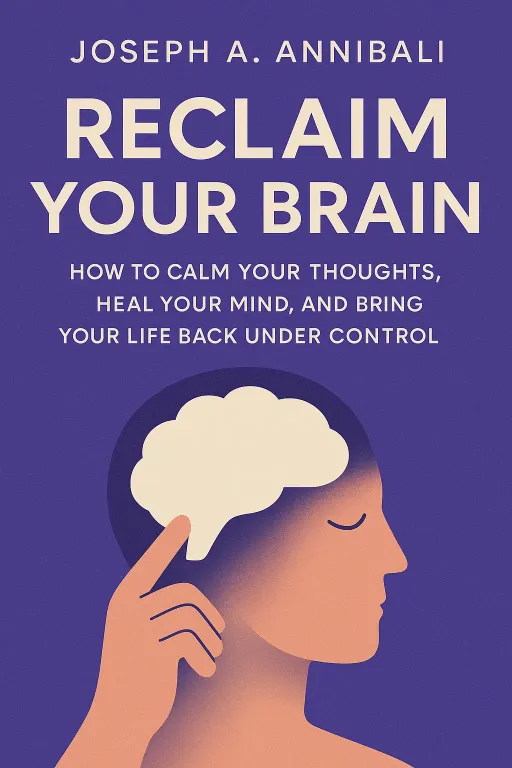
Albert Einstein: Have you ever felt like you have three radio stations playing in your head at the same time? One is your to-do list, another is a worry about a client, and the third is what you need to do for your family tonight. For entrepreneurs, this isn't just a feeling; it's a state of being. It's what Dr. Joseph Annibali calls the 'busy brain,' and it's a sign that a hidden civil war is raging between the part of your brain that plans and the part that panics. Today, with creative entrepreneur David Rojas, we're going to explore the groundbreaking insights from "Reclaim Your Brain." Welcome, David.
rojasdavid2010: Thanks for having me, Albert. And that 'three radio stations' metaphor... that's my life in a sentence. Running a videography business, a couple of tinting shops... my brain is a constant buzz.
Albert Einstein: It's a familiar tune for so many. And that's why this book is so compelling. It gives us a blueprint of what's happening inside. So today, we'll dive deep into this from two perspectives. First, we'll explore that hidden 'civil war' inside your brain between your inner CEO and your emotional core. Then, we'll discuss a powerful technique for rewriting the mental scripts that dictate your success and sanity.
rojasdavid2010: I'm ready. I think every business owner is looking for the manual to their own brain.
Deep Dive into Core Topic 1: The Brain's Executive Dysfunction
SECTION
Albert Einstein: Well, let's open it up to page one. David, that feeling of being pulled in a million directions is so universal, and the book gives it a name. It's a battle between your Prefrontal Cortex—let's call it your brain's CEO—and your Limbic System. We can think of that as the emotional 'first responder.' The CEO is in charge of logic, planning, time management, impulse control. The first responder handles fear, anxiety, excitement—the raw emotions. A 'busy brain' is simply the CEO losing control of the first responder.
rojasdavid2010: The CEO is overwhelmed. That makes perfect sense. My CEO is trying to plan a shoot, budget for new equipment, and schedule social media posts, but the first responder is panicking about a difficult client or a looming deadline.
Albert Einstein: Precisely. And this isn't just a metaphor; it's a biological reality of competing resources. The book gives a powerful example of this. It tells the story of a man named Thad. Imagine working for sixteen months straight on one massive, company-defining proposal. Day and night. Your company's future, your career, it all hangs in the balance.
rojasdavid2010: I don't have to imagine it. That's the feeling of launching a new service or getting through a packed wedding season.
Albert Einstein: Exactly. So for Thad, his stress response was on full blast for over a year. The book describes his limbic system—his emotional first responder—as being in constant overdrive. It was a state of emergency, every single day. Eventually, his Prefrontal Cortex, the CEO part that should be strategizing and staying calm, just... ran out of energy. It was completely overwhelmed and could no longer hold back the flood of anxiety and depression. He burned out.
rojasdavid2010: Wow. That's incredibly relatable. For us, it's wedding season. You're not just filming; you're a project manager, a therapist, a technician. Your PFC, your CEO, is the shot list, the schedule, the camera settings. But the limbic system is the bride's unexpected tears, the best man's awkward speech, the fear of missing a key moment. It feels exactly like that—the book calls them the 'wild horses' of the limbic system, right? Just running all over your carefully laid plans.
Albert Einstein: A perfect analogy! And the book stresses that when this happens, it's not a failure of character. It's a failure of. Your PFC is simply running out of the glucose and oxygen it needs to control those powerful limbic impulses. In your world, David, what do you think is the biggest drain on your 'PFC energy' during a typical work week?
rojasdavid2010: Oh, easily context-switching. In a single day, I can jump from editing a deeply emotional wedding film, which is all right-brain creativity, to a budget meeting for the tinting business, which is pure left-brain analytics. Then I might have to go direct a high-energy social media shoot for a car dealership. Each one of those switches feels like it requires my PFC to completely reboot.
Albert Einstein: Fascinating. So it's the cognitive friction of changing roles.
rojasdavid2010: Exactly. And by the end of the day, the CEO is exhausted. There's no energy left for the 'job' at home, which is being an emotionally present husband. My wife gets the dregs of my PFC, when the limbic system is already taking over from the day's stress. That's where the real challenge is.
Deep Dive into Core Topic 2: Hacking Your Brain's Narrative
SECTION
Albert Einstein: And that exhaustion, that feeling of 'not having enough,' leads perfectly to our second idea, which is perhaps the most hopeful part of the book. It argues that the we tell ourselves about that exhaustion is what gives it power. It's not just about managing the brain's hardware; it's about updating its software.
rojasdavid2010: I'm intrigued. So it's about the internal monologue.
Albert Einstein: Precisely. The book introduces us to a man named Carl, an accountant in his late forties. He's good at his job, but he always feels behind. He procrastinates, he's disorganized, and his internal story, his software, is brutal. He's constantly thinking, "I'm next to worthless. Why can't I keep up?" He genuinely believes he's lazy and incompetent.
rojasdavid2010: I know that voice. Every entrepreneur does. It's the voice of comparison, of not being 'enough'.
Albert Einstein: But then, something remarkable happens. Carl's son gets diagnosed with ADHD, and a lightbulb goes on for Carl. He recognizes the same patterns in himself. He gets evaluated and discovers he also has ADHD. Now, watch what happens to the story. It's no longer, "I'm lazy and worthless." The story changes to, "My brain is wired differently, and I have been succeeding for decades this invisible challenge." The book makes it clear that this one shift in narrative was as powerful as any medication he was prescribed.
rojasdavid2010: That's a complete game-changer. Because as a business owner, you're your own worst critic. The default story is often, "If I were better at time management, I could scale faster," or "If I were a better leader, my team wouldn't be so stressed." It's always a story of personal lack.
Albert Einstein: Yes! It's a judgment. So, using Carl's example, how could you rewrite one of those stories? Let's take that one: "I'm bad at time management."
rojasdavid2010: Hmm. The rewrite, based on this, would be something like... "I am successfully managing three distinct business operations simultaneously. The feeling of being stretched isn't a personal failing at time management, but a systemic challenge that now requires a new tool—like outsourcing my editing, hiring an assistant, or implementing a new project management software."
Albert Einstein: Brilliant! Do you feel the difference?
rojasdavid2010: Absolutely. The first story is a dead end. It's just guilt. The second story is empowering. It shifts the focus from a character flaw to a strategic problem to be solved. It gives the PFC, the CEO, a clear job to do, instead of just having it beat itself up.
Albert Einstein: And that, right there, is what the book calls self-directed neuroplasticity. By consciously choosing a new, more accurate story, you are literally giving your brain a new, more productive neural pathway to run on. You're taking back control from the negative loop that keeps the limbic system in charge. You're updating your own software.
Synthesis & Takeaways
SECTION
Albert Einstein: So, to bring it all together, we've seen the 'busy brain' not as a vague feeling, but as a very real battle between the executive PFC and the emotional limbic system. And we've discovered that one of the most powerful ways to arm our inner CEO isn't just to work harder, but to work smarter by rewriting the negative stories we tell ourselves.
rojasdavid2010: It's about understanding the biology of overwhelm and then using psychology to fight back. It feels much more manageable when you frame it that way.
Albert Einstein: It does. Now, the book is filled with practical tools, but there's one I think is perfect for someone juggling as much as you are, David. It's a technique for when you feel that limbic system hijack happening in real-time. It's called Heart-Focused Breathing.
rojasdavid2010: I love the sound of that. It connects to the personal side of what I'm working on—being more present, my faith. What does it involve?
Albert Einstein: It's wonderfully simple. There are five steps. First, you just have to recognize you're feeling stressed or overwhelmed. That's step one: awareness. Second, you consciously shift your focus to the area around your heart. Third, you start to breathe a little slower and deeper than you normally would. Nothing forced, just intentional.
rojasdavid2010: Okay, I can do that. What's next?
Albert Einstein: Fourth, and this is the key, you try to generate a positive, regenerative feeling. The book suggests thinking of someone you love, a moment of gratitude, the love you have for your wife, or the pride you feel when you deliver a beautiful wedding video. And fifth, from that calmer state, you can try to reframe the stressful situation from a new perspective. The science says this simple act can shift your heart-rate variability, which sends a powerful calming signal directly to your brain's limbic system.
rojasdavid2010: So the next time I'm in the middle of a chaotic shoot, or I get home feeling completely drained and my wife needs me, instead of just pushing through with brute force, I can take 60 seconds to do that. It's a practical way to manage the 'hardware' and the 'software' at the same time. That's something I can start doing today.
Albert Einstein: Exactly. It's not about eliminating the chaos of an entrepreneur's life. It's about learning how to reclaim your brain right in the middle of it. A powerful thought to end on. David, thank you for sharing your perspective today.
rojasdavid2010: This was fantastic. Thank you, Albert. I feel like my inner CEO just got a much-needed strategy briefing.