The Boundary Blueprint
Golden Hook & Introduction
SECTION
Nova: Most people think setting boundaries is about building walls to keep others out. In reality, boundaries are a blueprint for how you let people in without losing yourself in the process. They are the structural integrity of your emotional life.
Atlas: That is a sharp way to frame it. Most of us treat boundaries like a standoff, where we are either defending a fortress or we have just completely left the gate wide open, hoping for the best. It rarely feels like a balanced, intentional structure.
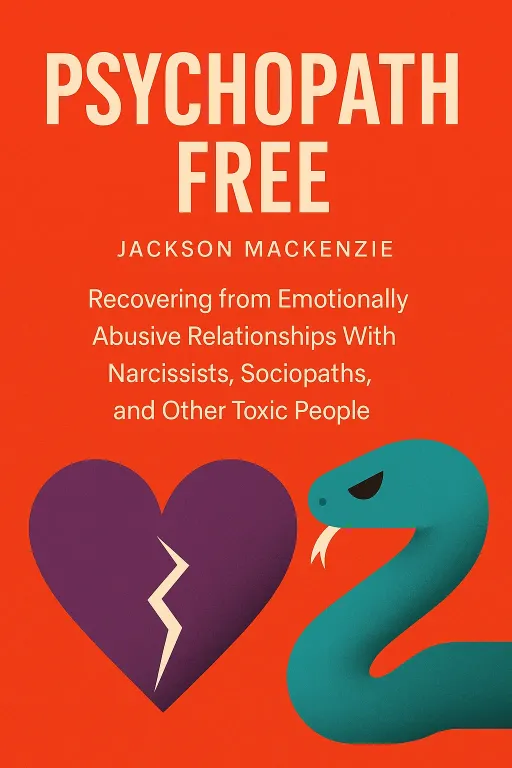
Nova: Exactly. And that is why we are diving into two essential books today that help us move from that defensive posture to a place of clarity. We are looking at Psychopath Free by Jackson MacKenzie and Drama Free by the licensed therapist Nedra Glover Tawwab.
Atlas: I have heard the name Nedra Glover Tawwab everywhere lately. She really shifted the conversation on this, didn't she?
Nova: She did. Tawwab is widely recognized for making boundary-setting accessible, stripping away the complex clinical jargon and replacing it with direct, actionable language. Her work is a perfect companion to Jackson MacKenzie’s Psychopath Free. MacKenzie’s book came from his own journey of untangling himself from a toxic relationship, and it focuses on the cognitive dissonance—that mental fog—that happens when you are dealing with someone who is pathologically manipulative.
Atlas: The combination makes sense. MacKenzie helps you understand the storm you are in, and Tawwab hands you the umbrella and a map to get out.
Nova: That is the perfect analogy. We are going to break down how to stop the emotional exhaustion of manipulation and start building a life where your peace is non-negotiable.
The Fog of Manipulation
SECTION
Atlas: Let’s start with the fog, because that is where most people get stuck. MacKenzie talks about this intense cognitive dissonance. When you are in a situation with someone toxic, you feel like you are losing your mind. Why is it so hard to just see it for what it is and walk away?
Nova: It comes down to the way our brains process inconsistency. When someone is manipulative, they often cycle between extreme idealization and devaluation. One day, they are the perfect partner or friend who understands you better than anyone else, and the next, they are cold or dismissive. That creates a physiological addiction. Your brain is constantly chasing the high of that initial idealization, even when the reality is painful.
Atlas: That explains the confusion. You keep waiting for the version of them that appeared in the beginning to come back. You think, if I can just be better, or if I can just explain myself more clearly, they will return to that person.
Nova: That is exactly the trap. MacKenzie points out that you are not actually interacting with a stable personality; you are interacting with a mask. The effort you spend trying to fix the situation is based on the assumption that the other person is operating from a place of empathy and logic. But when you are dealing with a toxic personality, that assumption is the error. You are trying to solve a problem with someone who does not view the problem the same way you do.
Atlas: This sounds exhausting. It is like playing a game where the other person keeps moving the goalposts, but you are still trying to score.
Nova: And that is the definition of emotional exhaustion. You are burning your own resources to maintain a reality that the other person is actively dismantling. MacKenzie’s work is vital here because he provides the validation that you are not crazy. The confusion is the intended result of the manipulation. Once you accept that the game is rigged, you stop trying to win the game and start looking for the exit.
Atlas: I imagine that realization is the hardest part. It is a blow to the ego to admit that you have been pouring energy into a void.
Nova: It is, but it is also the moment of liberation. Once you accept that you cannot change the other person, the focus shifts entirely to you. And that is where we need the tools to actually protect our space. That is where we turn to Tawwab’s approach.
The Tactical Art of Boundaries
SECTION
Atlas: This is the part I find most practical. We talk about boundaries as if they are these grand, dramatic declarations. But Tawwab suggests they are much quieter, right?
Nova: She does. Tawwab argues that boundaries are not about punishing other people. They are about clarifying your needs. The biggest mistake people make is believing that a boundary requires the other person’s permission or understanding.
Atlas: That is a profound distinction. I think most of us assume that for a boundary to be valid, the other person has to agree with it. Like, I can only set a boundary if you say, "Okay, that makes sense."
Nova: Right, and that is where the trap lies. If you wait for the other person to agree that your boundary is fair, you will be waiting forever. Tawwab’s framework is built on the idea that you state your boundary, and you do not need to defend it. You do not need to justify it. You do not need to explain why you are doing it. You just state what you will or will not tolerate.
Atlas: Give me an example of how that looks in practice. Because in the heat of the moment, it is very tempting to explain why I am setting a boundary.
Nova: Let’s say you have a family member who constantly gives you unsolicited advice about your career. The old way, the defensive way, is to say, "Look, I know you mean well, but I’ve been working really hard and I have a plan, so I don't really need your input because my boss said I’m doing great..."
Atlas: I can feel the exhaustion just listening to that. You are already in the weeds, defending your life choices.
Nova: Exactly. You are giving them ammunition to argue with you. Tawwab’s framework would suggest something much simpler. You would say, "I am not looking for feedback on my career right now, but I would love to hear how your garden is doing."
Atlas: That is so simple, but it feels incredibly difficult to execute. It feels rude.
Nova: That is the cultural conditioning talking. We are raised to believe that being polite means being accommodating, even at our own expense. But notice that the script is not aggressive. It is not an attack. It is a clear statement of your current capacity. By adding the redirection—asking about their garden—you are signaling that you still want to connect, just not on that topic.
Atlas: What happens if they push back? If they say, "I’m just trying to help, why are you being so sensitive?"
Nova: This is the crucial moment. If you engage with that "why are you being so sensitive" comment, you have lost the boundary. You are back in the cycle of defending yourself. Tawwab’s advice is to hold the line with a calm, repetitive statement. You can say, "I understand you want to help, but I am not looking for feedback right now."
Atlas: You just repeat it. It is like a broken record.
Nova: Yes. You do not elaborate. You do not change the phrasing to make it sound softer. You repeat the boundary. The goal is to make it boring for them to push against you. When they realize that they cannot get a rise out of you or drag you into a debate, they eventually stop.
The Anatomy of Over-Explaining
SECTION
Atlas: Why is over-explaining such a deep-seated habit for us? I notice that even when I am not being pressured, I feel the need to justify my "no."
Nova: It is a defense mechanism. We are terrified of being perceived as "bad" or "mean." We think if we provide enough evidence—if we show our work—the other person will see that our boundary is reasonable and therefore, we are still a "good person."
Atlas: That is a heavy burden to carry. It implies that my "no" is only valid if I have a bulletproof reason for it.
Nova: And that is the myth that Tawwab dismantles. A "no" is a complete sentence. Your preference is a valid reason. You do not need to be in a crisis or have an emergency to set a boundary. You can set a boundary simply because you prefer not to do something.
Atlas: So, applying this to the professional world, if a colleague asks for my help on a project that I simply do not have time for, instead of listing all the meetings I have and how tired I am, I should just say what?
Nova: You can say, "I don’t have the capacity to take that on right now."
Atlas: That is it? No, "I'm so sorry, I would love to but..."?
Nova: If you add the "I would love to," you are creating a lie that you have to maintain. If you add the "I'm so sorry," you are apologizing for having a limit. You are allowed to have a limit. "I don’t have the capacity" is a professional, neutral, and final statement.
Atlas: It feels almost clinical, but I can see how it saves so much energy. It stops the negotiation before it starts.
Nova: And that is the goal. You are protecting your energy for the things that actually matter. MacKenzie’s point about manipulation is that the manipulator thrives on your energy. By setting these firm, short boundaries, you are effectively starving the manipulation of its fuel. You are becoming a boring target.
Synthesis & Takeaways
SECTION
Atlas: We have covered a lot of ground here. We went from the internal confusion of being manipulated to the external tools to stop it. It seems like the common thread between MacKenzie and Tawwab is the reclamation of self.
Nova: That is exactly it. It is about moving from a reactive state—where you are constantly responding to the demands and the toxicity of others—to an intentional state, where you are the architect of your own space.
Atlas: If I am listening to this and I feel like I am currently in that fog, or I am constantly over-explaining my boundaries, what is the one thing I should do this week to start changing that?
Nova: The Tiny Step is this: Identify one recurring boundary infraction in your life. It could be a coworker who always interrupts you, a friend who vents to you for hours without asking how you are, or a family member who makes comments about your life. Write down a direct, polite script to address it. And here is the key: practice saying it without adding any explanation or defense. Just the statement.
Atlas: I love that. It is a low-stakes way to practice a high-stakes skill. Write the script down, and then just use it. Don't add the "because" or the "I'm sorry." Just the boundary.
Nova: Exactly. Because the moment you stop defending your boundaries is the moment you start truly owning them. You are not asking for permission to exist; you are simply stating the terms of your presence.
Atlas: That is a powerful place to land. It is not about being cold; it is about being clear. And clarity, as we have seen today, is the ultimate form of self-care.
Nova: It really is. It creates a space where healthy relationships can actually thrive, because they are built on mutual respect rather than the constant, exhausting negotiation of needs.
Atlas: This has been incredibly grounding. I think we have given our listeners a solid blueprint to start building those structures in their own lives.
Nova: I hope so. It is a practice, not a destination. You will get better at it every single time you choose yourself over the need to be understood.
Atlas: I am ready to start practicing. Thank you for this.
Nova: Thank you for the great questions. This is Aibrary. Congratulations on your growth!