The Surveillance Paradox: Protecting Data While Preserving Liberty.
Golden Hook & Introduction
SECTION
Nova: Think about all the 'free' digital services you use every single day. Your social media, your search engine, that helpful little voice assistant in your home. We love them, right? They make life easier, more connected. But what if these seemingly free services aren't actually free at all? What if they're subtly, imperceptibly, redesigning our very sense of self, our choices, our desires, without us even realizing it?
Atlas: Whoa, that's a bold claim, Nova. Are you saying my smart speaker is plotting against me, or that my scrolling habit is some grand conspiracy? Because honestly, it just feels like convenience to me.
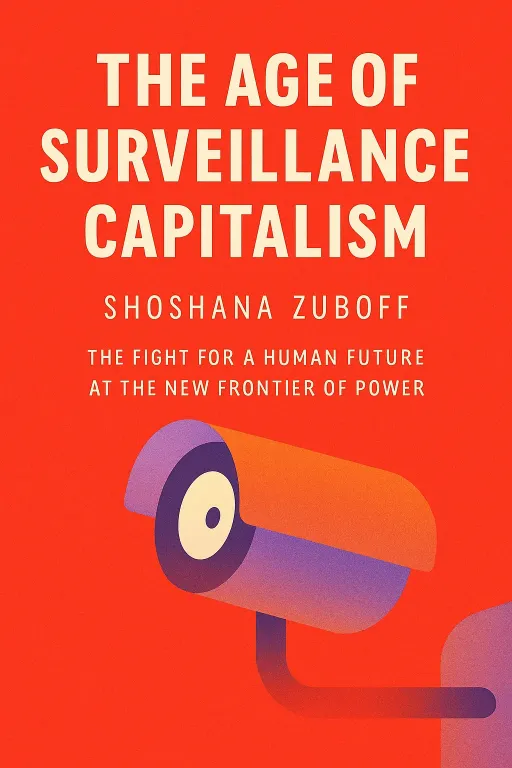
Nova: Not a conspiracy in the traditional sense, Atlas, but a profound shift in power. Today, we're diving into a topic that's both deeply unsettling and absolutely crucial for anyone navigating our digital world. We're looking at the ideas presented in two groundbreaking books: first, "The Age of Surveillance Capitalism" by Shoshana Zuboff, and then "Privacy Is Power" by Carissa Véliz. Zuboff, a Harvard Business School professor, actually shifted her focus from the psychology of the digital workplace to dissecting this new economic order, giving her an incredibly unique and critical lens. Her work really sparked a global conversation, praised for its groundbreaking analysis but also quite polarizing for its provocative claims.
Atlas: Okay, so it's not just a casual read, then. It sounds like it's challenging some fundamental assumptions about how we interact with technology. I'm curious, what's this "invisible hand" you're hinting at, and how does it connect to these books?
Nova: Exactly, Atlas. It’s about understanding the invisible hand shaping our digital lives. The commodification of our personal data isn't just another business model; it’s a new form of power, right under our noses.
The Invisible Hand: Understanding Surveillance Capitalism
SECTION
Nova: So let's start with Zuboff's core argument: surveillance capitalism. She says it's an economic system built on the secret extraction and commodification of human experience. It's not just about selling you products. It's about predicting and modifying your future behavior for profit.
Atlas: That sounds a bit dystopian. Can you give me a real-world example? Because when I use social media, I just see ads for things I've already looked at. That seems pretty straightforward.
Nova: Ah, but that's the surface layer, Atlas. Let's imagine Sarah, a young woman who starts using a new fitness tracking app. She loves it; it motivates her, tracks her runs, monitors her sleep. The app is 'free,' of course. But what Sarah doesn't see is that every single data point—her running routes, her pace, her sleep patterns, even she opens the app and for how long—is being collected.
Atlas: Okay, still sounds like standard data collection for service improvement, maybe to make the app better or suggest new features.
Nova: That's what we're told, right? But in surveillance capitalism, that raw data, what Zuboff calls 'behavioral surplus,' is then fed into highly sophisticated machine intelligence. These algorithms don't just know Sarah did; they start to predict. Will she buy that new pair of running shoes? Is she feeling stressed and likely to impulse-buy comfort food? Will she be susceptible to a particular political message?
Atlas: Wait, so the app isn't just about my fitness; it's about predicting my mood swings?
Nova: Precisely. And then, these predictions about Sarah's future behavior are sold to third parties in what Zuboff calls 'behavioral futures markets.' Advertisers, insurance companies, political campaigns—they buy access to these predictions so they can subtly nudge Sarah's behavior in their desired direction. If the algorithms predict Sarah is about to quit exercising, a targeted ad for a new, expensive fitness program might appear just at that moment, designed to keep her engaged and spending. The 'cause' is her raw behavioral data, the 'process' is its transformation into predictive insights, and the 'outcome' is her behavior being subtly shaped without her conscious awareness.
Atlas: That's actually really unsettling. It's not just about selling me running shoes; it’s about influencing my to buy them, or even my to run in the first place. That gives me chills.
Nova: It's a profound shift, isn't it? From offering a service to predicting and modifying human behavior itself. It makes the digital realm feel less like a tool and more like a carefully constructed environment designed to extract and influence.
Privacy as Power: Reclaiming Individual Autonomy
SECTION
Atlas: So, if that's the invisible hand subtly guiding us, where does our power come into play? Because right now, I'm feeling a bit like a puppet.
Nova: That's a natural reaction, Atlas, and it leads us directly to Carissa Véliz’s powerful argument: privacy power. She argues that our personal data is not just an abstract concept; it’s a valuable asset, a form of currency in the digital age. And by giving it away freely, we're essentially relinquishing control over ourselves.
Atlas: I've always thought of privacy as just a personal preference, like whether I prefer my curtains open or closed. But you're saying it's more fundamental than that?
Nova: Much more. Think of it this way: imagine two individuals, John and Jane. John is completely open online; every search, every purchase, every location ping, every health metric is broadcast. Jane, however, carefully curates her digital footprint, uses privacy tools, and understands consent. Now, when a company or even a political campaign wants to understand or influence people, they have a complete, granular profile of John. They know his vulnerabilities, his desires, his habits. They can target him with uncanny precision.
Atlas: So, like, if John searches for 'anxiety relief,' he might suddenly see ads for specific medications or therapy, even if he hasn't explicitly consented to that kind of targeting?
Nova: Exactly. His data profile makes him predictable, and therefore, manipulable. Jane, on the other hand, has maintained her digital autonomy. Her choices are truly her own, not a product of algorithmic nudges based on a comprehensive profile. She can explore ideas, express opinions, and make decisions without the constant, subtle influence of predicted behavior. Véliz says that protecting our personal data is essential for maintaining individual autonomy and even democratic societies. If our votes can be swayed by micro-targeted misinformation based on our psychological profiles, what does that do to the integrity of our democracies?
Atlas: But isn't it an uphill battle for an individual against these massive tech giants? I mean, it feels almost impossible to truly reclaim that power. It's like trying to bail out a sinking ship with a teaspoon.
Nova: It can certainly feel that way, and Véliz acknowledges the immense challenge. But she argues that every step matters. It's about understanding that every piece of data we share, every 'free' service we use, has a cost. By being more intentional, by demanding stronger privacy protections, and by making conscious choices about our digital lives, we collectively shift the balance of power. It's about recognizing the value of that currency, and choosing not to give it away for free unless we fully understand the terms. It's like knowing the value of your labor and demanding fair wages, rather than just working for 'exposure.'
Designing Ethical Systems: Balancing Protection and Innovation
SECTION
Atlas: Okay, so individuals can try to reclaim some power. But what about the systems themselves? How do we build technology that fall into these traps? How do we design for protection without stifling the very innovation that brings us so much good?
Nova: That's the deep question, isn't it? The core paradox: how do we design systems that protect data and privacy without stifling innovation or creating new forms of control? It's not about stopping progress, but about guiding it ethically. One key principle is 'privacy-by-design.'
Atlas: Privacy-by-design? What does that mean in practice?
Nova: It means that privacy isn't an afterthought, a patch you apply at the end. It's built into the very architecture of a system from day one. For instance, consider a new health app. A privacy-by-design approach would mean it collects only the absolute minimum data necessary for its function, a concept called 'data minimization.' It would encrypt data by default, offer clear and granular consent options, and give users easy ways to access, correct, or delete their data. It's a proactive, not reactive, approach to privacy.
Atlas: So, instead of collecting everything and then to secure it, you only collect what you need and build security around that smaller, essential core. That makes sense from a security perspective too, less attack surface.
Nova: Exactly! Another aspect is transparent and meaningful consent. Not those endless terms and conditions we all click 'agree' to without reading. But clear, concise explanations of what data is collected, how it's used, and who it's shared with. It’s about empowering users with genuine choice. Think of a secure messaging app that boasts end-to-end encryption and doesn't store your messages on its servers. That's a system designed with user privacy at its core, allowing for communication without the invisible hand of data extraction.
Atlas: But what about the argument that strict privacy regulations stifle innovation? That if companies can't collect vast amounts of data, they can't develop new AI models or personalized services? Isn't there a tension there between ethical safeguards and pushing the boundaries of technology?
Nova: That's a valid and constant tension, Atlas. But ethical system design argues that true innovation isn't just about you can build, but you build it and. It shifts the focus from 'move fast and break things' to 'move thoughtfully and build trust.' Innovation can thrive within ethical boundaries; it simply means prioritizing human values—like autonomy and privacy—alongside technological advancement. It forces engineers and designers to be more creative in finding solutions that respect individual rights. It's about building a digital future where technology serves humanity, not the other way around.
Synthesis & Takeaways
SECTION
Nova: So, what we've really explored today is this incredible paradox: how our pursuit of digital convenience has inadvertently created a new form of power that shapes our lives, and the urgent need to protect our data to preserve our liberty. We've moved from the invisible hand of surveillance capitalism to the tangible power of privacy, and finally, to the critical imperative of designing ethical systems.
Atlas: It’s a lot to unpack. I'm left thinking about how much of my digital life I've simply accepted without truly understanding the underlying mechanics. It makes me question every 'free' service and every 'convenient' feature.
Nova: That's the goal, Atlas. The most crucial takeaway isn't to retreat from technology, but to engage with it with strategic foresight. It's about cultivating a critical awareness of where your data goes and what it's used for. It’s about recognizing that privacy isn’t just a personal preference, but a collective good, a foundation for a truly free and innovative society.
Atlas: So, what's one concrete step somebody listening right now can take to start reclaiming some of that power?
Nova: I'd say, start by reviewing the privacy settings on your most-used apps and devices. Understand what data they're collecting and who they're sharing it with. Be intentional about your digital footprint. And perhaps most powerfully, advocate for products and policies that prioritize privacy-by-design. Your choices, however small, contribute to a larger shift.
Atlas: That's actually really inspiring. It feels like there's a path forward, even if it's a challenging one.
Nova: Absolutely. It's about becoming the guardian of your own digital self.
Nova: This is Aibrary. Congratulations on your growth!