Unraveling the Mind: Decoding Cognitive Biases in Decision-Making
Golden Hook & Introduction
SECTION
Nova: We like to think we're rational. Every decision, a careful calculation. Every choice, a product of pure logic. But what if I told you that's mostly a magnificent delusion?
Atlas: Oh, I know that feeling! The magnificent delusion of being entirely in control. I mean, we're strategists, architects, we for rationality. Are you suggesting we're just... elaborate puppets?
Nova: Elaborate, yes. Puppets, not quite. But definitely influenced by forces we rarely acknowledge. Today, we're pulling back the curtain on those forces, starting with the groundbreaking work of Dan Ariely in his book,.
Atlas: Ariely's work is fascinating. Didn't he get into this whole field because of a personal experience with severe burns? That's quite a unique origin story for a behavioral economist. It makes you wonder how much our own life experiences shape our understanding of human behavior. Nova, what's at the core of his big idea?
Nova: Exactly, Atlas. His own painful recovery, observing irrational medical choices, sparked his lifelong quest. At its core, Ariely shows us through incredible experiments that our irrationality isn't random; it's systemic, it's predictable. And once you understand those patterns, a whole new world of design opens up. Today, we're diving into why we make these quirky, illogical choices, and then, how we can actually use that understanding to design better outcomes for ourselves and others.
Unmasking Predictable Irrationality: The Hidden Drivers of Our Choices
SECTION
Nova: So, let's start with a classic. Why do we often choose things that aren't objectively the best for us, even when we have all the information? Ariely calls out something fundamental: we don't always know what we want until we see it in context. This phenomenon is often driven by what he termed 'relativity bias.'
Atlas: Okay, but isn't that just... comparison? We compare options all the time. That sounds too simple to be "predictably irrational." What's the twist?
Nova: The twist is that we often compare things that aren't directly comparable, or we're swayed by deliberately placed "decoy" options. Think about a classic subscription offer. Let's say you see three choices for a magazine:
Nova: Online subscription for $59.
Atlas: Whoa, wait. So, Option B and C cost the same, but C gives you more? Why would anyone ever choose B?
Nova: Exactly! Almost no one does. But here's the genius: Option B, the "print only" for $125, isn't there to be chosen. It's there to make Option C look like an deal. Without Option B, many people might rationally choose Option A, the cheaper online-only. But with the decoy, suddenly Option C, the more expensive combined package, becomes overwhelmingly attractive. That's relativity bias in action.
Atlas: That makes me wonder about every pricing page I've ever seen! So, we're not evaluating things in isolation; we're always looking for benchmarks, even if those benchmarks are strategically placed to manipulate us. Can you give another example of how this plays out in our everyday decisions?
Nova: Absolutely. Another powerful one is 'anchoring bias.' This is where our first piece of information, or an "anchor," heavily influences subsequent judgments, even if that anchor is completely arbitrary. Imagine you're at a bazaar, and the vendor first quotes an absurdly high price for a rug. Even if you negotiate them down significantly, your final price will likely be higher than if they had started with a more reasonable initial offer. That initial, seemingly random number, "anchored" your perception of value.
Atlas: That sounds rough, but… as an architect of systems, I can see how this could be a subtle but powerful lever. But where do you draw the line? If someone knows this, it feels like it could be used for less-than-ethical purposes. Is there a way to inoculate ourselves against these biases?
Nova: That's the million-dollar question, Atlas. Ariely's work reveals the problem, and acknowledging these biases is the first step. But it also sets the stage for the next big idea: if our irrationality is predictable, can we design environments that predictably nudge us towards better choices?
The Gentle Art of Nudging: Designing Choices for Better Outcomes
SECTION
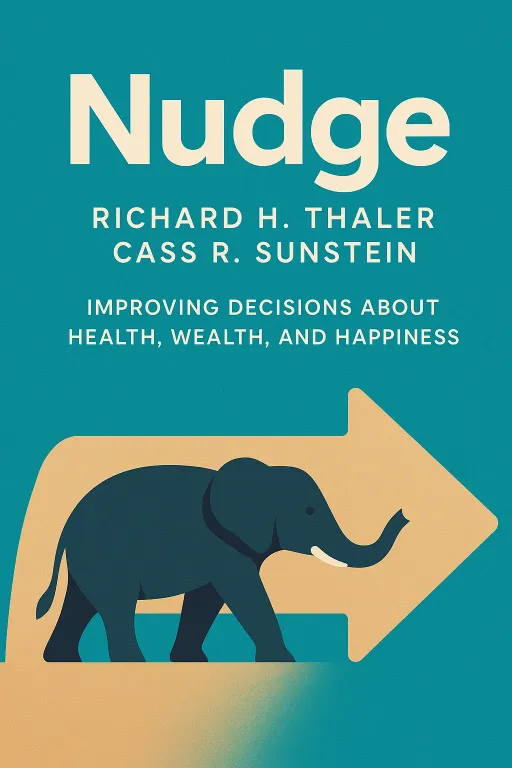
Nova: And that naturally leads us to the second key idea we need to talk about, which often acts as a counterpoint to what we just discussed: the concept of 'nudges,' popularized by Richard Thaler and Cass Sunstein in their highly influential book,. Thaler, in fact, won a Nobel Prize in Economic Sciences for his contributions to behavioral economics, partly for foundational work like this.
Atlas: Oh, I love that! So, understanding our predictable irrationality isn't just about avoiding being tricked; it's about using that knowledge to actually ourselves? What exactly is a 'nudge'? Is it like... reverse psychology?
Nova: Not quite reverse psychology, more like choice architecture. A nudge, as Thaler and Sunstein define it, is any aspect of the choice architecture that alters people's behavior in a predictable way without forbidding any options or significantly changing their economic incentives. It's about making the desired choice easier, more salient, or the default.
Atlas: Can you give an example? Because it sounds a bit abstract. How do you "alter behavior" without changing incentives?
Nova: Think about the classic example of the fly in the men's urinals at Amsterdam's Schiphol Airport. They etched a small image of a fly into the ceramic. The result? A significant reduction in "spillage" and cleaning costs. No one was forced to aim at the fly, no one was fined for missing it, but simply giving men a target to focus on dramatically changed their behavior for the better.
Atlas: Wow. That's actually really inspiring in its simplicity. It’s like, instead of telling people what to do, you just make the right thing the obvious thing. But where's the ethical line here? If you're designing systems to guide people, isn't that a form of manipulation, especially for someone in a high-stakes design field?
Nova: That's a crucial point, and one Thaler and Sunstein address directly. They argue for 'libertarian paternalism,' meaning nudges should be transparent, easy to opt-out of, and designed to improve welfare as judged by the decision-makers themselves. The goal isn't to force, but to facilitate. A powerful example is automatic enrollment in retirement savings plans.
Atlas: Oh, I’ve heard of that. So, instead of having to actively sign up for a 401k, you're automatically enrolled unless you specifically opt out?
Nova: Exactly. Traditionally, people had to choose to opt-in, and many, due to inertia or procrastination, never did. By making auto-enrollment the default, participation rates skyrocket, dramatically improving people's long-term financial security. They still have the freedom to opt out, but the 'nudge' of the default guides them towards a beneficial decision. The same principle applies to organ donation in some countries, where being an organ donor is the default unless you choose otherwise, leading to far higher donation rates.
Atlas: That’s a perfect example. That makes me wonder, from an 'Architect' perspective, how much of our digital and physical environments could be subtly redesigned using these principles? It's not about dictating choices, but about making the path of least resistance the path to the best outcome. It’s about building in good defaults.
Synthesis & Takeaways
SECTION
Nova: Precisely. So, to bring it all together, we start with Ariely showing us that we are irrational. Our brains have these amazing shortcuts and biases that lead us astray in consistent ways. Then, Thaler and Sunstein come along and say, "Okay, if it's predictable, we can use that knowledge. We can design 'choice architectures' – whether it's a website, a cafeteria, or a policy – that gently guide people towards decisions that are better for them, without taking away their freedom."
Atlas: In other words, it's about acknowledging our human quirks and designing them, not them. That's actually really inspiring. It frames the challenge not as "fix human nature," but "understand human nature, then build smarter systems."
Nova: That's it. It’s about conscious, ethical design. And this brings us back to our deep question: Where in your work do you see predictable irrationality playing out, and how could a subtle 'nudge' improve the outcome? Whether you're an architect, a strategist, or an investigator, recognizing these patterns in yourself and in the systems you interact with or design, is the first step to creating more optimal, more human-centered solutions.
Atlas: I can definitely relate. It's a powerful idea: shifting from just solving problems to preventing them by understanding the root causes of our behavior. It gives me chills, honestly, thinking about the potential impact.
Nova: Absolutely. It’s about making the right choices the easy choices.
Atlas: And giving people the freedom to still choose otherwise. That's the critical balance.
Nova: This is Aibrary. Congratulations on your growth!