The Hidden Engine: How Incentives Shape Decisions and Drive Behavior
Golden Hook & Introduction
SECTION
Nova: Atlas, quick game: I’ll say a common business scenario, you tell me the "logical" outcome. Ready?
Atlas: Oh, I like this. Hit me.
Nova: A company offers a huge bonus for hitting sales targets. What happens?
Atlas: Sales go up, obviously! People are motivated by money.
Nova: That’s what we happens, right? But what if those logical outcomes are often a smokescreen for something far more complex? What if the 'obvious' is actually obscuring a hidden engine driving our decisions?
Atlas: Wait, you're saying that sales going up isn't the whole story? I mean, that sounds a bit out there. Isn’t that just basic economics?
Nova: Exactly! That's the blind spot. We often assume people act rationally, driven purely by logic. But real-world decisions are heavily swayed by invisible forces: hidden incentives, cognitive biases, emotions, context. And overlooking these deeply human factors can lead to wildly flawed strategies and completely unexpected outcomes.
Atlas: Wow, so we're essentially walking around with a faulty GPS for human behavior? That’s kind of groundbreaking.
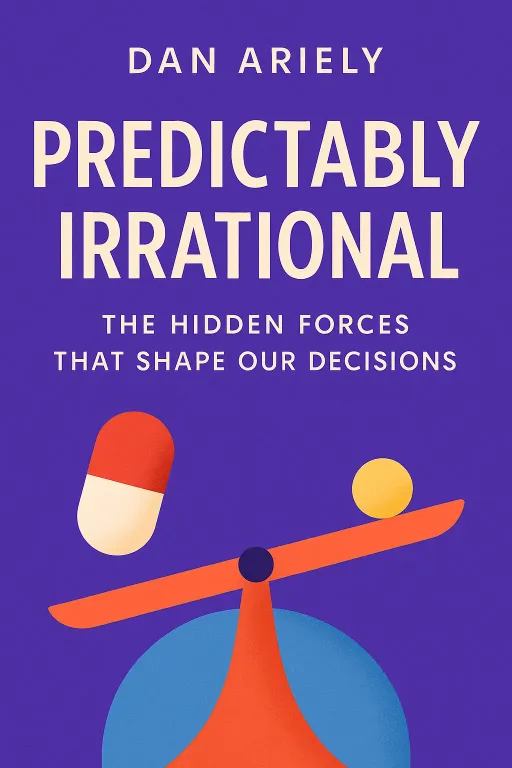
Nova: It absolutely is. And today, we’re unraveling that mystery with insights from two seminal works: by Dan Ariely and by Richard H. Thaler and Cass R. Sunstein. What’s fascinating about Ariely, a behavioral economist, is that he actually started his journey into understanding irrationality after a horrific burn accident. He spent months in hospital, observing his own and others' reactions to pain management and economic decisions. That personal, visceral experience gave him a unique lens into how systematically irrational we really are.
Atlas: Oh, I love that. So it wasn't just some abstract theory; it was born from a very real, human experience. That instantly makes me trust his insights more.
The Myth of Pure Rationality & Hidden Influences
SECTION
Nova: Absolutely. And that lived experience helped him uncover what he calls 'predictably irrational' behavior. It’s not just random; our irrationality follows patterns. Think about it: every day, we make choices, from what coffee to buy to major career moves. And we tell ourselves we're being logical, weighing pros and cons.
Atlas: Right, like I'm choosing this podcast over another because of its superior content and charming hosts. Pure logic!
Nova: Exactly! But what if I told you that a seemingly irrelevant option could completely change your "logical" choice? Ariely demonstrated this with a brilliant experiment involving subscriptions to magazine.
Atlas: Okay, I’m curious. Lay it on me.
Nova: So, he presented three options to students. Option one: an online-only subscription for $59. Option two: a print-only subscription for $125. And option three: a print-and-online subscription, also for $125.
Atlas: Wait, so the print-only and the print-and-online options cost the exact same? That sounds like a mistake.
Nova: It like a mistake, doesn't it? But it was a deliberate 'decoy' option. If you presented just the online-only for $59 and the print-and-online for $125, most people would go for the cheaper online option. But when that seemingly identical print-only option at $125 is introduced...
Atlas: Oh, I see where this is going! The print-only option makes the print-and-online option look like an incredible deal, a no-brainer. You get both for the price of one!
Nova: Precisely! In Ariely's study, when all three options were present, the vast majority—84%—chose the print-and-online bundle. When he removed the 'decoy' print-only option, and only offered online for $59 and print-and-online for $125, suddenly the online-only option became far more popular.
Atlas: That’s incredible. So just by putting a weird, almost useless option in front of people, you can dramatically steer their choice towards a more expensive package. That’s wild. For our listeners who are navigating complex sales funnels or even just trying to decide on a new software package, this sounds like it's happening all the time.
Nova: It is! It shows how our decisions are not made in a vacuum. They're influenced by the context, by the choices presented, and by how those choices are framed. We're not purely rational calculators; we're relative evaluators. We compare. And we can be easily led by those comparisons.
Predictably Irrational & Nudging: Leveraging Behavioral Insights for Better Outcomes
SECTION
Atlas: So if we're all a bit predictably irrational, Nova, can we at least be irrational for good? Or is it just about companies tricking us into buying more expensive stuff?
Nova: That’s a brilliant question, and it leads us directly to the second big idea: the power of 'nudging,' championed by Richard Thaler and Cass Sunstein in their book. This isn't about manipulation; it's about understanding these systematic irrationalities and designing 'choice architecture' that gently steers people towards better decisions.
Atlas: So, it's like using our own human quirks to help us, rather than hinder us? Give me an example of how this works in the real world.
Nova: One of the most powerful examples is organ donation. Think about it: everyone agrees organ donation is good, but rates vary wildly across countries. Why? Because of a simple 'nudge': the default option.
Atlas: Oh, I've heard about this! Are you talking about opt-in versus opt-out systems?
Nova: Exactly! In countries where you have to to be an organ donor—meaning you have to actively check a box or sign up—donation rates are often very low, sometimes as low as 10-20%. People intend to do it, but they procrastinate, forget, or it just feels like extra effort.
Atlas: Right, like that gym membership I keep meaning to cancel. Inertia is a powerful force.
Nova: Precisely. But in countries with an system, where you are automatically registered as a donor unless you actively choose to be, donation rates skyrocket to 90% or more. The default option, the path of least resistance, becomes the overwhelming choice.
Atlas: That’s such a simple change, but with such a profound impact. It's not about forcing anyone; it's just about making the default align with the desired outcome. That’s actually really inspiring. So what does that mean for someone trying to, say, get their employees to save more for retirement?
Nova: It means applying the same principle. Historically, companies would have employees to a 401k or retirement savings plan. Guess what happened? Low participation. But when companies shifted to an system – where new employees are automatically enrolled unless they specifically choose to leave the plan – participation rates soared. It’s a gentle nudge towards financial well-being, leveraging our natural tendency to stick with the default. It's about designing choices that make the 'right' decision the easiest one.
Atlas: That's a perfect example. It's like, instead of fighting against human nature, you're working with it. And it's not just about what's good for the company or the government, but what's genuinely beneficial for individuals too.
Synthesis & Takeaways
SECTION
Nova: So, what we've learned today is that the human mind is this incredibly complex, often illogical, but so, machine. And once we stop pretending we're purely rational, we unlock powerful levers. We can either be swayed by hidden incentives, like in the Economist example, or we can design our world, our systems, and even our personal habits to gently nudge ourselves and others towards better outcomes.
Atlas: Wow, that’s actually really inspiring. It shifts the blame from 'I'm just bad at making decisions' to 'the system wasn't designed to help me make good decisions.' It’s about building better paths.
Nova: Exactly! It's not about making people rational, but understanding their humanity to help them. This insight changes our view from idealized rational actors to complex, predictable humans, offering powerful levers for influence and improvement.
Atlas: That gives me chills. Thinking about the deep question we posed earlier, about business decisions that surprised us... I'm looking back at so many situations now, and I can clearly see how hidden incentives, context, or defaults could have played a massive role. It makes you wonder, what other 'logical' decisions in our lives are actually just a cleverly designed nudge?
Nova: It makes you question everything, doesn't it? And that's the point. Once you see the hidden engine, you can start to drive.
Atlas: This is Aibrary. Congratulations on your growth!