The Behavioral Edge: Understanding Human Impact on Sports Finance
Golden Hook & Introduction
SECTION
Nova: You know, Atlas, I was reading this wild stat the other day: professional sports teams are leaving billions of dollars on the table each year because they’re fundamentally misunderstanding human behavior. Billions!
Atlas: Billions? That sounds almost…predictably irrational, doesn't it? I mean, I can imagine it in personal finance, but at the professional sports level, with all the data and analytics? That’s a bold claim.
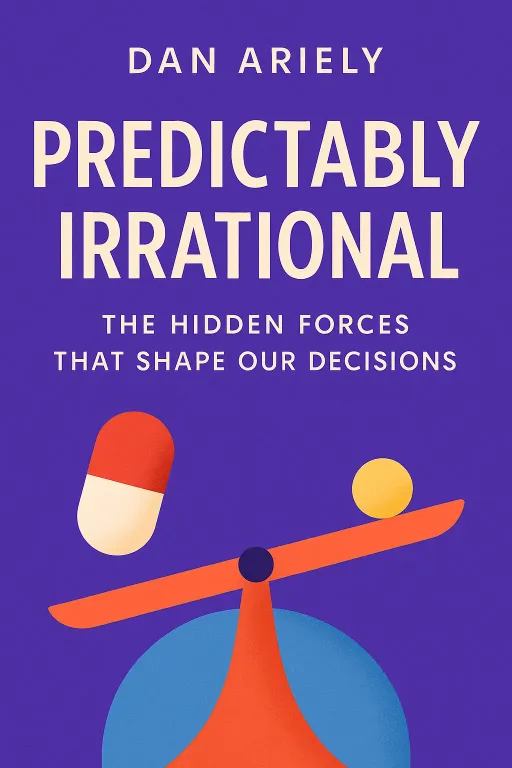
Nova: It is, and it brings us perfectly to two truly groundbreaking books today: "Predictably Irrational" by Dan Ariely, and "Misbehaving: The Making of Behavioral Economics" by the Nobel laureate Richard H. Thaler. Ariely, a Duke professor, is renowned for making complex behavioral science incredibly accessible through engaging experiments. Thaler, on the other hand, is one of the founding fathers of behavioral economics, essentially bridging psychology and traditional economics. Both of them, in their own ways, are ripping apart the old idea that humans are purely rational actors.
Atlas: Oh, I like that. So, we're talking about how the messy, illogical, utterly human side of us actually plays a massive, often overlooked, role in something as seemingly cutthroat and analytical as sports finance. This isn’t just about bad decisions, but bad decisions.
Nova: Exactly! And the core of our podcast today is really an exploration of this predictable irrationality. We'll dive deep into how understanding these human quirks isn't just academic; it's a competitive advantage for sports franchises, especially in high-stakes areas like player contract negotiations and fan engagement.
The Human Equation in Sports Finance
SECTION
Nova: Let's start with Ariely's central thesis from "Predictably Irrational." He argues that our irrationality isn't random or senseless; it's systematic, consistent, and therefore, predictable. He uses experiments to show how we consistently make decisions that deviate from what traditional economic theory would call rational.
Atlas: Okay, but how does that translate to a sports franchise? Are we talking about a general manager consistently overpaying for a player because of some emotional bias, or something more subtle?
Nova: It's often more subtle, and far more pervasive. Think about the concept of "anchoring." Ariely demonstrates how our first exposure to a number, even an arbitrary one, can disproportionately influence subsequent judgments and decisions. In sports, this could manifest in contract negotiations. If a star player's agent throws out an astronomical figure early on, even if it's completely unrealistic, it can anchor the team's perception of value, making a slightly lower, but still inflated, offer seem reasonable by comparison.
Atlas: Oh, I see. So the agent isn't necessarily expecting that first number, but it sets a high bar in the GM's mind. And then when they come down, it feels like a win, even if the final number is still above what they originally wanted to pay. That’s a clever psychological play.
Nova: Absolutely. And it's not just the agent; teams can do it too. They might lowball an initial offer, anchoring the player and their agent to a lower expectation. It's a dance of predictable irrationality. Another fascinating concept from Ariely is the idea of "the cost of zero." He shows how people are irrationally drawn to things that are free, even if the value proposition isn't actually better than a slightly priced alternative.
Atlas: That makes me wonder about fan engagement. Are teams capitalizing on "free"? Like, giving away free merchandise or experiences, even if the perceived value is low, just because it costs nothing to the fan?
Nova: Precisely. A team might offer a "free" bobblehead night. The actual cost of the bobblehead is minimal, but the word "free" creates an outsized attraction. People will endure long lines, traffic, and inconvenience for something free, even if the true cost in time and effort far outweighs the bobblehead's value. A team could use this to fill seats for a less popular game, knowing that the "free" offer will predictably draw a crowd, even if they could have charged a nominal fee and still had a good turnout. It’s about leveraging that psychological trigger.
Atlas: That’s actually really inspiring. So, it's not just about what a fan, but the of it. A five-dollar hot dog suddenly becomes a lot less appealing if it's presented next to something "free," even if the free item is less desirable.
Behavioral Economics and Strategic Advantage
SECTION
Nova: This leads us perfectly into Richard Thaler's work in "Misbehaving." While Ariely focuses on the individual's predictable irrationality, Thaler zooms out to show how these individual behaviors aggregate to create market anomalies and how understanding them can be a strategic advantage. Thaler, a Nobel laureate, essentially built the field of behavioral economics, proving that psychological insights aren't just anecdotes, but foundational to understanding economic decisions.
Atlas: So Thaler is giving us the academic framework for why these things happen, and how to spot them in bigger systems? Because in sports, you’re not just dealing with one player or one fan, you’re dealing with entire markets.
Nova: Exactly. Thaler introduced the concept of "mental accounting." This is where we treat money differently depending on its source or intended use, even though money is fungible. For a sports franchise, this could mean allocating funds from different revenue streams – say, broadcast rights versus ticket sales – to different purposes, even if that's not the most economically efficient use of capital.
Atlas: Oh, I’ve been there. It’s like having a separate "vacation fund" and "rent fund," even though it's all just money in the bank. So a team might have "player salary money" and "stadium renovation money," and find it harder to shift funds between them, even if the best economic decision would be to do so?
Nova: That’s a perfect analogy. A team might be reluctant to dip into their "player salary" budget for an urgent stadium repair, even if that repair would prevent future revenue loss, because of this mental accounting. It’s not rational, but it’s predictably human. Thaler also explores the "endowment effect," which is our tendency to value something we own more highly than if we didn't own it.
Atlas: Ah, so this is why it’s so hard for teams to trade away their homegrown talent, even if they're underperforming or past their prime. They're emotionally invested, and they perceive that player's value to be higher than the market might dictate.
Nova: That's spot on. A general manager might consistently overvalue a player drafted by their own team, or one who has spent their entire career with the franchise, even when objective analytics suggest a trade would be beneficial. The team has "endowed" this player with extra value simply by virtue of their shared history. This predictable bias can lead to holding onto players too long, missing out on valuable trade assets, or paying above-market rates for extensions. It’s a huge blind spot.
Atlas: That makes me wonder how this applies to fan loyalty. Is there an "endowment effect" for fans with their team? Because it feels like fans stick by their teams through thick and thin, often against all rational evidence.
Nova: Absolutely! Think about a fan who has supported a team for decades. They've invested time, emotion, and money. This creates an enormous endowment effect. Even if the team consistently performs poorly, the fan's perceived value of their relationship with the team is incredibly high. Franchises can leverage this by understanding that loyalty isn't just about winning; it's about fostering that sense of ownership and history. It's why throwback jerseys, alumni events, and celebrating team legends resonate so deeply. It taps into that endowed value.
Synthesis & Takeaways
SECTION
Nova: So, what Thaler and Ariely ultimately equip us with is a deeper understanding of the psychological forces at play in financial decisions, both individually and collectively. For a sports franchise, this isn't about manipulating people, but about anticipating and accounting for biases. It’s about building better strategies for negotiations, marketing, and even internal financial management, by understanding the predictable irrationality in all of us.
Atlas: That’s a great way to put it. It’s not about tricking people, but understanding the human OS, the operating system, that’s running beneath all the spreadsheets and scouting reports. It means that the best strategies aren't just analytically sound, but psychologically informed.
Nova: Exactly. And the takeaway here for anyone in the sports industry, whether you're an analyst, a strategist, or a visionary, is that ignoring these behavioral insights is leaving a competitive edge on the table. Trust your instincts that there's a deeper 'how' and 'why' behind success. It's about being able to anticipate, for instance, how a rival team's GM might be anchored to an outdated valuation, or how fans will predictably react to a "free" offer versus a discounted one.
Atlas: So, for our listeners who are driven by impact and want to connect their passion with purpose, this is essentially a call to explore how behavioral economics can be their secret weapon. It’s about realizing that the human element isn't a bug in the system; it's a feature, and a predictable one at that.
Nova: Precisely. It’s about not just seeing the numbers, but understanding the human story behind them. This is Aibrary. Congratulations on your growth!