

Beyond the Metrics: Unleashing Innovation Through Data.
Golden Hook & Introduction
SECTION
Nova: What if the biggest blind spot in your data isn't a lack of information, but a profound misunderstanding of humanity itself? We're talking about the predictable irrationality that makes us, well, us.
Atlas: Oh man, that sounds almost… poetic. So, our meticulously collected data, the stuff we build strategies around, could actually be leading us astray because we're not accounting for the squishy, illogical human element?
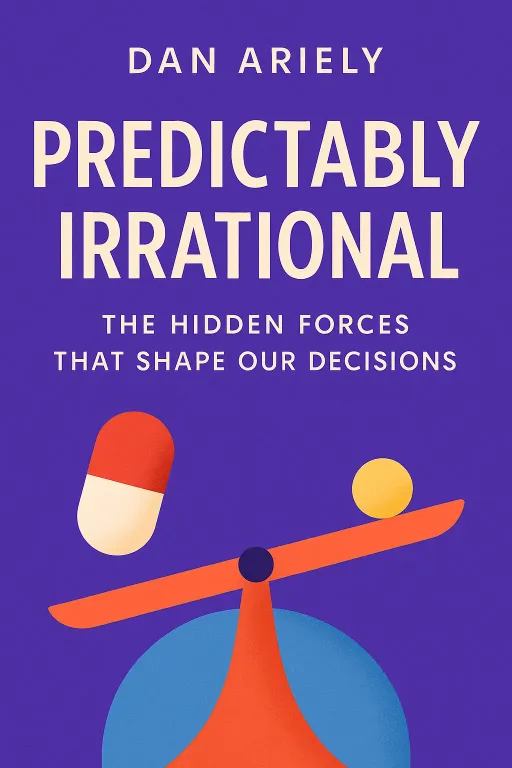
Nova: Exactly! Today, we're diving into the core insights from a book that brings this to light, "Beyond the Metrics: Unleashing Innovation Through Data." It’s a powerful compilation, drawing heavily from two titans in behavioral science: Dan Ariely's "Predictably Irrational" and Nir Eyal's "Hooked."
Atlas: I love that. And Ariely, his story is quite something, isn't it?
Nova: It absolutely is. What's fascinating about Ariely is that his deep dive into irrationality wasn't purely academic. His own profound experience recovering from severe burns gave him a unique, firsthand perspective on pain, decision-making, and self-control. It truly grounds his research in a very human reality.
Atlas: That context alone makes me trust his insights more. For those of us navigating complexity, trying to drive meaningful outcomes with data, this immediately feels relevant. You’re talking about moving beyond just numbers to something deeper.
The Blind Spot: Beyond 'What' to 'Why' in Data
SECTION
Nova: Precisely. Because often, our data analytics focuses on the 'what.' What did users click? What did they buy? How long did they stay? But it misses the crucial 'why.' It overlooks the irrational, yet predictable, aspects of human behavior.
Atlas: Okay, but wait. Isn’t more data always better? We’re constantly told to collect more metrics, optimize for conversion rates. For those of us trying to get ahead of the curve, how do we spot this 'blind spot' in our own metrics when the numbers look good on the surface?
Nova: That’s the crux of it. Imagine a fitness app, for instance. It tracks steps, calories burned, workout consistency. The data might show people engaging for a few weeks, then dropping off. The 'what' is clear: engagement declines. But if you don't understand the 'why' – perhaps the motivation wasn't about health, but social validation that faded, or the initial challenge became too monotonous – then your solutions will miss the mark.
Atlas: So it’s like we're seeing the footprints, but we have no idea where the person was going, or why they suddenly changed direction.
Nova: A perfect analogy! We're often optimizing for the footprints without understanding the journey or the traveler's motivations. This can lead to products that look great on paper, perform well on surface-level metrics, but fundamentally fail to connect with users on a deeper, more enduring level.
Atlas: That makes me wonder about all the times I’ve seen a product with amazing features, but it just… didn't stick. The cause, process, and outcome you described, where a company optimized for clicks but missed trust – that resonates. So, it’s like we're building a beautiful house, but people aren't staying because we didn't understand their need for a cozy fireplace, even if the blueprint didn't explicitly call for it. How do we actually detect these hidden forces?
Predictably Irrational & Habit-Forming Design: Leveraging Human Nature for Innovation
SECTION
Nova: That leads us perfectly into how we understand those hidden forces, by looking at human behavior not as random, but as predictably irrational. Ariely's work reveals that our irrationalities aren't chaotic; they follow patterns. Understanding these patterns allows us to design better systems and products.
Atlas: Predictably irrational – that sounds almost like an oxymoron. How can something be both? I mean, if it's predictable, isn't it rational in a way? And how does that help us design better systems, for example, for someone leading a team or trying to build a resilient organization?
Nova: That's a great question, and it's where the magic happens. Think about the 'decoy effect' in pricing. You have a small popcorn for $3 and a large for $7. Most people choose the small. But introduce a medium popcorn for $6.50 – suddenly, the large for $7 seems like a much better deal, and sales of the large skyrocket. The medium is the 'decoy.' Our decision isn't purely rational; it's influenced by context in a predictable way.
Atlas: Wow. So we're not always making decisions based on pure value, but on how options are framed relative to each other. That’s a subtle but powerful insight.
Nova: Exactly. And Nir Eyal takes this a step further with his "Hooked" model, which shows how to build habit-forming products by tapping into these intrinsic motivations and predictable behaviors. He outlines a four-step loop: Trigger, Action, Variable Reward, and Investment.
Atlas: Okay, so, a trigger, an action, a variable reward… and then an investment. Can you give us an example? Because for those of us trying to foster potential and build things that people truly love and return to, this sounds like a core framework.
Nova: Absolutely. Take a successful language learning app. The 'trigger' could be an internal one, like boredom, or an external notification reminding you to practice. The 'action' is opening the app and doing a lesson. The 'variable reward' isn't just completing the lesson; it's seeing unpredictable progress bars, getting a surprising new achievement badge, or unlocking a fun new character or game. And the 'investment' is when you spend time customizing your avatar, building a streak, or even paying for premium features.
Atlas: That's fascinating. So, it's about understanding how our brains are wired and then designing that wiring, not against it. It's not just about what the product, but how it makes us and on a deeper, almost subconscious level. For leaders nurturing potential, this sounds like a way to build deeply resonant experiences, where people are intrinsically motivated to engage.
Nova: It’s precisely that. It’s moving beyond simple utility to psychological engagement. It's about designing products that users love and return to, not out of obligation, but because they've become part of their routine, satisfying a deeper need.
Atlas: That gives me chills. So, the deep question for our listeners, especially the strategic innovators out there, is: How might your current product data reflect a 'predictably irrational' user behavior? Where are users doing things that don't quite align with what you'd expect, but in a consistent way?
Synthesis & Takeaways
SECTION
Nova: That’s the perfect question to reflect on. Because the blind spot in data analysis is overcome by applying these insights into predictable irrationality and habit formation. It's about moving from simply observing 'what' people do, to truly understanding 'why' they do it, by understanding the human operating system itself.
Atlas: So, if we're looking at our data and seeing users drop off at a certain point, instead of just tweaking the button color, we should be asking: 'What predictable human irrationality might we be triggering or failing to address here?' It’s about active listening, not just to the data, but to the implied human story behind it.
Nova: Exactly. And that's where the growth recommendation for our strategic innovators really comes in: dedicate specific, uninterrupted time each day to active listening. Not just to customer feedback calls, but to observing and truly understanding the human element that drives behavior, both rational and predictably irrational.
Atlas: This isn't just about building better products; it's about building a deeper connection with the people those products serve. It's about empathy at scale, understanding the user's hidden motivations before they even articulate them.
Nova: It's about making sure our innovations truly resonate, not just statistically perform. It's the difference between a product that's used, and a product that's loved and integrated into people's lives.
Atlas: And those insights don't just transform products, they transform how we understand ourselves and the world around us.
Nova: This is Aibrary. Congratulations on your growth!









