The Hidden Curriculum: Understanding How Power Shapes Education
Golden Hook & Introduction
SECTION
Nova: What if everything you thought you knew about 'learning' was subtly designed, not to enlighten you, but to keep you exactly where you are in the grand scheme of things?
Atlas: Whoa. That’s a bold claim, Nova. Are you saying our education system, or even how we learn in general, isn't as neutral as we think? Because I imagine a lot of our listeners, especially those building complex systems or strategies, pride themselves on objective information.
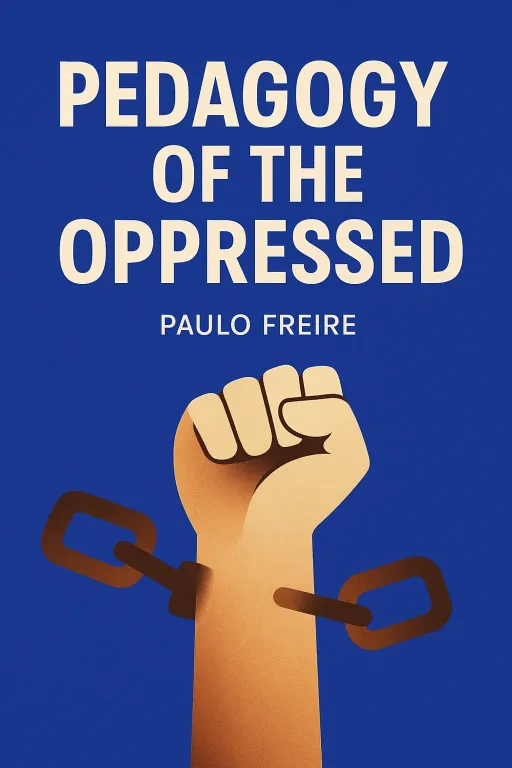
Nova: Exactly, Atlas. We often have this blind spot, believing knowledge transmission is a purely neutral act. But today, we're pulling back the curtain on that. We're diving into the profound insights of a truly revolutionary thinker, Paulo Freire, and his seminal work,.
Atlas: Freire. I'm familiar with the name, but perhaps not the depth of his ideas. What's his origin story?
Nova: Freire was a Brazilian educator, and his work with illiterate adults in rural communities profoundly shaped his philosophy. He saw firsthand how traditional education disempowered people, and he dedicated his life to understanding how learning could become a tool for liberation. It’s a perspective forged in the crucible of real-world struggle, not theoretical ivory towers.
Atlas: That context alone is fascinating. It makes me immediately think about the hidden structures in architecture, or the unspoken assumptions in business strategy. You know, the things you don't explicitly design for, but that profoundly shape the outcome.
The 'Banking Concept' and the Hidden Curriculum
SECTION
Nova: Precisely. And that leads us directly into his critique of what he called the 'banking concept' of education. Imagine a bank. The teacher is the depositor, holding all the knowledge, and the students are merely the empty receptacles, the bank accounts, waiting to be filled.
Atlas: So, the teacher "deposits" facts, dates, theories, and the student "stores" them. Sounds efficient on paper, I guess. Probably how a lot of us were taught.
Nova: Absolutely. It's the dominant model. But Freire argued this isn't neutral. This "depositing" approach reinforces a specific power dynamic: the teacher is the active subject, the knower, and the student is the passive object, the known. It discourages questioning, critical thought, and genuine engagement. It trains individuals to be compliant, to accept information rather than critically analyze it.
Atlas: That makes me wonder, how does this 'banking concept' manifest in, say, a modern professional environment? For our listeners who are architects or strategists, they're often 'depositing' ideas into clients or teams. Is there a hidden curriculum there?
Nova: Oh, undoubtedly. Think about a traditional corporate training session. Information is presented, often in a one-way flow, and employees are expected to absorb and replicate it. There’s little room for questioning the underlying assumptions, challenging the 'why' behind the 'what.' The hidden curriculum there is conformity, acceptance of the status quo, and a subtle message that expertise resides solely at the top.
Atlas: That sounds rough. So, an architect presents a meticulously designed blueprint, expecting clients to simply approve it, rather than truly engaging them in the design process from the ground up. The 'banking concept' of design, if you will.
Nova: Exactly. And the outcome? A client who might agree, but doesn’t truly own the vision, leading to less resilient projects, or a team that executes a strategy without truly understanding its strategic underpinnings. For instance, consider how traditional schooling, with its emphasis on rote memorization for standardized tests, subtly prepares individuals for roles within an established hierarchy. Students are taught to think, not to think critically. They learn to follow instructions, to recall facts, rather than to question the societal structures that create those facts. The process is smooth: information is delivered, absorbed, regurgitated. The outcome: compliant individuals less likely to challenge systemic issues, perpetuating existing social structures under the guise of 'neutral' knowledge. That's the insidious power of the hidden curriculum.
Atlas: So, it's not just about the content of the lesson, but the of delivery that embeds a certain power dynamic. I can see how that would hinder innovation. If you're always just accepting the 'deposit,' you're not generating new capital yourself.
'Problem-Posing Education' and Liberation
SECTION
Nova: Precisely, Atlas. And that leads us to Freire's powerful alternative: 'problem-posing education.' Instead of depositing, it’s about dialogue. It creates a horizontal relationship between teacher and student, where both become co-investigators of reality. They pose problems, and together, through critical reflection and action, they seek solutions.
Atlas: Okay, so how does an architect 'problem-pose' with a client who simply wants a solution, not a philosophical debate? Or a strategist with a team used to being told what to do? This sounds great in theory, but practically, how do you operationalize liberation in a high-stakes business context?
Nova: That's the deep question, isn't it? It requires a shift in mindset. Instead of presenting the finished blueprint, an architect might present the the client is facing – say, a need for more sustainable, community-integrated housing – and then guide the client through the process of the design solutions. The architect still brings expertise, but it's shared, not imposed.
Atlas: So, it's like designing an interactive museum exhibit versus just having placards. You immerse people in the challenge, and they learn by engaging with it, rather than just reading about it.
Nova: That’s a perfect analogy! Or, imagine onboarding new team members in a strategic firm. Instead of a week of lectures on company policy, you present them with a real, complex business challenge the company is currently facing. You provide them with resources, mentors, and the space to collectively research, debate, and propose solutions.
Atlas: That's actually really inspiring. They're not just learning the rules; they're learning and, more importantly,. It cultivates ownership and truly critical thinking, which is exactly what you want for lasting contributions. It's not about 'teaching' building codes, but about presenting a complex urban planning challenge to new hires, requiring them to research codes and propose solutions collaboratively. This shifts from depositing rules to engaging with real problems. The process is messy, iterative, full of debate. The outcome: not just compliance, but deeply understood, context-aware, and innovative problem-solving. This cultivates deeper understanding, ownership, and innovative problem-solving, leading to more resilient and context-aware designs that truly empower the community.
Nova: Absolutely. It’s about transforming the learning environment from a passive consumption model to an active, collaborative creation model. It empowers individuals to not just navigate the world, but to actively shape it.
Synthesis & Takeaways
SECTION
Nova: So, what we're really talking about here, Atlas, is that whether you're designing a building, a business strategy, or simply sharing knowledge, understanding the 'hidden curriculum' and embracing 'problem-posing' can transform how you engage and empower others. It moves beyond merely transmitting information to fostering genuine critical consciousness.
Atlas: For someone who builds systems and strategies, understanding these dynamics isn't just academic; it's about designing for genuine engagement, for fostering critical thinking, and ultimately, for creating solutions that truly empower, rather than just inform or dictate. It's about building structures, be they physical or conceptual, where people are active participants in their own growth and the evolution of the system.
Nova: Exactly. True impact comes from fostering critical consciousness, not just from the efficient transfer of facts. It's about helping people see the world, and their place in it, with new eyes.
Atlas: I think that’s a powerful call to action for anyone in a leadership or design role. Where are we still using the 'banking concept' in our work, and how can we introduce more 'problem-posing' questions to truly unlock the potential of our teams and our clients? That’s something to chew on.
Nova: It certainly is.
Atlas: This is Aibrary. Congratulations on your growth!