The Conventional Pedagogy Trap: Why You Need to Rethink How Knowledge is Transferred.
Golden Hook & Introduction
SECTION
Nova: What if I told you that most of what we call 'education' isn’t actually education at all, but something closer to a subtle form of intellectual oppression?
Atlas: Whoa, intellectual oppression? That's quite a statement, Nova. My initial thought is, "Come on, education is good for you!" But you’ve definitely piqued my curiosity. Are you saying our classrooms are secretly training grounds for... well, something less than critical thinkers?
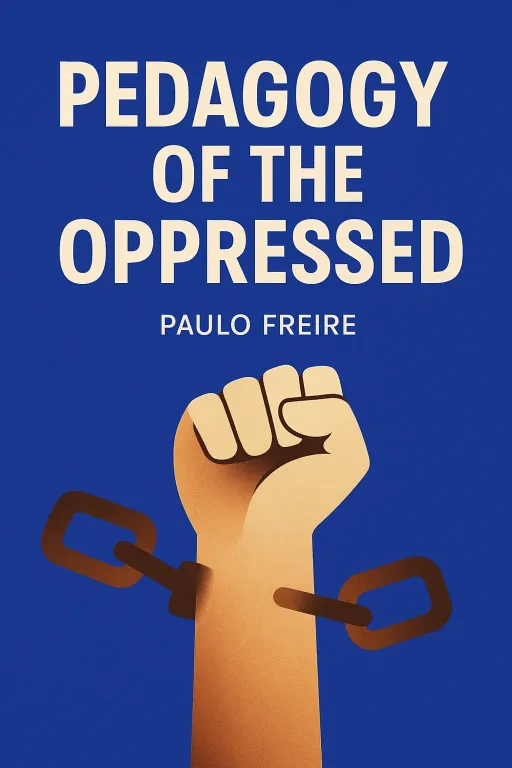
Nova: Exactly, Atlas! It sounds provocative, I know. But today, we're diving into the revolutionary ideas of Paulo Freire, particularly from his seminal work,. What's truly fascinating about Freire is that he didn't just theorize from an ivory tower. He developed this philosophy while in exile from his home country, Brazil, because of his groundbreaking work in adult literacy. He saw firsthand how education could either be a tool for liberation or a means of maintaining existing power structures. His personal experience of watching people learn to read not just words, but their world, gave his critique an incredible, lived urgency.
Atlas: That context alone makes his ideas feel incredibly weighty. So, he wasn't just observing; he was living the consequences of different educational approaches. That makes me wonder, how did that background shape his core critique of what he saw as the conventional model?
Nova: He identified what he famously called the "banking concept" of education. Imagine a bank. The teacher is the depositor, holding all the knowledge, and the students are the passive receptacles, the bank accounts, into which this knowledge is deposited.
Atlas: So it's like a teacher just 'downloading' information into our brains, and our job is simply to store it? That makes sense, but what's wrong with filling students' heads with knowledge if it's accurate? We need to learn facts, right?
The 'Banking Concept' of Education: Why Traditional Teaching Fails Us
SECTION
Nova: That’s the core of the trap, Atlas. On the surface, it seems efficient. We have a curriculum, we deliver information, students absorb it. But Freire argued this model stifles creativity, critical thinking, and genuine engagement. It treats students as objects, not subjects, of their own learning. Instead of fostering agency, it cultivates dependence.
Atlas: Okay, give me a vivid example. What does this "banking concept" look like in action, beyond just the metaphor?
Nova: Think about a typical history lecture. The professor stands at the front, delivering a meticulously prepared monologue about, say, the causes of the French Revolution. Dates, names, treaties, economic factors – all delivered with authority. Students are diligently taking notes, perhaps trying to memorize key phrases. Later, they might be tested on their recall of these facts.
Atlas: Right, sounds like almost every history class I ever took. I certainly remember memorizing a lot of dates.
Nova: Exactly. But what's often missing from that scenario is the. Why did these events resonate with people? How did they connect to the socio-economic conditions of the time? What were the human motivations, the philosophical underpinnings? Students might be able to regurgitate the facts, but do they genuinely understand the of revolution? Can they apply those lessons to contemporary social movements? Often, the answer is no. They’ve been filled, but not necessarily illuminated. They haven't been asked to question, to analyze, to relate it to their own lives or the world around them.
Atlas: That’s a powerful distinction. So, the efficiency of delivering facts comes at the cost of true understanding and the ability to think critically about those facts. I can definitely relate to feeling disengaged in those settings, where the goal felt like retention, not insight. It’s like being given a map but never taught how to navigate.
Nova: Precisely. This model, while seemingly benign, can produce followers rather than innovators. It trains people to accept information rather than to interrogate it, to fit into existing systems rather than to challenge and improve them. For our listeners, many of whom are strategic innovators themselves, this is a crucial insight. If we’re only depositing knowledge, we’re not cultivating the kind of minds that can build visionary edtech ecosystems or solve complex global challenges.
Atlas: That’s a bit chilling, honestly. It shifts from just being a less effective way to learn to something that actively disempowers. It makes me think about how many times I’ve been in a meeting or a presentation where information is just being dumped, and everyone nods along, but no one really processes or applies it. It’s the meeting equivalent of the banking concept.
Nova: A perfect analogy. It’s not just in formal education; it permeates how we transfer knowledge in corporations, in families, even in media. It creates a passive recipient, rather than an active participant.
Atlas: So, if that's the deeply ingrained problem, the conventional pedagogy trap, then what's the solution? Freire didn't just critique; he offered a powerful alternative, didn't he?
From Transactional to Transformative: Co-Creating Knowledge with Purpose
SECTION
Nova: Absolutely. He offered what he called "problem-posing education." This is where teachers and students become co-investigators. Instead of the teacher depositing answers, they both engage in a dialogue, posing problems and collectively seeking solutions. It's about shared inquiry, critical reflection, and mutual learning.
Atlas: Problem-posing? So it's not about giving answers, but asking questions, and then collaboratively figuring out the answers? That sounds much more engaging, but also… a lot harder to facilitate.
Nova: It requires a fundamental shift in mindset, for both the educator and the learner. And this is where I think we can bring in another powerful idea, from Simon Sinek's "Start With Why." Sinek emphasizes that people are inspired by purpose, not just information. When we combine Freire's dialogical approach with Sinek's 'Start With Why,' we get a truly transformative model. It’s not just about we learn, but we learn it, and ensuring that 'why' is deeply connected to our purpose.
Atlas: Okay, I’m intrigued. Give me a picture of this in action. How does a problem-posing, 'Start With Why' approach look in a real-world learning scenario?
Nova: Let's take that science class example again. Instead of starting with a chapter on ecosystems, the teacher might begin with a local environmental issue – perhaps a nearby river that's showing signs of pollution, or a community garden struggling with soil health. The problem is posed: "Our local river is experiencing this issue. How might we understand and address it?"
Atlas: Oh, I like that! Immediately, there’s a real-world context, a local problem to solve.
Nova: Exactly. Now, the students aren’t just passively learning about ecosystems; they're actively investigating ecosystem. They ask questions: What are the pollutants? Where are they coming from? What impact are they having? What scientific principles do we need to understand to even begin to answer these questions? They’re discovering the science – the biology, the chemistry, the hydrology – as a to solve a meaningful, local problem. The 'why' is inherent in the problem itself.
Atlas: That gives me chills, honestly. Suddenly, science isn't just abstract equations and terms; it's a living, breathing tool to impact their community. It's a purpose. But that sounds amazing, and also… a lot harder to implement. How do you scale that? And isn't there still a place for foundational knowledge, for those basic building blocks?
Nova: Absolutely there is. It's not about abandoning structure or core knowledge; it's about reorienting it. Foundational knowledge becomes a resource, a set of tools that learners actively seek out and utilize to solve the problems they're engaged with, rather than inert facts to be memorized. My take is that it’s moving from a transactional model – just facts for grades – to a transformative one, centered on shared purpose and active participation. It's about empowering agency, fostering curiosity, and building critical thinking skills. This is precisely what’s needed to build truly visionary edtech ecosystems, where technology serves to amplify human potential and collaboration, not just to deliver content.
Atlas: I can see how that cultivates a completely different kind of learner and problem-solver. It’s about engagement and intrinsic motivation, which are the holy grail for anyone trying to build something meaningful. So, for our listeners who might not be teachers, how can they apply this problem-posing, 'Start With Why' approach in their daily interactions? Maybe in team meetings, or even just mentoring someone?
Nova: That’s a fantastic question, Atlas. It's about shifting from telling to asking. Instead of just laying out a solution, you might start by posing the problem to your team: "What's the biggest challenge we're facing with this project right now, and how might we collectively approach it?" Or with a mentee, instead of giving direct advice, you might ask, "What's the core problem you're trying to solve, and what resources do you think you have to tackle it?" It’s about inviting participation, sparking collective inquiry, and uncovering the 'why' behind the action. It's about creating a shared journey of discovery, not just a one-way street of information.
Synthesis & Takeaways
SECTION
Nova: So, what we've really explored today is the profound danger of passive knowledge transfer – the "banking concept" – and the incredible power of collaborative, purpose-driven learning. It's a shift from filling buckets to lighting fires. It demands we rethink our roles, whether we're formally educating, leading teams, or simply sharing ideas. It's about recognizing that true learning isn't just about what you know, but how you come to know it, and the purpose that drives that journey.
Atlas: That’s a powerful reframe. So, it's about seeing every interaction as an opportunity for mutual growth and co-creation, not just delivery. It makes me think about the sheer wasted potential when we treat people as empty vessels rather than as active minds with their own insights and questions to bring to the table. It’s a systemic challenge, but also a deeply human one.
Nova: Exactly. And the deep question we want to leave our listeners with this week is: How can you transform a typical 'knowledge transfer' interaction in your own life into a collaborative, problem-posing dialogue?
Atlas: What if the greatest innovation in education isn't a new app, or a new curriculum, but simply a new conversation? A conversation that starts with 'why' and invites everyone to participate in solving the problem. That’s a future worth building.
Nova: Absolutely. Because when knowledge is co-created with purpose, its impact isn't just intellectual; it's truly transformative.
Nova: This is Aibrary. Congratulations on your growth!