The Pattern Breaker's Playbook: A Strategist's Guide to Future-Proof Innovation
Golden Hook & Introduction
SECTION
Nova: In 1903, the New York Times confidently predicted that human flight might be achieved in, and I quote, "one million to 10 million years." Just 69 days later, Orville and Wilbur Wright made their first successful flight at Kitty Hawk. The experts, the consensus, the smartest people in the room—were all spectacularly wrong.
candice: It’s an incredible story. It really makes you question how we define expertise.
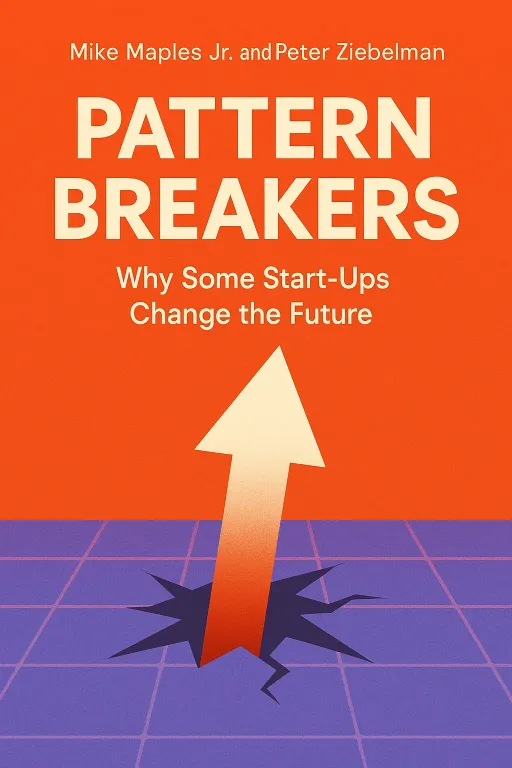
Nova: Exactly! Why are the people who are supposed to know the most so often blind to the future? And more importantly, how can we learn to see what they miss? That's the core question we're exploring today, with the help of a fantastic book, "Pattern Breakers" by Mike Maples Jr. and Peter Ziebelman. And I'm so thrilled to have Candice here with me. With your deep background in finance and strategy, Candice, I feel like you live and breathe the art of seeing patterns others don't.
candice: Thanks, Nova. It's a topic I'm fascinated by. In finance, being right when the consensus is wrong is where the real value is created. So this is right up my alley.
Nova: Perfect. Today we'll dive deep into this from two perspectives. First, we'll explore the book's powerful 'Inflection Theory'—a formula for seeing how breakthroughs are born. Then, we'll discuss the immense challenge and reward of being 'non-consensus and right,' using a fascinating story of a billion-dollar missed opportunity.
Deep Dive into Core Topic 1: Inflection Theory
SECTION
Nova: So, Candice, to start, the book argues that these breakthrough moments, like the Wright Brothers' flight, aren't just random bolts of lightning. There's a structure to them. The authors call it 'Inflection Theory,' and it’s a simple but profound equation: an Inflection plus an Insight equals a Breakthrough Idea.
candice: Okay, I like a good framework. Let's break that down. What do they mean by 'inflection' and 'insight'?
Nova: An inflection is a fundamental shift in the landscape, usually a new technology, a new regulation, or a major change in society. It’s an external event that creates the for radical change. But potential isn't enough. You need the second piece: the insight. And that's a non-obvious truth about how to harness that inflection to change human behavior.
candice: So the inflection is the 'what changed,' and the insight is the 'so what' for people.
Nova: Precisely! And the book gives a perfect example we all know: ridesharing. In 2011, Apple released the iPhone 4s. The big technological inflection was its embedded GPS chip, which could pinpoint your location with incredible accuracy for the first time.
candice: Right, that was the technical enabler.
Nova: Yes, but that alone didn't create Uber or Lyft. Many people saw the GPS chip and thought about mapping or location-based games. The breakthrough insight, the non-obvious part, was the belief that people would be willing to get into a car with a complete stranger. Ten years prior, that idea was absurd.
candice: The 'stranger danger' instinct is powerful. So what made that insight possible?
Nova: Another, more subtle inflection: the rise of social media and digital identity, specifically things like Facebook Connect. Suddenly, that 'stranger' had a face, a name, and mutual friends. You could build a layer of trust online. So, the inflection of GPS, combined with the insight that digital trust could overcome real-world fear, gave birth to the multi-billion dollar ridesharing industry.
candice: That's a powerful framework. In finance, we're constantly searching for market inflections, but the focus is often on the quantitative shift—the new technology, the interest rate change. The book's emphasis on the —the non-obvious change in behavior—is the piece that so many analytical models miss. The GPS chip was a tool, but the real breakthrough was monetizing trust between strangers.
Nova: I love how you put that, "monetizing trust." And the book says that the founders who see this are often what it calls 'unreasonable people,' because they persist in trying to adapt the world to their vision, not the other way around.
candice: It reminds me of that George Bernard Shaw quote: "The reasonable man adapts himself to the world: the unreasonable one persists in trying to adapt the world to himself." It’s the core of any true contrarian strategy. You're not just predicting a different future; you're betting capital and reputation on your ability to it. And that requires a level of conviction that goes beyond just a spreadsheet.
Nova: A conviction that, as we're about to see, is incredibly difficult to maintain when the entire world thinks you're crazy.
Deep Dive into Core Topic 2: Being Non-Consensus and Right
SECTION
Nova: And that bet, that contrarian stance, brings us to our second key idea, which is maybe the hardest part of all: being not just right, but non-consensus. Because if an idea is obviously good, big companies are already working on it. The book argues the greatest opportunities lie in being right when everyone else thinks you're wrong. And to illustrate this, the author shares this incredible, painful story about himself missing one of the biggest deals of the decade: Airbnb.
candice: Oh, I can't wait to hear this. A story of a big miss is always more instructive than a success story.
Nova: It's 2008. The author, a venture capitalist, is introduced to the founders of a struggling startup. The founders, Brian Chesky and Joe Gebbia, show up to the meeting not with a slick pitch deck, but with cereal boxes. They were so broke they were selling limited-edition, politically-themed cereals called "Obama O's" and "Cap'n McCain's" just to pay rent.
candice: Okay, that’s not a great first impression for a VC meeting. That screams desperation.
Nova: Exactly. Then, to make matters worse, their website demo fails to load. So all the author has is their verbal pitch: "We're a platform for people to rent out air mattresses on their floors to strangers." His brain immediately pattern-matches. He thinks, "This is just a worse version of Couchsurfing. com, but with payment. Who would pay to sleep on a stranger's floor? It's unsafe, it's weird." The consensus view was that it was a terrible idea. So, he passed on the investment.
candice: Wow. Hindsight is brutal.
Nova: Isn't it? But here’s the key. The author was stuck in the consensus view, focused on the 'stranger danger' problem. What he missed was Brian Chesky's non-consensus and right insight. Chesky understood that a robust, two-way rating and review system could do something revolutionary: it could between strangers at scale. He wasn't just renting rooms; he was building a trust engine.
candice: As an analyst, that story is both terrifying and validating. The author fell into a classic cognitive trap: pattern-matching to the past—to Couchsurfing—instead of seeing the new pattern being created. He saw the cereal boxes as a sign of desperation, not as a sign of incredible, scrappy resourcefulness. That's a mindset shift right there.
Nova: Absolutely. From your strategic perspective, what was the real asset he failed to see?
candice: He missed that they were building a trust engine, not a rental platform. Think about it: the hotel industry's greatest strength was brand trust and consistency. You knew a Marriott in Paris would be like a Marriott in Austin. Airbnb's insight was to reframe that strength as a weakness. They said, "Why would you your Paris trip to feel like Austin? Live like a local." They made 'authenticity' a higher-value good for a new generation of travelers. In doing so, they turned a hotel's biggest asset—consistency—into a liability. That's a brilliant strategic pivot.
Nova: They forced a choice, not a comparison. You're not choosing a 'better' hotel; you're choosing a different of travel.
candice: Exactly. And that's why they could build an empire with almost no physical assets, while the hotel chains were weighed down by them. The real asset was the trust network, and the author saw it as a liability. It’s a profound lesson in what we choose to see.
Synthesis & Takeaways
SECTION
Nova: So we have these two powerful, interconnected ideas from "Pattern Breakers." First, using Inflection Theory—spotting those external shifts and combining them with a non-obvious human insight—to see a new future.
candice: And second, having the courage and analytical rigor to pursue that vision when it's non-consensus, to be right when everyone else is pattern-matching to the past.
Nova: It’s a playbook for thinking differently, for actively breaking our own mental patterns. It’s not just for startup founders; it’s for anyone in a leadership or strategic role.
candice: I completely agree. It really comes down to questioning our own ingrained assumptions. The book is a great reminder for anyone trying to navigate a changing world. So, the question I'm left with, and the one I'd encourage everyone to think about, is this: What is one core, consensus belief in your industry or even your personal life that everyone just accepts as true?
Nova: That's a great question.
candice: And then ask, if a new inflection point—a new technology like AI, a major regulatory change, a demographic shift—were to hit that belief, would it still hold up? Or would it shatter? Because right there, in that intersection, is where the next breakthrough opportunity lies.
Nova: A perfect, pattern-breaking thought to end on. Candice, thank you so much for sharing your insights today.
candice: My pleasure, Nova. This was a lot of fun.