The 'Smart' Trap: Rethinking Professional Vocabulary for Impact
Golden Hook & Introduction
SECTION
Nova: What if I told you the biggest obstacle to sounding truly smart in your professional life isn't a lack of knowledge, but a surplus of certain words?
Atlas: Whoa, that's a bold claim, Nova. Most of us are taught the opposite – load up on the polysyllabic terminology to impress, right? Like, if you're not using "synergy" or "paradigm shift" every other sentence, you're not playing in the big leagues.
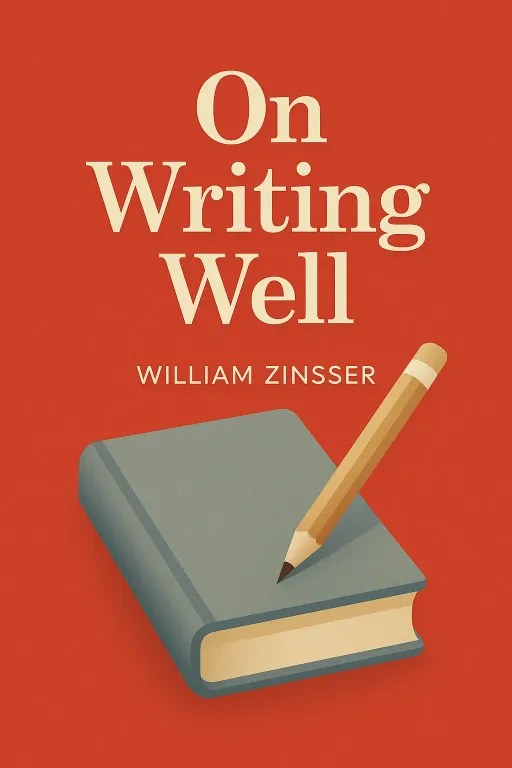
Nova: Exactly, Atlas! We often fall into what we call 'The Smart Trap.' We think complex vocabulary signifies intelligence, but often, it's just a barrier. Today, we're diving into that fascinating paradox, inspired by two enduring guides to effective communication: William Zinsser's classic, "On Writing Well," and the compact but mighty "The Elements of Style" by William Strunk Jr. and E. B. White. Zinsser, a journalist and teacher, brought such a human, accessible touch to the art of writing, emphasizing clarity above all. And Strunk & White, well, their little book has been a cornerstone for generations, teaching us the power of precise word choice.
Atlas: So this isn't just about sounding good, it's about making an actual impact? For the articulate professional who wants to influence and lead, that's a huge distinction. It’s not about showing off your vocabulary, it’s about getting your message across.
Nova: Precisely. It’s about choosing the words for maximum clarity and impact for your specific audience, not just to serve your ego. And that brings us directly to the first major pitfall we need to talk about.
The 'Smart' Trap: Why Complex Vocabulary Fails
SECTION
Nova: The 'smart' trap is a blind spot. Professionals, often with the best intentions, reach for the most academic or convoluted terms, hoping to impress. They become linguistic peacocks, fanning out their feathers of jargon, but the audience just sees a lot of fluff and misses the message entirely.
Atlas: Okay, but isn’t there a time and place for precise, specialized language, especially in technical fields? I can imagine a lot of our listeners in specialized roles thinking, "But my industry this terminology!" If I don't use the acronyms, I'll be seen as an outsider.
Nova: That's a fair point, Atlas. There absolutely is a place for precise technical language a specialized audience who shares that understanding. The trap isn't the existence of jargon; it's the of it. Let me give you an example. I once worked with a brilliant engineer, let's call him Mark. Mark had developed a groundbreaking new energy storage system. He was presenting to a panel of venture capitalists, most of whom had a general business background, not deep engineering expertise.
Atlas: Oh, I see where this is going.
Nova: Mark’s presentation was full of terms like "thermodynamic efficiency coefficients," "anisotropic magnetoresistance," and "stochastic resonance algorithms." He was clearly brilliant, but his pitch was a linguistic labyrinth. The VCs were visibly nodding, but their eyes were glazing over. They understood he was smart, but they couldn't understand he was selling, it mattered, or it would make them money.
Atlas: So, the 'smart' words ended up making him seem competent, because he couldn't articulate the value clearly. That's a brutal lesson. It’s like he built a magnificent bridge, but forgot to make it accessible to cross.
Nova: Exactly. He failed to connect. The goal of communication, especially professional communication, is not to demonstrate your intelligence. It's to transfer an idea, to persuade, to inspire action. When you use words that create a barrier instead of a bridge, you've lost before you even began. It becomes about your ego, not your audience's understanding.
The Clarity Shift: Mastering Impactful Professional Vocabulary
SECTION
Nova: So, how do we shift from that linguistic peacock displaying feathers in vain to a communication ninja who hits their target every single time? The solution isn't dumbing down; it's smartening up our word choices.
Atlas: A communication ninja! I like that. But what does that look like in practice? Give me an example of someone who truly masters this, not just some abstract ideal of "being clear." How do I actually that?
Nova: Let's consider Zinsser's core tenet: stripping away clutter to reveal the core message. He champions simplicity and brevity. Imagine a corporate memo that originally read, "In order to optimize our synergistic operational workflows, it is imperative that we delineate a robust framework for cross-departmental resource allocation, thereby fostering enhanced inter-divisional collaboration and maximizing fiscal efficiencies."
Atlas: Wow. My eyes just glazed over hearing that. I'm pretty sure I could translate that into a haiku, and it would still be too long.
Nova: Right? Now, imagine it rewritten: "To improve how our teams work together, we need a clear plan for sharing resources across departments. This will boost collaboration and save money."
Atlas: Oh, I love that! The second version is not only clearer but it feels more confident, more direct. It's not less intelligent; it's just more. It commands attention because it respects the reader’s time and intelligence.
Nova: Precisely. And that's where Strunk & White come in with their emphasis on choosing the word, not necessarily the most obscure. Powerful language comes from precision. Think of it like a chef choosing the perfect spice – not the most exotic, but the one that truly elevates the dish. It's about precision, not just volume. You wouldn't use saffron in every dish, just where it makes sense.
Atlas: That’s a great analogy. It’s about impact, not just flashiness. So, for the professional looking to influence, it's about making every word count, making it work for the message, not against it. It's about choosing words that serve your audience, not just your ego.
Nova: Exactly. Take a common professional phrase like "leverage our core competencies." It sounds impressive, but it's vague. What if you said, "use our strengths" or "apply our expertise"? Suddenly, it's clear, direct, and powerful. The simpler phrase often conveys greater authority because it’s unambiguous.
Atlas: This makes me wonder, how does someone this? It sounds like an unlearning process as much as a learning one, especially if you’ve been rewarded for using big words in the past. Where do you even begin to become this "communication ninja?"
Synthesis & Takeaways
SECTION
Nova: It absolutely is an unlearning process, Atlas. True mastery in communication isn't about complexity; it's about clarity, purpose, and ultimately, impact. When you choose precise, accessible language, you build trust, you foster understanding, and you dramatically increase your influence. You're not just speaking; you're connecting.
Atlas: So, the deep question you posed in the book content really resonates here: Were there words you used that could have been simpler or more direct without losing meaning? It's a daily audit for impact, isn't it? It's about reflecting on every email, every presentation, every conversation.
Nova: It truly is. It's a muscle you build. So, for our listeners, here's a challenge: for the next week, pick one piece of professional communication you create each day – an email, a report, even a quick Slack message. Read it back and identify just one word or phrase that could be simpler, more direct, and more impactful. Then, rewrite it.
Atlas: That’s a fantastic, actionable step. We’d love to hear your 'smart trap' stories or your 'clarity shift' wins. What's one word you've simplified for greater impact, or a phrase you've retired from your professional vocabulary? Share your insights with us on social media!
Nova: Because when you master the art of clear communication, you don't just sound smart; you smart, in the most effective way possible.
Nova: This is Aibrary. Congratulations on your growth!