The Architect of Wealth: Nudging Financial Decisions
Golden Hook & Introduction
SECTION
Orion: Jon, you and I have both seen it. A brilliant surgeon or a savvy tech CEO who, when it comes to their own money, makes decisions that are just baffling. They chase hot stocks right at the peak, they panic-sell at the bottom, or worse, they just never get around to signing up for the 401 that offers free money. It's not that they aren't smart. So what's going on?
Jon: It’s a question that keeps a lot of us in the finance industry up at night, Orion. You see incredible intelligence in one area of a person's life, and then what seems like a complete blind spot in another. It’s a paradox we deal with every single day.
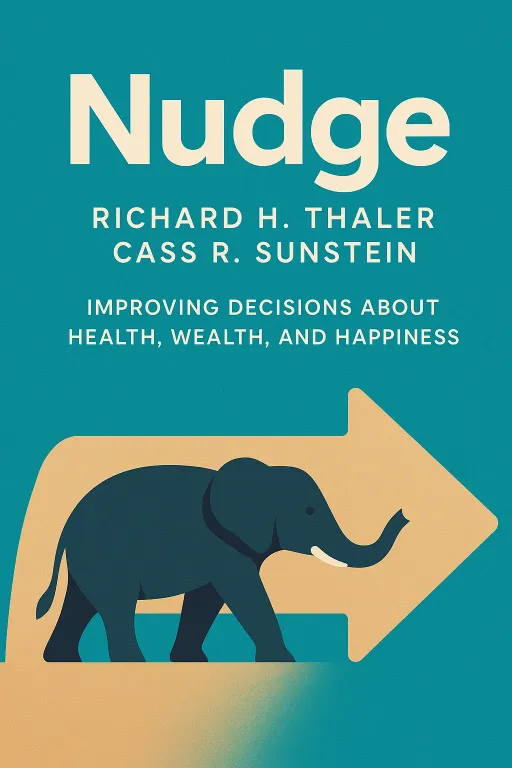
Orion: Well, the groundbreaking book 'Nudge' by Richard Thaler and Cass Sunstein argues the problem isn't the person—it's the system they're in. The 'choice architecture' is flawed. And that makes people like you and me, Jon, 'Choice Architects.' Whether we realize it or not, we are designing the environments in which people make crucial financial decisions.
Jon: That’s a powerful and slightly intimidating thought. The idea that the structure of the choice can be more important than the choice itself.
Orion: Exactly. And that's what we're going to explore today. The book's central idea is something they call 'Libertarian Paternalism.' It sounds like a contradiction, but it's simple: we can and should design choices to help people, to 'nudge' them toward better outcomes, but—and this is the libertarian part—without ever taking away their freedom to choose something else.
Jon: So, guiding them, but not forcing them. I like that. It respects their autonomy but acknowledges reality.
Orion: Precisely. Today we'll dive deep into this from two powerful perspectives from the world of finance. First, we'll explore the incredible, almost magical, power of defaults and how they can be used to automatically build wealth for people who do nothing at all. Then, we'll uncover the hidden dangers when people given choices, and how the very way options are presented can lead to disastrous investment strategies.
Deep Dive into Core Topic 1: The Power of the Default
SECTION
Orion: So let's start with that first idea, the power of defaults. The book makes a crucial distinction between two kinds of people: 'Econs,' who are the perfectly rational, calculating beings that traditional economics assumes we are...
Jon: The kind of person who never misses a deadline, always eats their vegetables, and perfectly calculates compound interest in their head. I’ve yet to meet one in real life.
Orion: Exactly. And then there are 'Humans,' which is... well, all of us. We're busy, we forget things, we procrastinate, we're influenced by emotion. And this is where defaults become so incredibly powerful. The book tells this landmark story about retirement savings plans, the 401. For decades, the standard process was 'opt-in.'
Jon: Right. You get hired, you get a mountain of paperwork, and somewhere in there is a form to join the 401. You have to choose to do it.
Orion: And what do Humans do when faced with a complex choice and a bit of paperwork?
Jon: They say, "I'll get to it later." And "later" often becomes "never."
Orion: Precisely. The default setting is non-participation. But then, some companies, guided by behavioral economists, decided to flip the switch. They introduced 'Automatic Enrollment.' When you get hired, you are enrolled in the 401 at a set savings rate, say 3%. You don't have to do anything. If you don't want to participate, you have to actively find a form and sign it to.
Jon: You change the path of least resistance. Instead of action being required to saving, action is required to saving.
Orion: And the results were staggering. The book cites a famous study by Madrian and Shea. At a company with the old opt-in system, participation rates for new employees after three months were a dismal 20%. After they switched to automatic enrollment? Participation jumped to 90%. Instantly.
Jon: That's not just a story, Orion, that's a multi-trillion dollar insight for the global economy. The friction of a single form, a single decision, can cost someone millions over a lifetime. We've seen it. We switched to automatic enrollment in our own firm's 401 and the participation rate for new hires went from around 60% to nearly 100% overnight. The book is spot on.
Orion: And what's so brilliant about this nudge is that it perfectly fits the 'Libertarian Paternalism' model. No one is forced. If you truly don't want to save, you can opt out. But it protects the vast majority of 'Humans' from their own inertia. The book calls this the "yeah, whatever" heuristic. We just go with the flow.
Jon: And it's not just about money, is it? You're just making me think about how this applies elsewhere.
Orion: You're way ahead of me. The book points out this isn't just about money. They cite stunning data on organ donation rates in Europe. In countries like Germany, where the default is 'opt-in'—you have to actively sign up to be a donor—consent rates are pathetically low, around 12%. But right next door in Austria, where the default is 'opt-out'—you are considered a donor unless you actively say no—the consent rate is 99%. Same people, different choice architecture.
Jon: It's a profound point. As a choice architect for my clients, it forces me to ask: what is the 'path of least resistance' I'm creating? Is it leading them toward their goals, or away from them? The default is the most powerful force in finance that nobody talks about. But it raises a question for me, Orion. If defaults are this powerful, where is the line between a helpful nudge and manipulation, especially in a competitive market like finance?
Orion: That is the million-dollar question, and it leads us perfectly into our second topic. Because what happens when there no default? What happens when we force people to choose?
Deep Dive into Core Topic 2: Naïve Investing & Flawed Heuristics
SECTION
Orion: You'd think forcing a choice would be better, right? It makes people engage. But 'Nudge' shows that this can be even more dangerous if the choice architecture is bad. This brings us to what the book calls "naïve diversification" or the "1/n" heuristic.
Jon: '1/n'... meaning you just divide your money by the number of options available?
Orion: Exactly. It's a simple mental shortcut. The book describes a classic experiment. Imagine a company offers its employees a very simple 401 plan with just two funds: a stock fund and a bond fund. What do most employees do?
Jon: My guess is they split it 50/50. Half in stocks, half in bonds. It feels balanced.
Orion: That's exactly what happens. But then, the company's choice architect—maybe after reading a marketing brochure—decides to "improve" the plan by offering more choice. The new plan has funds: nine different stock funds and the same one bond fund. Now what do you think the employees' overall asset allocation looks like?
Jon: Oh, I see where this is going. If they're using that '1/n' rule, they're not thinking about stocks versus bonds. They're just thinking about the ten funds. They'll put 10% in each fund.
Orion: And what does that do to their stock allocation?
Jon: It goes from 50% to 90%. Their risk profile is completely blown up, not because of a conscious decision to take on more risk, but simply because of the they were shown.
Orion: It's a shocking finding. The menu itself nudged them into a wildly different and riskier strategy. Their choice was an illusion, guided by the architecture.
Jon: That is... deeply unsettling. And it speaks directly to my world as a marketer and a fund manager. It implies that you can 'nudge' investors towards a certain asset class simply by presenting more options within that class. It's not about the quality of the funds, but the quantity on the menu. That has massive ethical implications for how 401 plans are constructed and how financial products are marketed.
Orion: Precisely. And it's not just novices who fall for this. The book tells this absolutely amazing story about Harry Markowitz. For our listeners, Markowitz won the Nobel Prize for creating Modern Portfolio Theory. He is, quite literally, the father of mathematical diversification.
Jon: The 'Econ' of all 'Econs' when it comes to investing.
Orion: You would think! But when an interviewer asked him how he allocated his own retirement funds, he confessed he didn't run his own complex models. He just used a simple 1/n heuristic: a 50/50 split between stocks and bonds.
Jon: Wow. So even the master falls for the simple rule of thumb. That's incredible. It shows how deep these biases run. It's not about being smart or dumb; it's about how our brains are wired to handle complexity. We look for shortcuts.
Orion: We are all Human.
Jon: And as choice architects, we have to know that the shortcuts we offer can either lead to a safe destination or, as you said, right off a cliff. It's our responsibility to build guardrails into the system.
Synthesis & Takeaways
SECTION
Orion: So, to bring it all together, we've seen two powerful and interconnected forces at play from the book 'Nudge'. First, the immense power of defaults to guide 'Humans' to better outcomes by leveraging our natural inertia.
Jon: And second, the hidden danger in the menu of choices itself, where naïve heuristics and flawed mental shortcuts can lead even the smartest people to make wildly irrational investment decisions. The architecture of the choice is paramount.
Orion: The big takeaway from 'Nudge' for anyone in a position of influence—whether you're a CEO running a company, a financial advisor with clients across the globe from Texas to Abu Dhabi, or even a parent helping a child open their first savings account—is to become a conscious and ethical Choice Architect.
Jon: I agree completely. It’s a shift in mindset. You stop just providing information and start thinking about the decision-making environment itself. The question to ask is this: 'What choices am I designing for others, and what is the path of least resistance?'
Orion: And what should that path lead to?
Jon: It should make it easy to do the right thing. That's the core of a good nudge, and I believe it's the foundation of responsible financial leadership in the 21st century.