Thinking Fast and Slow: Understanding Your Brain's Two Systems for Better Decisions.
Golden Hook & Introduction
SECTION
Nova: Atlas, rapid-fire word association for you. Ready?
Atlas: Always ready, Nova. Hit me.
Nova: "Investment."
Atlas: Growth. Future. Stress.
Nova: "Diagnosis."
Atlas: Certainty. Experience. Gut feeling.
Nova: "First impression."
Atlas: Instant judgment. Right or wrong, it sticks.
Nova: Ah, "gut feeling," "instant judgment." You've just hit on some of the brain's sneakiest shortcuts. Because while we often trust those snap judgments, our minds are quietly influenced by biases we barely register.
Atlas: Oh, I know that feeling. Like when I'm convinced I've found the perfect solution to a problem, only to realize I overlooked something obvious later. It feels like my brain ran a marathon without telling me.
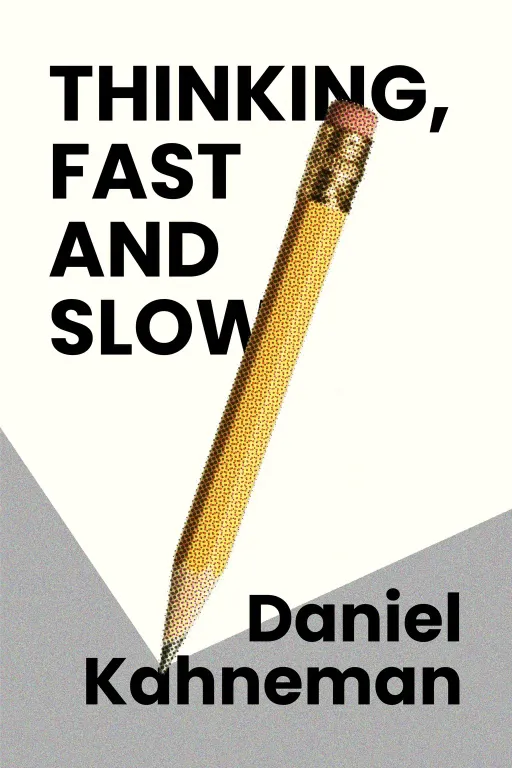
Nova: Exactly! And that's what we’re dissecting today, diving deep into Nobel laureate Daniel Kahneman’s groundbreaking work, "Thinking, Fast and Slow." It's fascinating because Kahneman, a psychologist, won the Nobel Prize in Economic Sciences for this research, showing just how profoundly our psychology shapes even the most 'rational' domains.
Atlas: That’s a great way to put it. It sounds like he’s pulling back the curtain on how our brains truly operate, not just how we they operate.
The Blind Spot - Unconscious Biases and System 1 Thinking
SECTION
Nova: Precisely. Kahneman introduces us to two characters in our heads: System 1 and System 2. Think of System 1 as your brain's autopilot. It's fast, intuitive, emotional, and always on. It's what makes you swerve to avoid a sudden obstacle or recognize a grumpy face in a crowd without thinking. It’s incredibly efficient.
Atlas: I can see that. For someone who thrives on efficiency and quick decisions—like an aspiring scientist in a high-stakes lab, or a driven achiever managing multiple projects—System 1 sounds like a superpower. Isn't intuition often praised as a sign of expertise? How can this 'autopilot' be a blind spot?
Nova: That's the deceptive part. While System 1 is brilliant for survival and routine tasks, its speed often comes at the cost of accuracy. It loves shortcuts, and these shortcuts, called heuristics, can lead to predictable, systematic errors—biases—especially when faced with complexity or ambiguity.
Atlas: So, even when I I'm being logical, my brain might be playing tricks on me? That sounds a bit out there. Can you give an example?
Nova: Absolutely. Kahneman gives a classic example called the "Linda Problem." Participants are told: "Linda is 31 years old, single, outspoken, and very bright. She majored in philosophy. As a student, she was deeply concerned with issues of discrimination and social justice, and also participated in anti-nuclear demonstrations." Then they're asked, which is more probable: A) Linda is a bank teller, or B) Linda is a bank teller and is active in the feminist movement?
Atlas: Oh, I love this kind of puzzle! My System 1 is already screaming "B!" She sounds like a feminist activist.
Nova: And that's the trick! Your System 1 is building a coherent, plausible story based on the description. But logically, B cannot be more probable than A. The set of "bank tellers and active feminists" is a of "bank tellers." Every feminist bank teller is also a bank teller. So, the probability of being a bank teller has to be higher or equal to the probability of being a bank teller something else.
Atlas: Wow, that’s actually really surprising. My gut feeling was so strong for B! It feels like my brain just went for the more detailed, more emotionally resonant story, even if it defied basic logic. That’s going to resonate with anyone who struggles with making objective choices.
Nova: It’s a perfect illustration of what Kahneman calls the "conjunction fallacy," where specific conditions are judged to be more probable than a single general one. Our System 1 prioritizes coherence and vividness over statistical reality. For an aspiring scientist, this is critical. Imagine a researcher seeing a pattern in their data that perfectly aligns with their hypothesis. System 1 might jump to "Aha! Proof!" without rigorous System 2 checks.
Atlas: That makes me wonder, how often do we make these kinds of errors in everyday life, or even in a crucial medical diagnosis, just because a story right? It’s not just about being wrong; it’s about being confidently wrong without realizing it.
Engaging System 2 - Deliberate Thought and Decision-Making
SECTION
Nova: Exactly. And that naturally leads us to the second key idea: If System 1 is so powerful and prone to error, how do we get System 2 to step in? System 2 is the slow, effortful, logical part of your brain. It’s what you use to solve a complex math problem or consciously focus your attention. The problem is, System 2 is lazy. It prefers to let System 1 handle things unless it's explicitly called upon.
Atlas: Yeah, I can definitely relate. After a long day of analytical work, my brain just wants to coast. So how do we 'nudge' ourselves to engage System 2, especially when striving for mastery in a field where precision is everything? How do you build habits to activate that slower, more deliberate thinking when it's naturally inclined to conserve energy?
Nova: That’s where understanding these systems becomes incredibly powerful. Richard Thaler, another Nobel laureate who built on Kahneman’s work, explores 'nudges'—subtle interventions that guide our choices without restricting them. For our internal systems, it’s about creating mental nudges. One strategy is to deliberately pause and question your initial reaction. Ask yourself: "What's another way to look at this?" or "What evidence would disconfirm my current belief?"
Atlas: So, it's about building a 'mental checklist' or a 'second opinion' for your own thoughts? Like a surgeon double-checking instruments before an operation, but for your brain?
Nova: Precisely. Let's take a medical example. A doctor sees a patient with a set of symptoms that immediately points to a common diagnosis—that’s System 1 forming a quick, coherent story. But a skilled doctor, engaging System 2, will systematically review all possible differentials, order specific tests, and consider less common diagnoses, even if they initially seem less likely. They're actively seeking disconfirming evidence to avoid a premature System 1 conclusion.
Atlas: That’s a perfect example. For an aspiring scientist, this means not just collecting data, but actively designing experiments to their hypotheses, not just confirm them. It's about building a habit of critical self-reflection. But how do you make that a habit? System 2 feels like a workout.
Nova: It is a workout! But like any muscle, it gets stronger with practice. One effective way is through structured thinking processes. For example, in research, explicitly outlining alternative hypotheses before starting an experiment, or having a peer review process where others are with finding flaws in your logic. It’s about externalizing System 2 functions. Or even simpler, when you're about to make an important decision, write down the pros and cons, or imagine you're advising a friend on the same problem. That forces you out of your own System 1 bubble.
Atlas: That’s actually really inspiring. It means mastery isn't just about accumulating knowledge, but about mastering the of thought itself. For someone driven to achieve, that's not just a strategy; it's a fundamental skill.
Synthesis & Takeaways
SECTION
Nova: Absolutely. The profound insight from Kahneman's work is that our minds are not always the rational, objective machines we assume them to be. We have two operating systems, and while System 1 is a marvel of efficiency, it’s also a master of illusion, leading us astray with its biases.
Atlas: So, the real challenge isn't just knowing the facts, but knowing how your brain those facts. It's about recognizing when your fast-thinking brain might be leading you down a biased path, and then actively engaging that slower, more deliberate System 2. How will you build that System 2 muscle this week?
Nova: My call to action is simple: Next time you feel a strong 'gut feeling' about a decision—whether it's about a scientific conclusion, a personal choice, or even a snap judgment about someone—take 30 seconds. Just 30 seconds. Ask yourself, "What's another way to look at this?" or "What information might I be missing or ignoring?" That small pause can be your most powerful 'nudge' towards better decisions.
Atlas: That’s a concrete step everyone can take. It's about embracing the journey of becoming a more thoughtful decision-maker, not just reaching the destination.
Nova: Indeed. Understanding these two systems doesn't make us perfect, but it gives us the tools to be more aware, more deliberate, and ultimately, to make clearer, more objective decisions in both science and life.
Atlas: This is Aibrary. Congratulations on your growth!