The 'Why' Behind the 'How': Understanding Human Choice
Golden Hook & Introduction
SECTION
Nova: Decision.
Atlas: Oh, man. Regret. Or… what to have for lunch.
Nova: Exactly! See, those are two very different kinds of decisions, but how much conscious, deliberate thought went into either of them? Probably less than you think.
Atlas: Really? I feel like I agonize over lunch choices. Is that not System 2 in action?
Nova: Well, we’re about to peel back the curtain, Atlas. Because today, we’re diving into the fascinating world of human choice, or more accurately, the surprising lack of pure rationality in it. We’re going to explore two groundbreaking books that fundamentally shifted our understanding of how our minds work.
Atlas: Okay, so this isn't just about what to eat, it's about we pick what we pick. I'm intrigued.
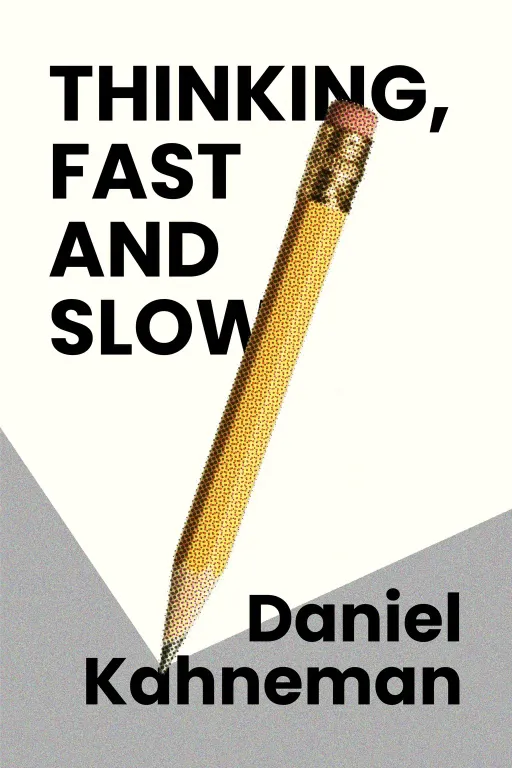
Nova: Absolutely. First up, we have “Thinking, Fast and Slow” by the incredible Daniel Kahneman. What’s truly remarkable is that Kahneman, a psychologist, won the Nobel Memorial Prize in Economic Sciences for his work on prospect theory. He basically brought psychology into the rigid world of economics, showing that humans are not always the rational actors economists assumed.
Atlas: That's a huge deal! A psychologist winning an economics prize feels like a friendly invasion. It makes me wonder what foundational assumptions he overturned.
Nova: Exactly, and then we'll connect that to "Nudge: Improving Decisions About Health, Wealth, and Happiness" by Richard H. Thaler and Cass R. Sunstein. Their work took Kahneman's insights and showed us how to actually them, influencing choices without coercion. Thaler himself later won a Nobel Prize for his contributions to behavioral economics, partly building on these very ideas.
Atlas: So this isn't just theory, it's about real-world impact. I'm already seeing the threads here. This sounds like it's going to challenge a lot of our assumptions about ourselves.
The Unseen Architects of Choice: Cognitive Biases and Dual-Process Thinking
SECTION
Nova: It absolutely will. Let's start with Kahneman’s most famous contribution: the two systems of thinking. He calls them System 1 and System 2. Think of System 1 as your intuition, your gut feeling. It’s fast, automatic, effortless, and often emotional. It’s what tells you to duck when something flies at your head, or to recognize a familiar face instantly.
Atlas: Oh, I love that. So it's my "spidey-sense" brain, the one that makes snap judgments.
Nova: Precisely. Now, System 2 is the opposite. It’s slow, deliberate, effortful, and logical. This is the part of your brain that solves complex math problems, or carefully considers the pros and cons of buying a new car. It requires concentration.
Atlas: So my brain has a super-fast, instinctual mode and a slower, analytical mode. That makes sense. But I always thought my analytical mode was in charge.
Nova: That’s the blind spot, Atlas! Kahneman argues that most of our decisions are actually driven by the often-unseen System 1. It’s constantly running in the background, offering suggestions, impressions, and feelings. If System 2 isn't actively engaged and vigilant, it often just goes along for the ride.
Atlas: Wait, so my brain is actively trying to trick me into making quick, possibly wrong decisions? That's kind of… rude.
Nova: Not tricking, but definitely taking shortcuts. Think of it this way: your brain is incredibly efficient. System 1 helps you navigate the world without constantly expending energy. But those shortcuts, or heuristics, can lead to predictable errors – what we call cognitive biases.
Atlas: Can you give an example of System 1 leading me astray? Something less math-y than, say, rocket science.
Nova: Absolutely. Here’s a classic from Kahneman: A bat and a ball cost $1.10 in total. The bat costs $1.00 more than the ball. How much does the ball cost?
Atlas: Oh, I know this one! Ten cents. Easy.
Nova: That, my friend, is your System 1 speaking. It’s fast, intuitive, and for most people, the first answer that pops into their head. But it’s wrong.
Atlas: It’s wrong? But… it feels so right!
Nova: Exactly! If the ball cost 10 cents, and the bat cost $1.00 more, the bat would be $1.10. Add that to the 10-cent ball, and you get $1.20, not $1.10. The correct answer is five cents for the ball, and $1.05 for the bat. It costs effort for System 2 to override that initial System 1 impulse.
Atlas: Whoa. That’s actually really powerful. I still feel the pull of the ten cents even after you explained it. So, how does this play out in something less mathematical, like why I always buy the same coffee, even if a new, potentially better one is available?
Nova: That’s a perfect example of System 1 at work. It prefers familiarity, avoids effort, and relies on past patterns. It’s easier for System 1 to stick with the known, safe choice – your usual coffee – than to engage System 2 to evaluate a new, unknown option. This comfort with the familiar is a bias called the "status quo bias." We prefer things to stay the same.
Atlas: So it's not just about logical errors, but also about habits and comfort. That gives me chills, thinking about how many decisions I make on autopilot.
The Art of Gentle Persuasion: Nudges and Architecting Decisions
SECTION
Nova: And understanding these mental shortcuts and biases is one thing, but what if we could for them? What if we could subtly influence choices to help people make better decisions, without forcing them? That's where "Nudge" comes in.
Atlas: Okay, so this sounds like taking the "spidey-sense" brain and gently guiding it. But wait, isn't that a bit manipulative? Like, Big Brother but with good intentions?
Nova: It’s a critical question, Atlas, and one that Thaler and Sunstein address head-on. They call their approach "libertarian paternalism." The 'libertarian' part means people are still free to choose whatever they want. There's no coercion, no mandates. The 'paternalism' part means it's okay for institutions to try and influence choices in a way that will make people's lives better.
Atlas: So you're not taking away my freedom, but you're making the "good" choice easier or more obvious. Give me an example of how this plays out in the real world.
Nova: One of the most famous examples of a nudge, though it predates the book, is the image of a fly etched into the men's urinals at Amsterdam's Schiphol Airport.
Atlas: A fly? What possible difference could a fly make?
Nova: It’s brilliant in its simplicity. Men, apparently, are more likely to aim at a target. The fly provides that target, reducing spillage by 80%. No signs, no reprimands, no coercion – just a tiny visual cue that subtly nudges behavior towards a desired outcome.
Atlas: That's incredible! So it's not about telling people what to do, it's about changing the environment so their System 1 naturally does the "right" thing.
Nova: Exactly. Another powerful nudge is the concept of default options. In many countries, organ donation rates are incredibly low. But in countries where the default option is to be an organ donor – meaning you have to if you don't want to be one – donation rates skyrocket.
Atlas: Oh, I see. So because System 1 prefers the path of least resistance, if the "good" choice is the default, most people just stick with it. That really highlights the irrational yet predictable nature of human behavior you mentioned earlier.
Nova: It does. And this has massive implications. Think about retirement savings: if employees are automatically enrolled in a savings plan, even if they can opt out, participation rates are much higher than if they have to actively opt in. These are all examples of choice architecture.
Atlas: So, how do I, as someone trying to frame an idea or a story, 'nudge' someone towards my amazing concept without being pushy or manipulative? Because I care about human connection, I don't want to trick people.
Nova: That's where your 'humanist' and 'creator' side comes in. It’s about understanding your audience's cognitive landscape. If you know their System 1 is looking for simplicity, familiarity, and emotional resonance, then your framing should leverage that. Make the choice. Highlight the benefits that appeal to their intuitive self.
Atlas: So, instead of burying the lead, I should make the most compelling part the default, the easiest thing to grasp?
Nova: Precisely. And if you want them to engage System 2, to think deeply about your idea, you need to grab their attention with something truly compelling, something that breaks through the System 1 autopilot, and then present the information in a clear, logical, easy-to-process way. It’s about meeting their brain where it is.
Synthesis & Takeaways
SECTION
Nova: So, bringing these two powerful ideas together, what Kahneman showed us about our internal mental machinery – the biases and shortcuts – is the 'why.' It’s why we make the decisions we do. And what Thaler and Sunstein showed us with 'nudges' is the 'how' – how we can design environments and frame choices to work that machinery, rather than against it.
Atlas: It’s like the key isn't just to have a good idea, but to understand the mental landscape of your audience before you even present it. Instead of just telling people something, you're helping them arrive at the conclusion themselves.
Nova: Exactly. It's about empathy, really. Understanding the human mind allows you to craft narratives and ideas that truly resonate, because you're speaking to both their fast, intuitive self and their slower, logical self, in a way that feels natural and unforced. It changes how you frame everything.
Atlas: That’s actually really inspiring. It means we have more power than we think to gently guide ourselves and others towards better outcomes, just by understanding a bit more about how our brains actually work.
Nova: It's a profound shift from assuming pure logic to embracing our wonderfully irrational, yet predictable, human nature.
Atlas: So, as you go about your day, what's one decision you'll look at differently, knowing about System 1 and System 2, and perhaps, how you're being nudged?
Nova: This is Aibrary. Congratulations on your growth!