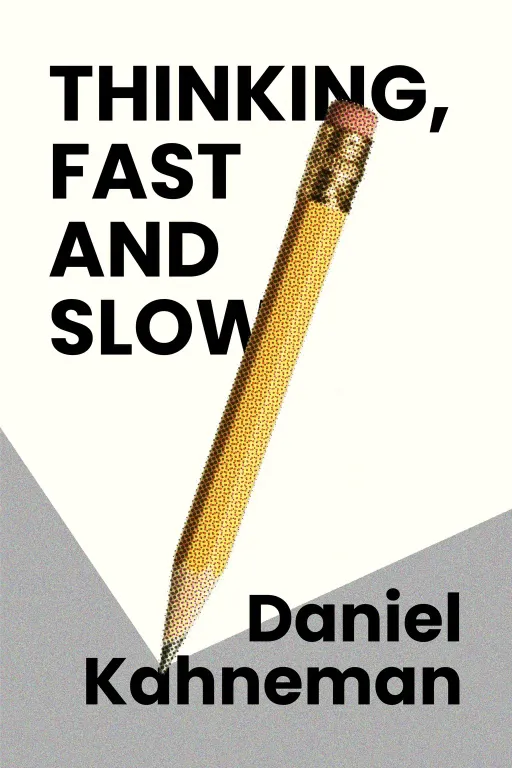
The 'Thinking Fast, Thinking Slow' Trap: Rethinking Strategic Decisions.
Golden Hook & Introduction
SECTION
Nova: What if your sharpest strategic decisions, the ones you pride yourself on, are actually riddled with invisible traps? We're talking about the mental shortcuts that feel like genius but can lead to catastrophic blind spots.
Atlas: Invisible traps? Nova, for anyone building complex systems, or trying to anticipate geopolitical shifts, that's not just an interesting thought experiment, that's a five-alarm fire. We rely on our insights.
Nova: Absolutely, Atlas. And that's precisely why today, we're diving into the groundbreaking work of Daniel Kahneman, particularly his seminal book, "Thinking, Fast and Slow," and also touching on "Nudge" by Richard H. Thaler and Cass R. Sunstein. Kahneman actually won the Nobel Memorial Prize in Economic Sciences for his pioneering research that essentially fused psychology with economics, fundamentally changing how we understand human judgment and decision-making.
Atlas: That’s a huge claim! Fusing psychology and economics. So, what did he uncover that's so transformative for decision-makers?
Nova: He revealed that our minds operate with two distinct systems. Imagine them as two engines constantly running in parallel, but with very different fuel and speeds.
The Dual Engines of Decision: System 1 vs. System 2
SECTION
Nova: The first engine, System 1, is our fast, intuitive, emotional, and often unconscious mode of thinking. It's what helps you recognize a friend's face instantly, or slam on the brakes in an emergency. It's efficient, largely automatic, and brilliant for quick judgments.
Atlas: Oh, I see. Like when you get that gut feeling about a new technology or a potential vulnerability. It just.
Nova: Exactly. But here's the crucial part: System 1 is also prone to biases and can be easily tricked. It loves a good shortcut.
Atlas: A shortcut that leads us astray? That sounds rough, especially when you're trying to build resilience into a system or predict a market shift. How often does this "fast thinking" get it wrong?
Nova: More often than we realize. Consider Kahneman's famous "Bat and Ball Problem." It goes like this: A bat and a ball cost $1.10 in total. The bat costs $1.00 more than the ball. How much does the ball cost?
Atlas: My immediate, gut reaction is ten cents. That feels right.
Nova: And that, Atlas, is System 1 at work, offering a quick, intuitive answer. It's elegant, simple, but unfortunately, incorrect. If the ball cost ten cents, the bat would cost $1.10, making the total $1.20. The correct answer, which requires a bit more deliberate thought, System 2, is five cents for the ball.
Atlas: Wow. That's a powerful illustration. My brain just screamed "ten cents!" It makes me wonder about all the times in a high-stakes strategic meeting where my initial, confident assessment was actually my System 1 taking a shortcut. How do we even begin to identify those moments when our intuitive genius might be an impulsive error?
Nova: That's the million-dollar question. System 1 is always running, constructing a coherent story from limited evidence, often ignoring what it doesn't know. It's also susceptible to something called the "Halo Effect."
Atlas: The Halo Effect? Can you give an example?
Nova: Certainly. Imagine you're evaluating a potential strategic partner. If their CEO gives a brilliant presentation, or they have a sleek, well-designed product, your System 1 might automatically attribute other positive qualities to them—like "they must be incredibly reliable" or "their internal processes must be flawless"—even without any direct evidence. Your initial positive impression casts a "halo" over everything else.
Atlas: I totally know that feeling! It’s like when a company has a fantastic PR campaign, and you subconsciously assume their cybersecurity must be top-notch, or their supply chain is perfectly ethical, even though those are entirely separate issues needing rigorous System 2 analysis. It sounds like System 1 is a master storyteller, even if the story isn't entirely true.
Nova: Precisely. It creates a coherent narrative, making the world feel predictable, even when it's not. The challenge for strategic thinkers, for the architects and futurists, is to recognize when that compelling narrative might be missing crucial data or leading them down a biased path. That's where System 2 comes in.
Atlas: The slow, deliberate engine. The one that actually crunches the numbers and checks the assumptions. But engaging System 2 takes effort, doesn't it? It feels like grinding gears sometimes.
Nova: It absolutely does. System 2 is effortful, analytical, and requires focus. It’s what you engage when you're solving a complex equation, learning a new language, or meticulously planning a long-term geopolitical strategy. The problem is, our brains are wired for efficiency, so System 1 tries to dominate whenever possible.
Strategic Nudges & The Art of Slowing Down
SECTION
Atlas: So, we have this powerful, fast, but error-prone System 1, and a slower, more reliable, but lazy System 2. How do we move from just these biases to actually them, especially when in leadership, trusting your gut is often praised? How do we build resilience when our own brains are working against us?
Nova: That's a brilliant pivot, Atlas, because it brings us to the concept of "nudges," eloquently explored by Thaler and Sunstein. They show that instead of trying to force people to be perfectly rational—which is exhausting and often futile—we can design environments that subtly guide choices toward optimal outcomes.
Atlas: Designing environments? You mean like "choice architecture"?
Nova: Exactly. Think about something as impactful as retirement savings. In many companies, employees have to actively opt-in to a 401k plan. But if you change the default—if employees are automatically enrolled and have to —participation rates skyrocket. It's a simple nudge, not a mandate, that leverages System 1's tendency to stick with the default.
Atlas: That’s a perfect example. For our listeners who are building large-scale systems or processes, this isn't about manipulating users, but about designing for better outcomes, making the desired choice the easiest one. So, how can we apply this to our own strategic decisions? How do we "nudge" ourselves or our teams to engage System 2 when it truly matters?
Nova: That's where Nova's Take comes in: the superpower of knowing to trust your gut and to slow down. System 1 is invaluable for experienced experts in familiar situations. A seasoned cybersecurity analyst might a threat before they can articulate why, based on years of pattern recognition. That's System 1 operating at its peak.
Atlas: So, for a sentinel, that 'spidey-sense' about an anomaly isn't always a bias, it could be highly refined intuition.
Nova: Precisely. But when you're facing novel situations, high uncertainty, or decisions with long-term, irreversible consequences—like launching a new AI paradigm with ethical implications, or making a major geopolitical move—that's when you must consciously engage System 2.
Atlas: How does one do that in practice? It sounds like you need a mental checklist, or a "System 2 activation protocol."
Nova: You're close! It involves building deliberate "friction" into your process. For example, before making a major strategic investment, intentionally seek out dissenting opinions. Create a "pre-mortem" where you imagine the project has failed a year from now, and then work backward to identify all the potential reasons why. This forces System 2 to look for flaws that System 1 might gloss over.
Atlas: A pre-mortem. That’s brilliant. It's like building resilience into the decision-making process itself, not just the systems we're designing. It forces you to anticipate the unseen, the strategic blind spots.
Nova: And it’s about designing the "choice architecture" of your own mind. When the stakes are high, ask: What data am I seeing? What alternative explanations are there? What biases might I be falling prey to? Am I experiencing the Halo Effect with this new partner, or confirmation bias with this data?
Atlas: So it's not about eliminating bias entirely, which sounds impossible, but about intelligently managing our thinking and building systems around those inherent human tendencies. It's about securing our future by securing our minds.
Synthesis & Takeaways
SECTION
Nova: Exactly, Atlas. The profound insight here isn't that humans are irrational, but that we're predictably irrational. True strategic advantage, and the ability to build a more secure future, comes from understanding those internal engines. It's about designing processes that leverage System 1's speed when appropriate, but crucially, installing System 2 checks when the risk of a biased shortcut is too great.
Atlas: It's a call to self-awareness, then. To understand our own cognitive landscape before we try to map the global chessboard or design the next generation of AI. It makes me wonder, where in our listeners' current decision-making processes might System 1 be leading them astray, and how can they introduce those vital System 2 checks?
Nova: A powerful question to ponder. This isn't just about making better individual choices; it's about building organizational resilience and ethical foresight into every strategic move. The future depends on our ability to think clearly, deliberately, and with an acute awareness of our own mental architecture.
Atlas: That's such a hopeful way to look at it, Nova. It empowers us to actively shape our decision environments.
Nova: Indeed. It's about cultivating that superpower of knowing when to trust the gut, and when to slow down and truly think.
Atlas: This is Aibrary. Congratulations on your growth!