

The Science of Better Decisions: Why Intuition Isn't Enough
Golden Hook & Introduction
SECTION
Nova: We're often told to "trust our gut," to follow that intuitive feeling, that immediate instinct. But what if that gut feeling, that quick, seemingly wise impulse, is actually leading us down a predictable path to error, missed opportunities, and even regret? What if our brains are wired in ways that trip us up more often than we realize?
Atlas: Oh man, that's a provocative start. Because "trust your gut" feels like such fundamental advice, especially in fast-paced environments. Are you suggesting we can't even rely on our own internal compass? That sounds a bit unsettling.
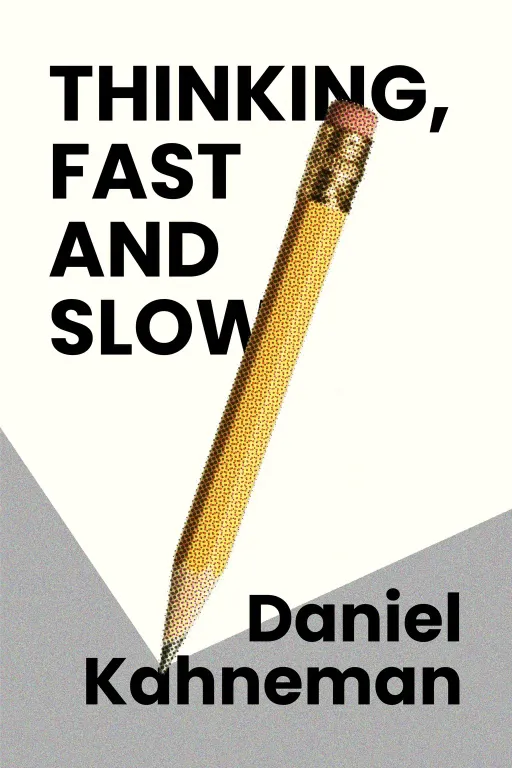
Nova: Unsettling, perhaps, but also incredibly liberating once you understand it. Today, we're dissecting "The Science of Better Decisions" by diving into two groundbreaking works that completely reshaped our understanding of human judgment: "Thinking, Fast and Slow" by Nobel laureate Daniel Kahneman, and "Nudge" by fellow Nobel winner Richard H. Thaler and Cass R. Sunstein. Kahneman's work, a culmination of decades of research, fundamentally changed how we understand human rationality, earning him a Nobel Prize in Economic Sciences, even though he's a psychologist. It's a testament to how profoundly he shifted the understanding of human judgment.
Atlas: That's a powerful endorsement. Two Nobel laureates tackling how we make choices. So, are we talking about a complete overhaul of decision-making, or more about fine-tuning?
Nova: It's more profound than fine-tuning, Atlas. Today we'll dive deep into this from two crucial perspectives. First, we'll explore the surprising ways our own brains often lead us astray—the cognitive blind spots that create these predictable errors. Then, we'll discuss how we can use that very understanding to architect environments that "nudge" us towards wiser, more rational choices. It’s about moving from recognizing the problem to actively designing solutions.
The Blind Spots in Our Brains: Why Our Intuition Betrays Us
SECTION
Nova: So, let's start with Kahneman. He introduced this brilliant framework of two systems of thought. System 1 is our fast, intuitive, emotional, automatic thinking. It's what allows you to instantly recognize a face, or know that 2+2=4. It's incredibly efficient, but it's also prone to systematic errors. System 2 is our slow, deliberate, logical, effortful thinking. It's what you use to solve a complex math problem, or carefully weigh the pros and cons of a major life decision.
Atlas: Okay, so System 1 is the autopilot, and System 2 is the manual override. I can see that. But what happens when the autopilot takes over when it shouldn't, or when it’s giving us bad directions?
Nova: Precisely. Kahneman and his late collaborator Amos Tversky showed that System 1 often overrules System 2, even in experts, leading to what they called cognitive biases. For example, consider the "anchoring effect." Imagine a legal case where a judge is asked to estimate a sentence for a crime. If before they make their decision, they're subtly exposed to a completely arbitrary number—say, by rolling a dice that's rigged to land on a high or low number—that irrelevant number will actually influence the sentence they hand down.
Atlas: Wait, hold on. You're saying a judge, presumably a highly rational and trained individual, could be influenced by a random dice roll? That sounds a bit out there. How does that even work unconsciously?
Nova: It's astonishing, isn't it? System 1, our quick thinking, latches onto that initial number, that "anchor," even when it knows it's irrelevant. Then, System 2 tries to adjust from that anchor, but it doesn't adjust enough. So, if the anchor was high, the final judgment will be higher; if low, it will be lower. It's not a conscious manipulation; it’s an automatic, unconscious mental shortcut that even seasoned professionals fall prey to. It explains why the first offer in a negotiation often sets the tone, or why a ridiculously high initial price for a product makes a slightly lower price seem reasonable.
Atlas: That makes me wonder, how many decisions have I made, thinking I was being totally rational, but I was actually just adjusting from some arbitrary first number I heard? That’s kind of alarming. What other sneaky biases are at play?
Nova: Another classic is the "availability heuristic." This is our tendency to overestimate the likelihood of events that are more easily recalled or more vivid in our memory. Think about fears of flying versus driving. Statistically, driving is far more dangerous, but plane crashes, when they happen, are dramatic, widely reported, and stick in our minds.
Atlas: Right, like a visually striking news report about an accident makes you think it happens all the time, even if it’s an outlier. So, our perception of risk isn't based on actual data, it's based on how easily we can conjure up an image?
Nova: Exactly. System 1 prioritizes vividness and emotional impact over actual probability. This bias impacts everything from how we assess investment risks to how we perceive health threats. It means we often make decisions based on compelling stories rather than cold, hard facts. So, are you saying our brains are fundamentally flawed? Not flawed in a broken sense, but wired for efficiency, which sometimes comes at the cost of accuracy. The key is recognizing these ingrained mental shortcuts so we can pause, question our assumptions, and apply more rigorous thought when it truly matters.
Architecting Better Choices: From Bias to Behavioral Design
SECTION
Nova: But understanding these flaws isn't just about despair; it's about empowerment. Because if our irrationality is predictable, it also means we can predict how to "nudge" ourselves and others towards better outcomes. This is where Richard Thaler and Cass Sunstein's work in "Nudge" comes in. They explain how small changes in the way choices are presented can significantly influence decisions without restricting people's freedom of choice.
Atlas: That's a great way to put it. Moving from problem to solution. So, if our brains are so easily swayed, can we actually use that to our advantage and design for better behavior? Give me an example. How does a "nudge" actually work?
Nova: A perfect example is organ donation rates. In some countries, like Germany, the default is "opt-in," meaning you have to actively sign up to be an organ donor. Their rates are quite low, around 12%. In other countries, like Austria, the default is "opt-out," meaning you are automatically a donor unless you actively choose not to be. Their rates are over 99%.
Atlas: Whoa. That's incredible, that something so small – just changing the default setting – can have such a massive impact. Are you telling me that people aren't making a conscious decision, they're just going with the flow?
Nova: Precisely. It’s a powerful nudge. Most people don't have strong feelings either way, or they intend to get around to it but procrastinate. So, the default setting, the path of least resistance, becomes the overwhelmingly chosen option. It demonstrates that human behavior is predictably irrational, and we can design these "choice architectures" to encourage better outcomes.
Atlas: That definitely resonates, because I know I often just stick with the default on software or settings, usually out of laziness. But isn't that a bit manipulative? Where's the line between a helpful nudge and an unwelcome push?
Nova: That's a crucial question, and Thaler and Sunstein are very clear about it. A true "nudge" is transparent and preserves freedom of choice. You can always opt out or choose differently. It's not about forcing you; it's about making the desired option the easiest or most obvious one. Think about how cafeterias arrange food: placing healthy options at eye level and less healthy ones further away is a nudge. No one is stopping you from eating the cake, but the fruit is just.
Atlas: I like that distinction: transparent and preserving choice. So, if I know my brain is biased, and I know nudges work, how do I "nudge" myself to make better decisions in my own life, especially when facing complex problems, or trying to break a bad habit?
Nova: That's the million-dollar question, Atlas. It starts with awareness. If you know you're prone to, say, the "status quo bias" — sticking with what you know even if a better option exists — you can consciously set up a "pre-commitment." Like, if you want to save more, set up an automatic transfer to savings on payday. You've nudged your future self towards a better outcome by making the "good" choice the default.
Synthesis & Takeaways
SECTION
Nova: Ultimately, the science of better decisions isn't about eradicating intuition; it's about knowing when to trust it and, crucially, when to engage our slower, more deliberate System 2. It's about recognizing the invisible forces shaping our choices and taking back some control.
Atlas: It's like becoming a detective of your own mind, uncovering the hidden levers, and then, as you say, a subtle architect of your environment. That's actually really inspiring. It means we're not just victims of our own psychology.
Nova: Exactly. The next time you face a significant decision, especially one with high stakes, pause. Ask yourself: "What hidden biases might be at play here? Is this a System 1 decision that needs System 2 scrutiny?"
Atlas: And how can I subtly restructure my options, or my environment, to make the better choice the easier choice for myself? It's about designing your way to better outcomes, not just hoping for them.
Nova: It truly is. So, here's a reflective question we want to leave all of you with: Consider a recent decision you made. What biases might have influenced your choice, and knowing what you know now, how might you approach it differently next time?
Nova: This is Aibrary. Congratulations on your growth!









